

Most crawlspace moisture problems in this part of Washington start at the roofline, not underground. A downspout that dumps water four feet from the foundation, or a splash block that's kicked out of place, will saturate the soil right next to your crawlspace vents faster than any amount of ground water ever could. Fix where the water lands before you spend money on anything under the house.
A roof over an average home in Mount Vernon or Burlington sheds a genuinely large volume of water every winter, and the gutter system is only doing its job if that water actually gets carried away from the foundation once it leaves the downspout. In a lot of older homes across Skagit and Whatcom counties, the downspout empties onto a splash block or a short run of corrugated pipe that was adequate when the house was built but has since settled, clogged, or been buried under landscaping. Once that happens, water pools against the foundation wall, works its way through hairline cracks or porous block, and raises the moisture level in the crawlspace air. From there it condenses on cold ductwork, feeds mold and wood rot, and eventually shows up as a musty smell in the living space above.
Crawlspace moisture is a chain of small failures, and downspout drainage is usually the first link. The most common issues we see on inspections in this region are:
Any one of these on its own is usually manageable. Two or three together, over a wet winter, is what turns into rotted floor joists and insulation that's sagged out of the joist bays.
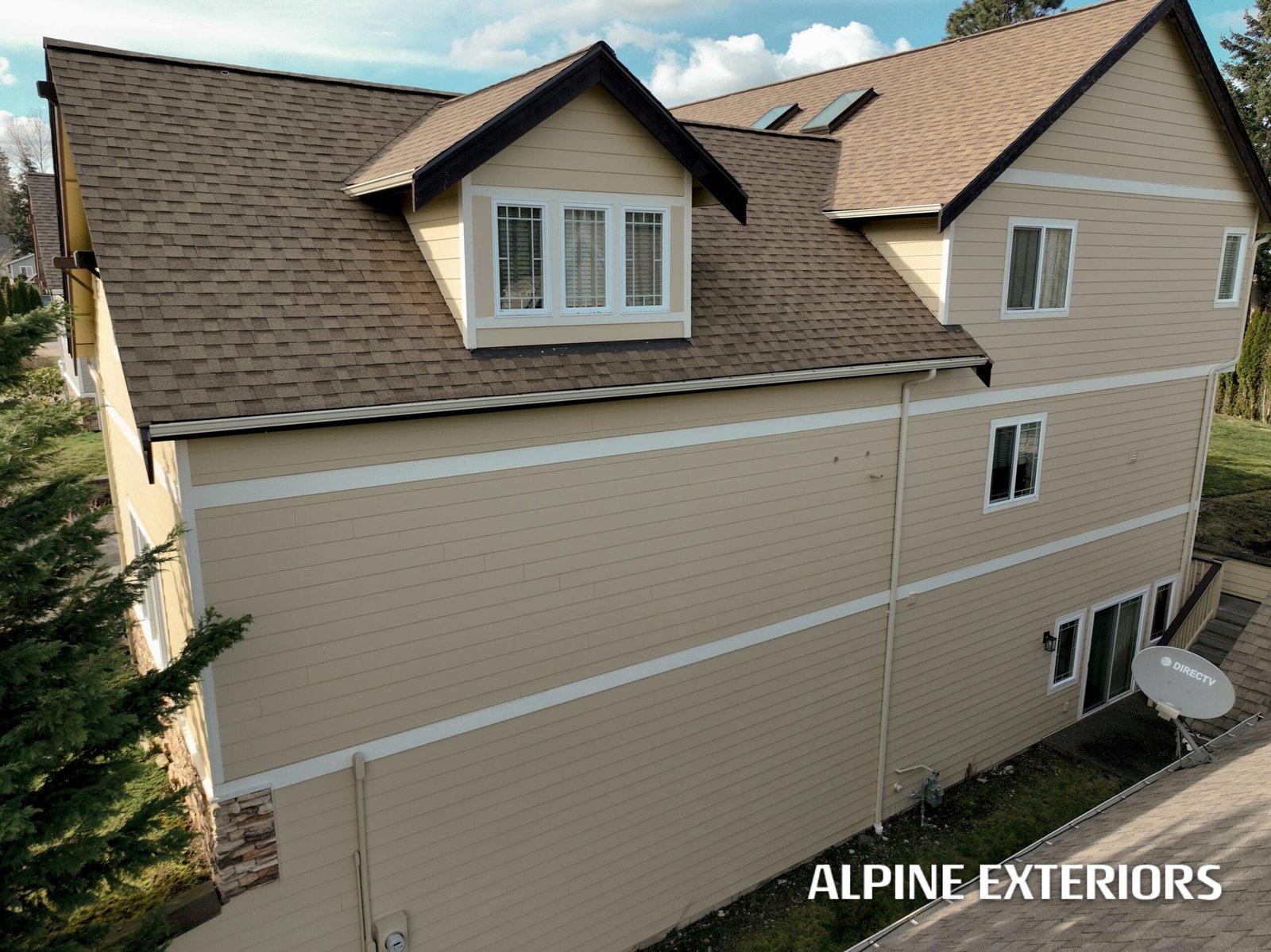
Skagit, Island and Whatcom counties get a long, steady wet season rather than short, intense storms, and that changes what actually fails first. From October through March, soil around foundations stays saturated for weeks at a time, so a downspout that discharges too close to the house doesn't just cause an occasional puddle — it keeps the same few square feet of ground waterlogged for most of the winter. Roofs shaded by big-leaf maple, cedar and Douglas fir, which describes a lot of lots in Sedro-Woolley, the Bellingham hillsides and parts of Anacortes, grow moss quickly, and moss holds water against the roofing and gutters far longer than a bare, sun-exposed roof would. That extra moisture load ends up in the gutters and downspouts, so clogs and standing water at the gutter line are more common here than in drier parts of the state.
Wind is the other regional factor. Homes out on the Skagit flats and along the water in Anacortes, La Conner, Camano Island and Stanwood take steady wind off the Strait of Juan de Fuca and Puget Sound, which loosens gutter hangers and downspout straps over time and can blow leaves and needles into gutters from unexpected directions. On the islands and other waterfront lots, salt-laden air accelerates corrosion on lower-quality aluminum and steel gutter hardware, so fasteners and seams fail sooner than the same materials would inland. Up toward the Cascade foothills near Concrete and the upper Sedro-Woolley area, occasional snow and ice loads can also crack older plastic downspout elbows right at the point where they'd otherwise carry water away from the house. None of this is hurricane-force weather — it's persistent, moderate, wet weather that rewards drainage systems built to run reliably for months at a time rather than survive a single big event.
The Washington State Energy Code also plays a role that's easy to overlook. Current energy code provisions for crawlspaces call for a continuous ground vapor barrier and specific insulation and ventilation detailing, precisely because this climate produces enough ambient humidity that an unprotected dirt floor will raise moisture levels in the space above code-acceptable limits. A home can have flawless gutters and downspouts and still fail a moisture inspection if the vapor barrier inside the crawlspace was never installed correctly or has torn loose over the years.
Start outside, and start at the downspout itself. Walk the perimeter of the house during or right after a heavy rain and watch where each downspout is actually discharging. If you see water pooling within a few feet of the foundation, that downspout needs an extension, a tightline connection to solid PVC pipe, or a properly sloped drain run to daylight or a drywell — not just a longer splash block, which still leaves water sitting close to the house. Check that the ground slopes away from the foundation for at least several feet in every direction; regrading a section of yard is inexpensive compared to the cost of drying out and repairing a crawlspace later.
Next, get eyes on the gutters themselves at least twice a year, ideally in late fall before the wet season and again in late winter. On heavily treed lots in Whatcom and Skagit counties, moss and needle buildup can clog a gutter system in a matter of months, and a clogged gutter overflows straight down the siding and foundation wall, bypassing the downspout entirely. Metal or mesh gutter guards reduce this workload but don't eliminate it — they still need periodic checking.
Underneath the house, confirm there's an intact ground vapor barrier covering the entire crawlspace floor, with seams overlapped and sealed rather than just laid loosely. If foundation vents are painted over, blocked by insulation, or missing screens, that airflow needs to be restored. A cheap hygrometer left in the crawlspace for a week will tell you more about ongoing moisture problems than a single dry-day inspection ever will.
Be honest about the limits of DIY fixes here. Extending a downspout or clearing a gutter is reasonable weekend work. Regrading around a foundation, tying multiple downspouts into a buried drain system, or diagnosing whether wood framing has already started to rot are jobs where getting it wrong costs more than getting a professional opinion up front. Alpine Exteriors inspects gutters, downspouts and the drainage path around the foundation together, because treating them separately is how homeowners end up paying twice — once for a drainage fix that didn't address the real discharge point, and again when the crawlspace problem it caused shows up later.
As a practical minimum, water should be carried at least four to six feet past the foundation, and further on lots that are already flat or slope toward the house. On many properties in Skagit and Whatcom counties, tying the downspout into a solid tightline that runs to a drywell or daylight discharge point works better than relying on distance alone, especially where the yard doesn't have much natural fall.
Indirectly, yes. Moss holds moisture against shingles and in gutters longer than a clean roof would, which increases the volume and duration of water moving through your downspouts during the wet months and raises the odds of a gutter clog that sends water down the foundation wall instead of away from it. Keeping shaded roofs treated and gutters clear reduces that load.
Soil naturally releases moisture into the air above it, and in this climate that's enough to keep a crawlspace persistently humid if there's no barrier stopping it. Over time that humidity condenses on cold surfaces, promotes mold growth on framing and insulation, and can violate the moisture control provisions of the Washington State Energy Code, which is one reason it comes up during real estate inspections and refinance appraisals.
They're not really separable — exterior drainage controls how much water reaches the soil around your foundation, and crawlspace ventilation plus the vapor barrier control what happens to the moisture that's already there. A house with excellent downspout drainage but a torn vapor barrier can still have a wet crawlspace, and vice versa, so both need to be functioning at the same time.
If you've noticed standing water near your foundation after a storm, a musty smell in the house, or gutters that overflow every winter, it's worth having someone look at the whole system rather than guessing at one fix. Alpine Exteriors, WA contractor license ALPINI751OW, serves homeowners throughout Skagit, Island and Whatcom counties — including Mount Vernon, Anacortes, Burlington, Sedro-Woolley, La Conner, Stanwood, Camano Island and Bellingham — and can walk your property to trace exactly where water is coming from and where it needs to go. Reach out to schedule an inspection before the next wet season sets in.