
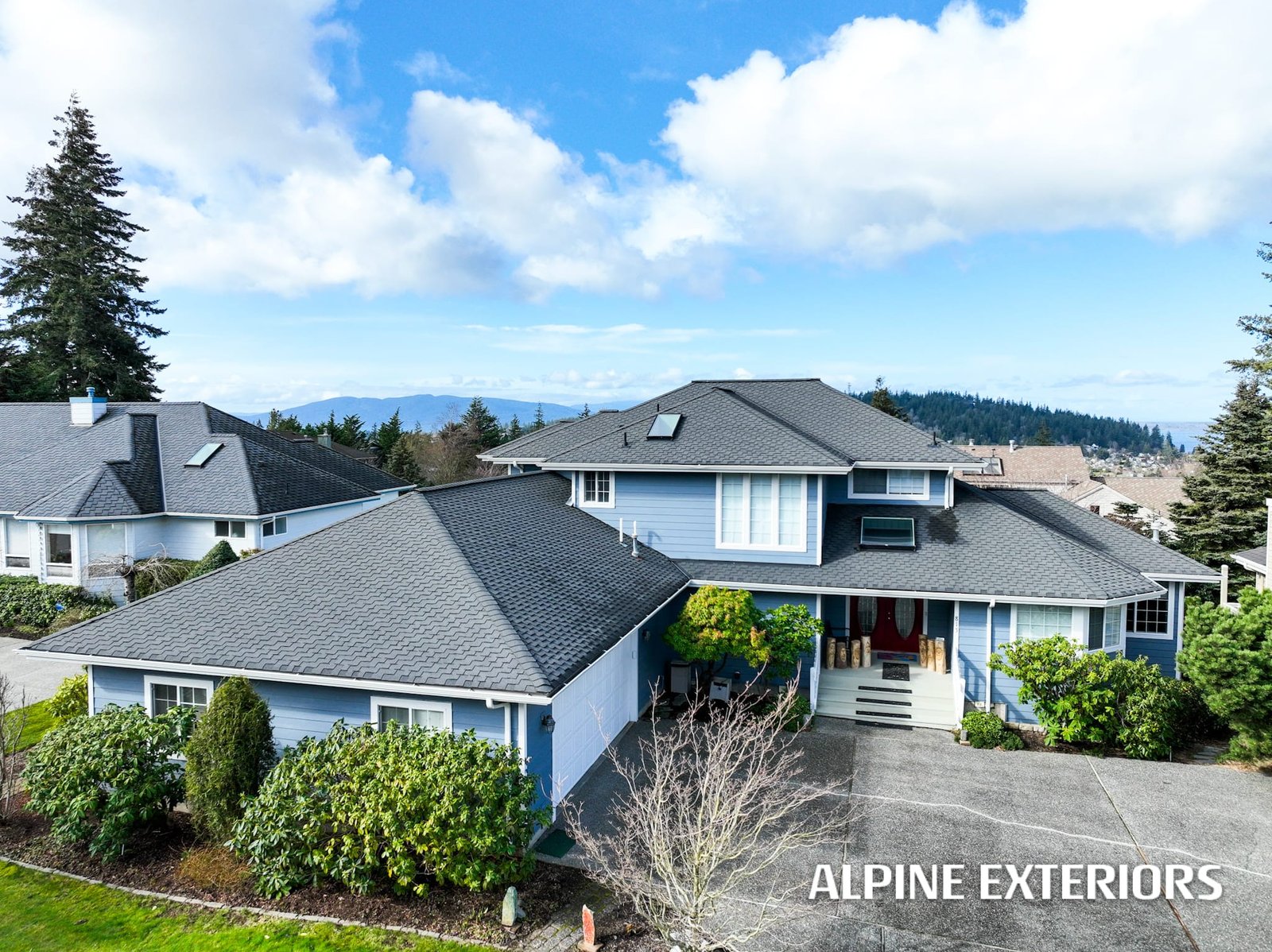
If your roof has a long, mostly unbroken ridgeline — common on the gable-roofed homes going up around Mount Vernon and Burlington — a continuous ridge vent usually moves moist attic air out more evenly through our long wet winters. If your roof is broken up by hips, dormers, valleys, or additions, which is common on older farmhouses and remodels around Sedro-Woolley and La Conner, individual box vents are often the more practical fit, since they don't depend on one long, straight run at the peak. Neither option is automatically "better" everywhere in Skagit, Island, and Whatcom counties — roof shape, wind exposure, and how the attic is currently venting all matter more than which style you pick. What matters most in our climate isn't the vent type, it's whether exhaust is balanced against enough intake air at the soffits, and whether the install itself is tight enough to keep driving rain out. Alpine Exteriors sees both situations across Anacortes, Camano Island, Stanwood, and Bellingham, and the right call comes down to the specific roof in front of us.
A ridge vent is a low-profile vent that runs along the peak of the roof, hidden under matching cap shingles, exhausting air along the entire ridge rather than through a few separate points.
Because it vents continuously, a ridge vent tends to keep the underside of the roof deck more evenly dry through months of steady rain, which matters on shaded, north-facing roof planes around Bellingham and Sedro-Woolley where moss and lingering dampness are already a problem. It's also a cleaner look — no domes breaking up the roofline — which owners on view lots in Anacortes or along Camano Island's waterfront tend to prefer. Newer ridge vent products use an external baffle and weather filter built to let air out while blocking wind-driven rain from being pushed back in, which matters when a southwesterly blows hard off the Strait or across the open Skagit flats.
The honest limitations: a ridge vent only works as well as the ridge it sits on. Short, broken-up ridgelines don't give it enough length to exhaust the whole attic, and hip roofs — common on a fair number of newer builds around Mount Vernon and Burlington — sometimes don't have enough ridge at all. It also has to be paired with matching soffit intake or it will pull air from the wrong place, and cheaper vent styles without an external baffle are more prone to letting wind-driven rain past the vent during a hard winter storm.
Box vents are individual static vents — small metal or plastic housings set over a cut opening in the roof deck, usually placed in a row below the ridge, each one its own exhaust point.
Their advantage is flexibility. They can go wherever there's usable roof deck, which makes them a good fit for hip roofs, additions, dormers, and the multi-ridge, multi-valley rooflines common on older homes around La Conner and Sedro-Woolley where a single continuous ridge vent isn't an option. They're mechanically simple — no internal baffle system to fail — and can be added to an existing roof without touching the ridge cap, which sometimes makes them the practical retrofit when a full re-roof isn't happening.
The drawbacks are real. Airflow through scattered box vents is less even than a continuous ridge vent, and two placed too close together can short-circuit each other rather than drawing properly from the soffits. Each box vent is also its own roof penetration with its own flashing and seam — more individual points of entry for water during sustained, driving winter rain. On roofs shaded by conifers, common across Whatcom and Skagit County, needle litter and moss can build up around the base of each unit and hold moisture against it. Visually, they're more noticeable — a row of domes rather than a clean ridge.
| Ridge Vent | Box Vents | |
|---|---|---|
| Cost | Moderate cost per linear foot when installed during a re-roof; retrofitting onto an existing roof adds labor for cutting and re-flashing the ridge. | Lower cost per individual unit, but an attic typically needs several to match a ridge vent's exhaust area, so the total often lands in a similar range. |
| Lifespan | Generally matches the life of the roofing system when the baffle and cap shingles aren't damaged by falling branches or foot traffic. | Individual housings, especially plastic ones, can crack, fade, or corrode from UV and salt air before the roof itself is due for replacement. |
| Maintenance | One continuous run to check periodically for moss buildup, debris, or worn cap shingles along the ridge. | Each unit is a separate point to inspect — flashing, screen, housing — more spots to check and reseal over time. |
| Appearance | Low profile; blends into the roofline and is barely visible from the ground. | Visible individual caps spaced across the roof plane, more noticeable on a steep or highly visible roof. |
Roof shape decides a lot before wind or rain even enters the picture. A long, simple gable roof — typical of newer construction around Mount Vernon, Burlington, and Stanwood — usually gets more even exhaust from a continuous ridge vent than from box vents trying to cover the same attic. A complicated roofline with hips, valleys, dormers, or an add-on section, common on older homes and remodels around La Conner, Sedro-Woolley, and parts of Bellingham, often doesn't have enough continuous ridge to work with, and box vents — sometimes paired with a shorter run of ridge vent where the roof allows it — end up being the workable answer.
Wind exposure matters too. Homes out on the open Skagit flats, along the Anacortes waterfront, on Camano Island, or facing the Strait get pushed by wind-driven rain in a way a sheltered, tree-lined lot in town doesn't. On those roofs we specify a ridge vent product with a proper external baffle rated for that exposure, or, if box vents are the better structural fit, keep them off the most wind-exposed ridge sections with extra care on the flashing. Salt air on the islands and near the water in Anacortes and La Conner also shortens the life of unprotected metal fasteners and housings faster than it does inland, so material choice matters regardless of vent type.
Moss-prone, shaded roofs — common wherever a house sits under fir or cedar cover around Bellingham and Sedro-Woolley — benefit somewhat from the more even drying a ridge vent provides across the whole attic. That said, moss growing on top of the shingles is mostly a function of shade and surface moisture, not attic ventilation, so better venting protects the wood underneath but won't stop surface moss on its own. In the foothill areas that see occasional snow and ice, balanced intake and exhaust also helps keep attic temperatures closer to outdoor levels, reducing the uneven roof-deck warming that contributes to ice damming at the eaves.
Washington's adopted residential energy and building code sets minimum attic ventilation based on net free ventilating area relative to the attic floor — commonly a ratio of 1 to 150, reducible to 1 to 300 with a vapor retarder or qualifying venting arrangement. Whichever vent type ends up on your roof, Alpine Exteriors sizes the system to meet that ratio rather than guessing, because an undersized system won't move enough air regardless of how well it's built.
Indirectly, yes, but it's not the main fix. Good attic ventilation keeps the roof deck's underside drier and closer to outdoor temperature, which helps the wood last and reduces some of the conditions moss favors from underneath. Moss on top of the shingles is mostly driven by shade and surface moisture, so on a heavily shaded roof you'll still want cleaning and, where possible, some tree trimming — venting alone won't stop it.
A properly installed ridge vent with an external baffle and weather filter, matched with enough soffit intake, is built to handle wind-driven rain, including gusts off the Strait and across the Skagit flats. Problems usually trace back to an older vent style without that baffle, not enough matching intake, or cap shingles that weren't sealed correctly along the run — the vent design itself is rarely the cause.
Generally, no, not on the same connected attic space — nearby box vents give the system an easier path to pull air from instead of drawing properly from the soffits, which weakens the ridge vent's performance. It's a different story if the box vents serve a separate, isolated attic area, like over a garage or an addition not connected to the main attic — that combination is fine.
Signs it isn't include frost or moisture on the underside of the roof deck in cold weather, a musty attic smell, ice damming along the eaves in winter, or discoloration and sagging on the sheathing. If you're seeing any of that, it's worth having someone get up into the attic and actually look, rather than guessing from the ground.
Ridge vent, box vents, or a mix of both — the right answer depends on your roof's shape, how exposed it is to wind and rain, and what's already going on in your attic. Alpine Exteriors, WA contractor license ALPINI751OW, works on roofs throughout Mount Vernon, Anacortes, Burlington, Sedro-Woolley, La Conner, Stanwood, Camano Island, and Bellingham, and can take a look at your attic and ridge before recommending which way to go. Reach out for an inspection and a straight answer about what your roof actually needs.