
Most homes in Mount Vernon, Burlington, Sedro-Woolley and the surrounding Skagit Valley do perfectly well with a quality architectural (laminate) shingle — it handles our wet winters, sheds the moss that builds up under shaded fir and cedar canopies, and holds up to the gusty wind that funnels across the Skagit flats without a premium price tag. Designer shingles earn their keep on a smaller slice of homes: a period farmhouse near La Conner, a craftsman in one of Bellingham's older neighborhoods, or a waterfront place on Camano Island or in Anacortes where curb appeal and a heavier, dimensional look matter as much as function. Neither product is wrong for this region — the decision usually comes down to how long you plan to own the house, what the roofline actually shows off, and how much you want to spend once versus spend twice.
Architectural shingles, sometimes called laminate or dimensional shingles, are built from two or more layers of asphalt fused together, which gives them a thicker profile and a shadow-line look compared to old three-tab shingles. They're the roofing workhorse across Skagit and Island counties right now, and for good reason. The extra layer adds real wind resistance, which matters on open ground between Mount Vernon and Stanwood where there's little to break the wind coming off the flats, and again out toward the water in Anacortes and on Camano Island where gusts off the Strait and Puget Sound can push hard on an exposed roof plane. Most architectural products carry wind ratings well above what a standard three-tab shingle offers, and manufacturers rate many lines for the higher exposure common in coastal Washington.
They also drain well, which is the single biggest factor in this climate. Skagit and Whatcom counties see long stretches of steady winter rain rather than short, intense downpours, and a roof here needs to shed water efficiently for months at a time without ponding at valleys or letting moisture wick under the shingle edge. Architectural shingles' thicker mat and tighter seal along the eaves and valleys handle that well when installed with proper underlayment and ice-and-water shield at the vulnerable spots.
The tradeoff is mostly cosmetic. Architectural shingles look good — the shadow banding reads as texture from the street — but they don't fully mimic the deep, irregular profile of natural slate or heavy cedar shakes. On a simple gable roof that's rarely noticed. On a highly visible, architecturally detailed home, it can look slightly flat up close.
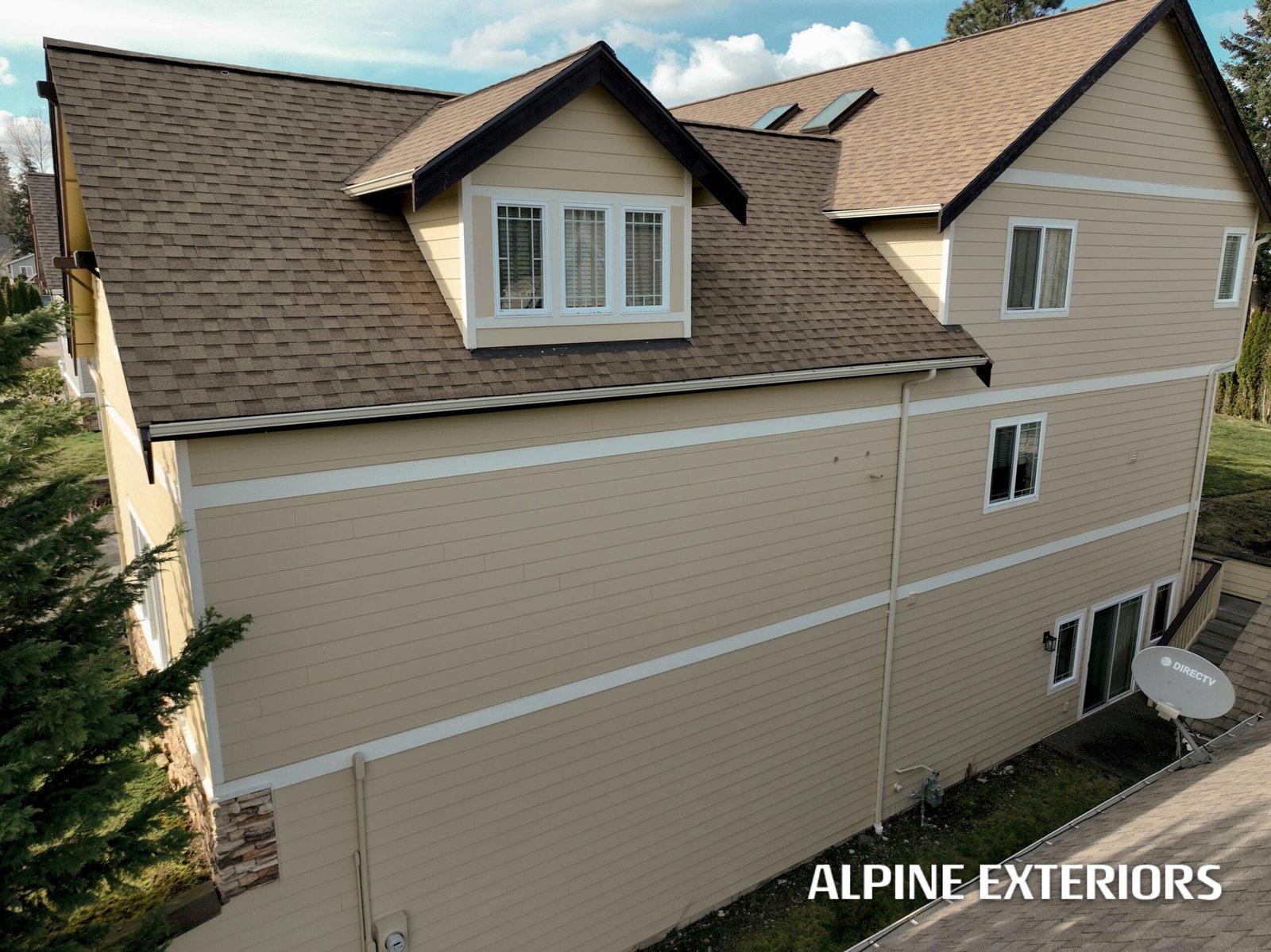
Designer shingles (sometimes marketed as "luxury" shingles) take the laminate concept further, with thicker, multi-layer construction and irregular tab cuts meant to imitate slate or hand-split cedar shakes. They're heavier, often carry longer warranties, and on the right roofline they genuinely look better — deeper shadow lines, more randomness in the pattern, a premium feel that reads even from the sidewalk. On a steep-pitched craftsman in Bellingham's Fairhaven or Columbia neighborhoods, or a stately home along the water in Anacortes or La Conner, that upgrade in appearance can be worth it.
Functionally, they carry the same regional advantages as architectural shingles and then some. Their added mass generally translates to strong wind ratings and a longer expected service life, which can matter on an exposed bluff lot on Camano Island or a hilltop property catching the full sweep of wind off the Salish Sea. Many designer lines also use algae-resistant granules, which helps on the shaded, moss-prone roofs common under the fir stands around Sedro-Woolley and the wooded lots east of Mount Vernon — though no shingle is truly moss-proof, and any roof with heavy tree cover still needs periodic cleaning regardless of product tier.
The drawback is straightforward: cost and complexity. Designer shingles run meaningfully more per square than architectural, the install often takes longer because of the irregular cuts, and on a plain, unremarkable roofline the visual upgrade may not be visible from the ground at all — meaning you're paying for detail nobody will see.
| Architectural Shingles | Designer Shingles | |
|---|---|---|
| Typical material cost | Moderate — generally the more budget-friendly asphalt option for a full re-roof | Higher, often noticeably more per square due to thicker, multi-layer construction |
| Expected lifespan | Commonly in the 25–30 year range with proper ventilation and installation | Often rated longer, with some premium lines pushing toward 30–40+ years |
| Maintenance in this climate | Periodic moss removal on shaded lots; standard gutter and valley checks after wind events | Similar upkeep, though algae-resistant granules on many lines can somewhat reduce moss and streak buildup |
| Appearance | Clean shadow-line texture; reads well on standard rooflines and most home styles | Deeper, more irregular profile meant to mimic slate or shake; stands out on detailed or high-visibility rooflines |
| Wind performance | Solid wind ratings suitable for open, exposed terrain when installed correctly | Generally equal or better due to added mass and layered construction |
For most homeowners between Burlington and Stanwood, an architectural shingle from a reputable manufacturer, installed correctly with the right underlayment and ventilation, is the practical choice. It handles the steady rain, resists the wind coming across the valley, and holds its own against moss on shaded lots when paired with a reasonable maintenance schedule. It's also the shingle that makes the most financial sense if you're re-roofing a straightforward gable or hip roof where the extra texture of a designer product won't be visible from street level.
Designer shingles earn their premium on homes where the roof is part of the architecture — a steep, visible pitch, dormers, multiple planes, or a historic or high-end style where the deeper shadow lines actually register. They also make sense for an owner planning to stay long-term on an exposed site, like a bluff-top lot on Camano Island or a waterfront property in Anacortes, where the combination of salt air, open wind exposure and long-term ownership can justify paying more up front for a longer-rated, heavier-built product. Whichever way you lean, we always factor in the Washington State Energy Code's ventilation and attic requirements during the design phase, since a shingle is only as good as the roof assembly underneath it — poor ventilation shortens the life of even the best product.
Alpine Exteriors walks homeowners through both options on-site, roof by roof, rather than pushing one product line by default. We'll look at your roof's exposure, pitch, tree cover and visibility from the street before recommending architectural or designer shingles, and we'll give you real cost ranges for your specific roof rather than a generic per-square number that doesn't account for tear-off, decking repairs, or code-required upgrades.
Often, yes, but the gap depends heavily on installation quality and attic ventilation, not just the product itself. A well-installed architectural shingle with proper ventilation can outlast a poorly installed designer shingle. If you're comparing two correctly installed roofs, the heavier designer product will generally hold up longer under sustained rain exposure and wind, but the difference is measured in years, not decades, for most homes in Skagit and Whatcom counties.
No shingle is fully moss-proof. Algae-resistant granules, found on many designer lines and some architectural products, slow down black streaking and can reduce how quickly moss gets a foothold, but a roof under heavy fir or cedar cover in Sedro-Woolley or the wooded lots around Mount Vernon will still need periodic cleaning and possibly zinc or copper strips near the ridge to manage moss long-term, regardless of which shingle tier you choose.
Usually not, if the roof is a simple gable or hip shape without much visibility of the shingle detail from the ground. The irregular, dimensional look that justifies the price premium is easiest to see on steep, complex rooflines with dormers or multiple visible planes. On a plain single-story roof, a quality architectural shingle typically delivers nearly the same street-level appearance for less money.
Salt air doesn't degrade asphalt shingles the way it corrodes metal fasteners and flashing, so the shingle choice itself is less critical than the flashing, fastener and ventilation details around it. That said, both architectural and designer shingles with strong wind ratings are a sensible baseline on exposed waterfront lots, and we typically recommend corrosion-resistant fasteners and flashing regardless of which shingle tier is used.
If you're weighing architectural versus designer shingles for a home in Mount Vernon, Anacortes, Burlington, Sedro-Woolley, La Conner, Stanwood, Camano Island or Bellingham, Alpine Exteriors can walk your roof in person and give you a straight comparison based on your actual pitch, exposure and budget — not a generic sales pitch. Alpine Exteriors is licensed in Washington (contractor license ALPINI751OW) and handles roofing, windows, decks and gutters across Skagit, Island and Whatcom counties. Reach out to schedule a roof evaluation and get real numbers for both options before you decide.