
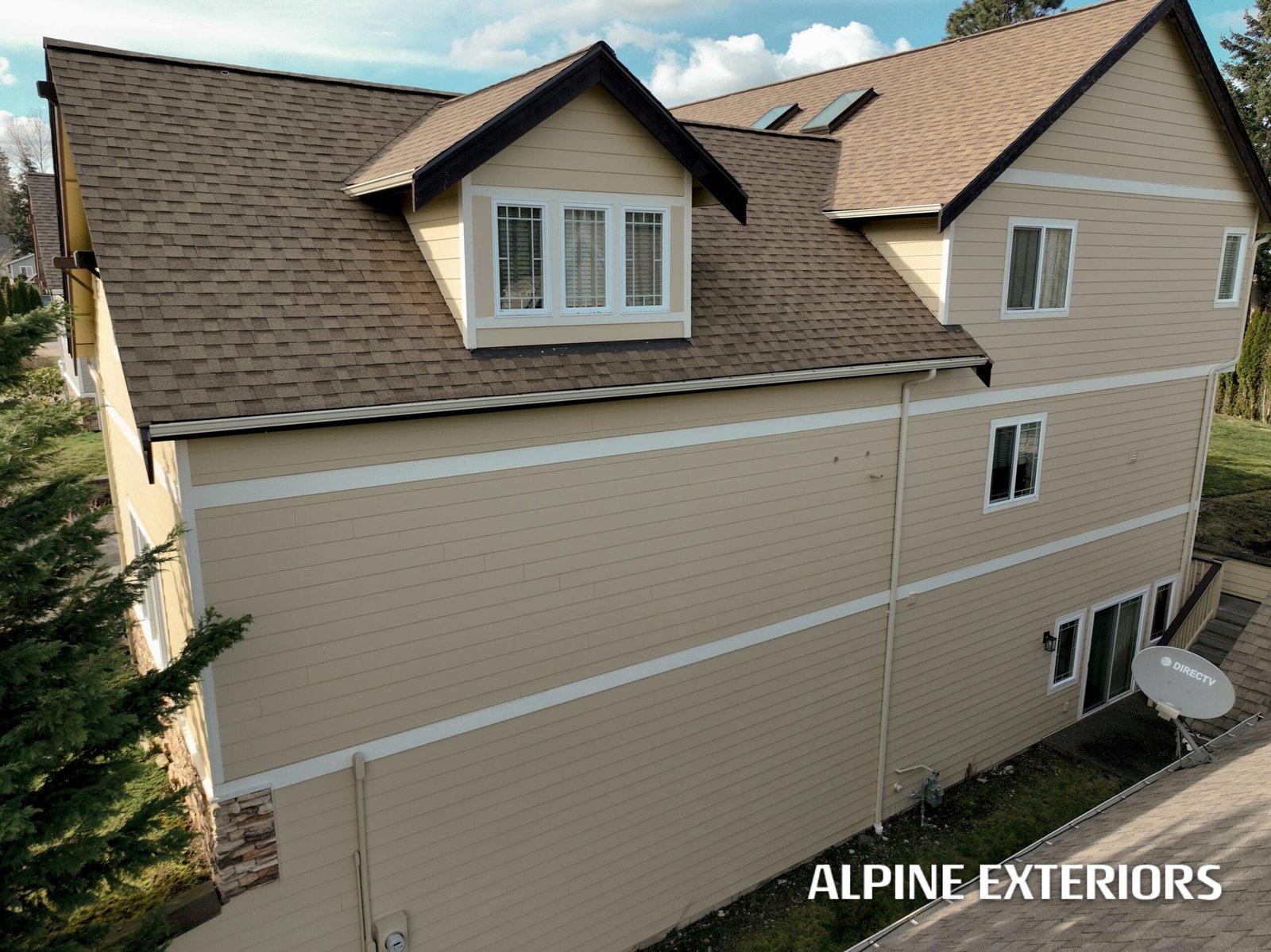
Most houses in Mount Vernon, Anacortes, Burlington, Sedro-Woolley and the surrounding lowlands are still wearing standard 5-inch K-style gutters with 2x3-inch downspouts, and on a lot of roofs that's undersized for what actually falls out of the sky here during a strong Pacific frontal system. If your roof has any size to it — a long run without a break, a valley that dumps two roof planes into one gutter run, or a steep pitch that speeds runoff — you're generally better served by 6-inch gutters paired with 3x4-inch downspouts, especially on the downhill side of the roof and anywhere water concentrates.
Gutter capacity is a function of three things: the width and depth of the trough, the size and number of downspouts, and how much roof area actually drains into that one run. A 5-inch gutter with a single 2x3 downspout is rated by most manufacturers to handle a modest roof section in a modest rain event. It was never really engineered around this region's wet-season reality, where a series of days can each dump a significant amount of rain, sometimes arriving as a fast, heavy pulse rather than a gentle all-day drizzle. When more water arrives per minute than the trough and downspout can move, the gutter overtops at its lowest point — usually right above an entry door, a walkway, or a window — well before it's actually full end to end.
The other variable homeowners underestimate is downspout count, not just downspout size. A gutter can be the right width and still fail if there's only one downspout serving a run that's fifty or sixty feet long, or serving a valley where two roof planes converge. Splitting that load across two downspouts, or upsizing to a single larger one, often solves a chronic overflow problem that looks like a "gutter size" issue but is really a "not enough exits for the water" issue.
A handful of local conditions push the math here in a direction that doesn't apply everywhere:
Start by looking at the roof, not the catalog. A simple, single-story roof with short runs and no valleys may genuinely be fine with 5-inch gutters — there's no need to pay for capacity you'll never use. But for anything with a valley, a long unbroken run, a steep pitch, or a lower roof section catching runoff from a second story above it, 6-inch gutters and 3x4 downspouts give real margin during the heaviest weeks of the year instead of running right at the edge of overflow.
Match downspout count to roof area, not habit. As a rough starting point, a downspout roughly every 35 to 40 feet of gutter run keeps water moving even in a heavy event, and any valley or long converging run usually deserves its own dedicated downspout rather than sharing one with the rest of the roof.
Plan for moss, don't just plan around it. If a roof section sits in shade for most of the day, budget for gutter cleaning at least twice a year — before the fall rains start and again after the wettest stretch of winter — and consider that moss treatment on the roof itself reduces what ends up washing into the gutter in the first place. Gutter guards can cut down on leaf debris, but they're not a substitute for cleaning; fine moss and granule grit will still work through most guard systems over time, and a clogged guard is arguably harder to clear than an open gutter.
On the islands and immediate shoreline, ask about hardware, not just gutter material. Standard aluminum gutter can hold up fine, but the screws, hidden hangers and end caps are usually the first things to corrode in salt air — stainless or heavier-coated fasteners and hangers spaced a bit tighter than the inland standard are a reasonable upgrade given the wind and salt exposure on Camano Island and around Anacortes.
In the foothill areas, address the attic before blaming the gutter. If ice keeps forming at the eaves in cold snaps, more attic insulation and better soffit-to-ridge ventilation — consistent with what the Washington State Energy Code already expects of the building envelope — usually does more for the ice-dam problem than any change to the gutter itself.
Alpine Exteriors walks each roof's actual drainage pattern before recommending a gutter size, because the same house on a quiet inland lot and a similar house exposed on Camano Island can reasonably end up with two different specs. There's no single "right" gutter size for the region — the right size is the one that matches that specific roof's area, pitch, valleys and exposure.
Not necessarily. If the roof is simple, the runs are short, and you've genuinely never seen overflow during the heaviest rain of the year, the existing gutters are probably doing their job and there's no reason to replace working equipment. The upgrade to 6-inch matters most where there's a valley, a long run, a steep pitch, or a lower roof catching runoff from above — situations where the math is tighter to begin with.
It depends on the roof's shape more than its total square footage. A rough guide is one downspout per 35 to 40 feet of gutter run, with any valley or converging roof section getting its own downspout rather than sharing one with a long straight run. A contractor who walks the roof can tell you where water is actually concentrating, which is usually more useful than a generic per-square-foot rule.
No. Guards reduce the volume of leaves and larger debris that gets in, which helps, but fine moss fragments and roof grit still work through most guard designs over time, especially on shaded roofs common around Burlington and Sedro-Woolley. Guards are worth having on a roof with real moss or tree debris, but they extend the interval between cleanings — they don't eliminate the need for it.
Often, yes. If the roof has short, straight runs with no valleys and drains easily, a properly maintained 5-inch system with the right number of downspouts can handle this region's rain without trouble, and paying for 6-inch capacity you don't need is a fair drawback to weigh against the extra cost. Size should follow the roof's actual drainage pattern, not a blanket assumption that bigger is always better.
If your gutters overflow in heavy rain, stay clogged with moss, or you're planning a roof or gutter replacement anywhere from Mount Vernon and Burlington out to Anacortes, La Conner, Camano Island or Bellingham, Alpine Exteriors can walk the roof, look at where water actually concentrates, and recommend a gutter and downspout size that fits that specific house rather than a one-size answer. Alpine Exteriors is a licensed Washington contractor (license ALPINI751OW) serving Skagit, Island and Whatcom counties for roofing, windows, decks and gutters. Reach out for an on-site look at your roof's drainage before the next round of fall rain arrives.