

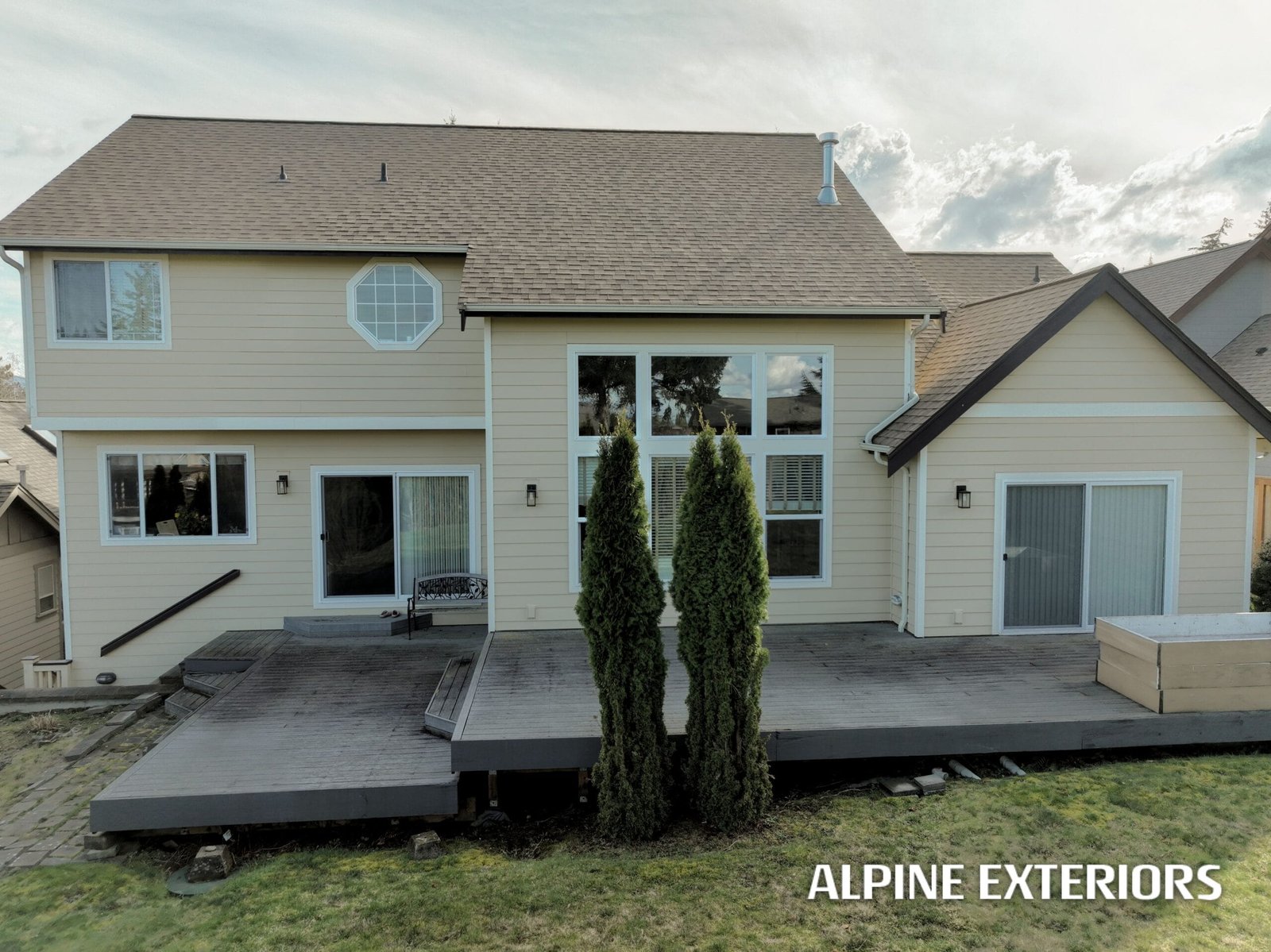
Ice and water shield is a self-adhering, waterproof membrane installed directly on the roof deck beneath the visible roofing material, most commonly at the eaves, valleys, and around penetrations like chimneys and skylights. It seals tightly around every nail that passes through it, creating a backup barrier in the exact spots where water is most likely to find its way underneath shingles or metal panels and into the house.
A standard roof relies on layers working together: the shingles or panels shed the bulk of the water, a synthetic or felt underlayment covers the whole deck as a general moisture barrier, and flashing directs water away from transitions. Ice and water shield is a third, more aggressive layer used only where the risk of water intrusion is highest. Unlike standard underlayment, which is simply laid down and fastened, ice and water shield has a rubberized asphalt or synthetic adhesive backing that bonds to the plywood or OSB deck and self-seals around fastener penetrations. That self-sealing property is the whole point — even if wind-driven rain or meltwater works its way past the shingles above, it hits a membrane with no clear path downward through nail holes.
The name comes from its original purpose in colder climates: stopping water from ice dams. An ice dam forms when heat escaping through the attic melts snow on the upper roof, that meltwater runs down to the colder overhanging eave, refreezes, and builds a ridge of ice that backs water up under the shingles. Ice and water shield at the eaves gives that backed-up water nowhere to go but back out, instead of into the attic insulation and ceiling drywall. But the membrane does the same job for any water forced backward under the roofing by wind or debris, which is the more common scenario in this part of Washington.
Roofers typically run the membrane from the edge of the eave to a point roughly two feet inside the exterior wall line, far enough to cover the area directly above living space, and they run full-width strips down every valley, since valleys concentrate more runoff per square foot than any other part of the roof. Low-slope sections, dormer cheeks, skylight curbs, and chimney saddles usually get it too, because those are the spots where flashing alone has the least margin for error.
Skagit, Island and Whatcom counties don't deal with the deep, sustained freeze-thaw cycling that makes ice damming a near-certainty in the Rockies or the upper Midwest. In most winters, a roof in Mount Vernon, Burlington, or Anacortes will see more rain than snow, and true ice dams are the exception rather than the rule at sea level. That said, a few local conditions still make ice and water shield worth taking seriously here, just for slightly different reasons than in a colder state:
What doesn't apply here is worth saying plainly: this isn't hurricane country, and ice and water shield in this region isn't doing the job of a wind-uplift or storm-surge defense the way it might in a Gulf Coast or Southeast installation. Its job locally is quieter — managing chronic wet weather, wind-driven rain, and the occasional cold snap, not a named storm event.
You don't need to cover an entire roof deck in ice and water shield, and a contractor who proposes that for a standard asphalt shingle roof on the flats is probably overbuilding the job and the price along with it. What's worth asking for, and worth confirming is actually happening, is coverage at the places that matter: the eaves (extended further if your home is up toward the foothills or has a documented history of ice buildup), every valley, and around every roof penetration — skylights, chimneys, plumbing vents, and any dormer.
The honest drawback is that ice and water shield isn't a cure-all: it won't fix a roof that's already failing structurally, it won't stop moss from growing, and it does nothing for a leak caused by bad flashing detail work rather than water finding a nail hole. It's one layer in a system, and it only performs as well as the flashing, underlayment, and shingle work installed around it. Alpine Exteriors treats it as a standard part of a properly detailed reroof in this region, not an upsell, because the places it protects are the places we see the most callbacks on roofs that skipped it.
Not the entire roof deck, but nearly every roof benefits from it at the eaves, valleys, and penetrations, since those are the spots where wind-driven rain and any freeze-thaw activity concentrate. How far up the eave it extends is a reasonable thing to vary by elevation and exposure — a home near Sedro-Woolley's higher ground or with a documented ice history warrants more coverage than a sheltered lot down on the flats.
No. Moss grows on the surface of the roofing material because of shade and moisture, and a membrane installed underneath the shingles has no effect on that. What ice and water shield does is reduce the consequences if moss-lifted shingles let water underneath — it's a backup for water intrusion, not a moss treatment, and moss still needs to be managed separately.
It varies with roof size, roof pitch, and how many valleys and penetrations the roof has, but as part of a full reroof it's typically a modest incremental cost — commonly in the range of a few hundred to around a thousand dollars — rather than a major line item. Adding it later, after the roofing is already installed, generally costs more because it requires removing finished material to get to the deck.
Washington's adopted residential building code requires an ice barrier membrane at eaves in areas with a history of ice-dam-related water damage, and most roofing contractors in this region install it at eaves and valleys as standard practice regardless of the specific code trigger for a given jurisdiction, simply because it's inexpensive insurance against the wettest and windiest parts of the year. A local contractor can tell you what applies for your specific city and roof design.
If you're planning a reroof or dealing with a leak that keeps coming back in the same spot, Alpine Exteriors can walk your roof, show you exactly where a membrane like this makes sense for your home's exposure and elevation, and give you a clear scope before any work starts. Alpine Exteriors is a licensed Washington contractor (ALPINI751OW) serving Mount Vernon, Anacortes, Burlington, Sedro-Woolley, La Conner, Stanwood, Camano Island and Bellingham — reach out for a roof evaluation and a straightforward, written estimate.



