
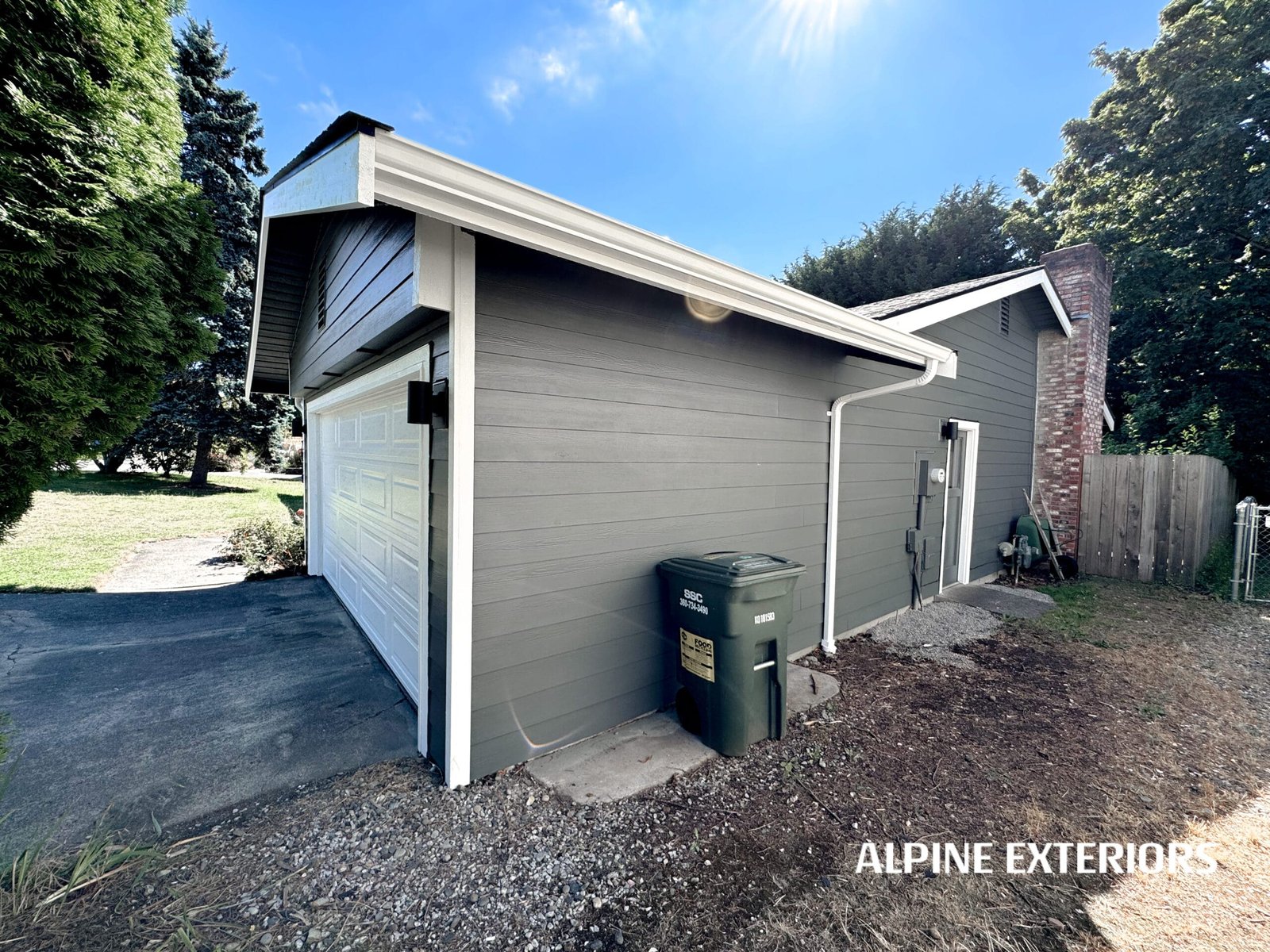
Walk the perimeter of almost any older home in Mount Vernon, Anacortes, Burlington, Sedro-Woolley, La Conner, Stanwood, Camano Island or Bellingham after a hard winter rain and you'll often find the same thing: a downspout emptying straight onto the ground a few inches from the foundation, with a shallow trench or a bare patch of mud to show for it. It's one of the most common problems we see on service calls, and it's also one of the more fixable ones — if it gets caught before a full season of Pacific Northwest rain has had a chance to work on it.
Downspouts that dump at the foundation instead of carrying water well away from the house don't always announce themselves right away. The signs tend to build gradually over a wet season, which is part of why they get ignored until they're expensive.
Any one of these on its own isn't necessarily an emergency, but a cluster of two or three around the same downspout is a strong signal that water has been finding its way into the soil next to your footing for a while.
This is a very regional problem, and the causes in Skagit, Island and Whatcom counties look different from what you'd find in a drier climate.
The biggest factor is simply volume. Winters here bring long stretches of steady, soaking rain, punctuated by heavier atmospheric-river events that can drop a lot of water in a short window. A downspout that terminates two feet from the house with no extension or splash block might handle a light shower fine, but during a real winter storm off the Sound it can put more water against the foundation in a few hours than the soil can absorb or shed.
Moss is a quieter contributor. Shaded roofs under fir and cedar canopy — common on wooded lots around Sedro-Woolley, Stanwood and the Camano Island tree line — stay damp longer and grow moss that clogs gutters and downspout throats. A partially blocked downspout backs up, overflows at the hangers, and starts dumping water along the fascia and foundation wall instead of routing it through the pipe as designed.
Wind is a factor most homeowners underestimate. The open exposure across the Skagit flats and the funnel effect along the Strait can be surprisingly strong, and it's enough over time to work gutter straps loose, knock splash blocks out of position, or pull a downspout's lower elbow away from the wall entirely — redirecting water that used to run a few feet away right back against the siding and footing.
On Camano Island, Anacortes and other near-water properties, salt-laden air accelerates corrosion on gutter hangers, screws and downspout brackets faster than it would inland. A corroded fastener lets a downspout section sag or separate at a joint, which is often how a system that worked fine for years suddenly starts leaking at the base.
In the foothills toward Sedro-Woolley and the eastern edges of the service area, occasional freezes add another wrinkle. Ice damming at the gutter edge, or a downspout that freezes solid overnight, can force meltwater over the top of the gutter or crack a downspout seam, both of which send water straight down along the foundation instead of through the pipe.
Finally, a lot of this region — particularly the valley floor around Mount Vernon, Burlington and La Conner — has fairly flat lots and clay-heavy soil that doesn't drain quickly. Even a downspout that's technically extended a few feet from the house can still pool water against the foundation if the grading nearby is flat or, worse, tilts back toward the house.
Not every downspout dumping at the foundation is a five-alarm problem, but the urgency depends heavily on what's underneath and how long it's been happening.
A large share of homes in this region are built over crawl spaces rather than full basements, and that matters here. Water that saturates the soil next to a crawl space foundation wall doesn't have to breach the wall to cause damage — it raises humidity in the crawl space, which promotes wood rot in floor joists and rim boards, invites carpenter ants and other moisture-seeking pests, and can lead to mold on insulation and subfloor. None of that happens overnight, but it compounds every winter it's left alone.
Treat it as urgent if you're seeing active water intrusion into a crawl space or basement during rain, a foundation crack that's visibly grown since you last checked it, or soil that's noticeably settling or sinking near the foundation. Those point to water that's already undermining the soil bearing your footing, and waiting through another wet season is a real risk.
Treat it as important-but-not-emergency if what you're dealing with is a displaced splash block, a short extension that's come loose, or minor ponding without any interior or structural symptoms yet. It should still get fixed before the next heavy rain stretch, but it's not something that requires an after-hours call.
Most downspout-at-the-foundation problems fall into one of a few repair categories, and very few require replacing the whole gutter system. That said, it's worth being honest about when a bigger fix actually makes sense.
| Situation | Typical fix | Rough cost range |
|---|---|---|
| Downspout discharges within a foot or two of the foundation, otherwise sound gutters | Add or replace downspout extensions, reset splash blocks with proper slope | Roughly $50–$150 per downspout |
| Chronic ponding despite extensions, flat or poorly graded soil nearby | Tie downspouts into a buried solid-pipe drain line routed to daylight or a dry well | Roughly $150–$450 per downspout depending on run length and digging conditions |
| Gutters overflowing from moss/debris, corroded hangers, sagging sections | Full or partial gutter system replacement, upgraded hangers | Roughly $1,800–$5,000+ depending on home size, material and number of stories |
| Suspected foundation settling, crawl space rot already visible | Foundation and framing repair in addition to drainage correction | Highly variable — requires an in-person assessment |
A couple of honest caveats worth knowing before you commit to a fix. Buried downspout drain lines solve the immediate ponding problem, but if they're installed without a cleanout access point, they can silt up or clog with moss debris over a few seasons and you won't know until water starts backing up again — insist on a cleanout if you go this route. And extensions alone won't fix the problem if the underlying grade slopes toward the house; in that case, some regrading or a shallow swale needs to happen alongside the downspout work, or the water just finds a new path back to the same wall.
Full gutter replacement is rarely the first move for a foundation-drainage complaint on its own — it's usually the right call when the gutters themselves are failing (rusted through, pulling away from the fascia, undersized for the roof area) and the downspout issue is really a symptom of that larger problem.
Most of what keeps downspouts working correctly here is unglamorous maintenance, done on a schedule that matches the local climate rather than a generic checklist.
Look for the correlation first — does the damp spot, crack or crawl space moisture line up with where a specific downspout empties? If a problem area sits directly below or a few feet from a downspout outlet, that's a strong indicator. Foundation issues can also come from poor overall lot grading, a high water table, or plumbing leaks, so if the trouble doesn't track with downspout locations, it's worth having someone look at drainage more broadly rather than assuming it's the gutters.
Simple cases — a loose splash block, a downspout that just needs a longer extension — are reasonable DIY fixes for a lot of homeowners. It's worth bringing in a contractor once you're dealing with buried drain lines, regrading near the foundation, or any sign the water has already caused damage to the crawl space or foundation wall, since those situations benefit from someone who can assess the whole drainage picture rather than just the one downspout.
A commonly used rule of thumb is at least four to six feet, more if the surrounding grade is flat or slopes back toward the house, which is common on valley-floor lots around Mount Vernon and La Conner. The exact distance that works depends on your specific grading — the goal is simply getting the water past the zone where it can seep back toward the footing before it soaks in.
Often, no — many policies treat gradual water intrusion and resulting damage as a maintenance issue rather than a covered peril, since it's considered preventable. Coverage varies significantly by policy and insurer, so it's worth reading your specific policy language or asking your agent directly rather than assuming either way. That's one more reason catching this early, before it becomes a foundation repair, tends to be the cheaper path regardless of coverage.
If you've noticed a downspout emptying too close to the house, a damp crawl space, or a foundation crack that's changed since last winter, it's worth having it looked at before the next round of heavy rain rolls in off the Sound. Alpine Exteriors works on roofing, gutters, windows and decks throughout Skagit, Island and Whatcom counties — Mount Vernon, Anacortes, Burlington, Sedro-Woolley, La Conner, Stanwood, Camano Island and Bellingham — and can walk your property, trace where each downspout actually discharges, and tell you plainly whether you're looking at a quick extension fix or something that needs a more involved drainage solution. Alpine Exteriors is licensed in Washington under contractor license ALPINI751OW. Reach out to schedule a foundation drainage and gutter inspection before the wet season puts it to the test.