
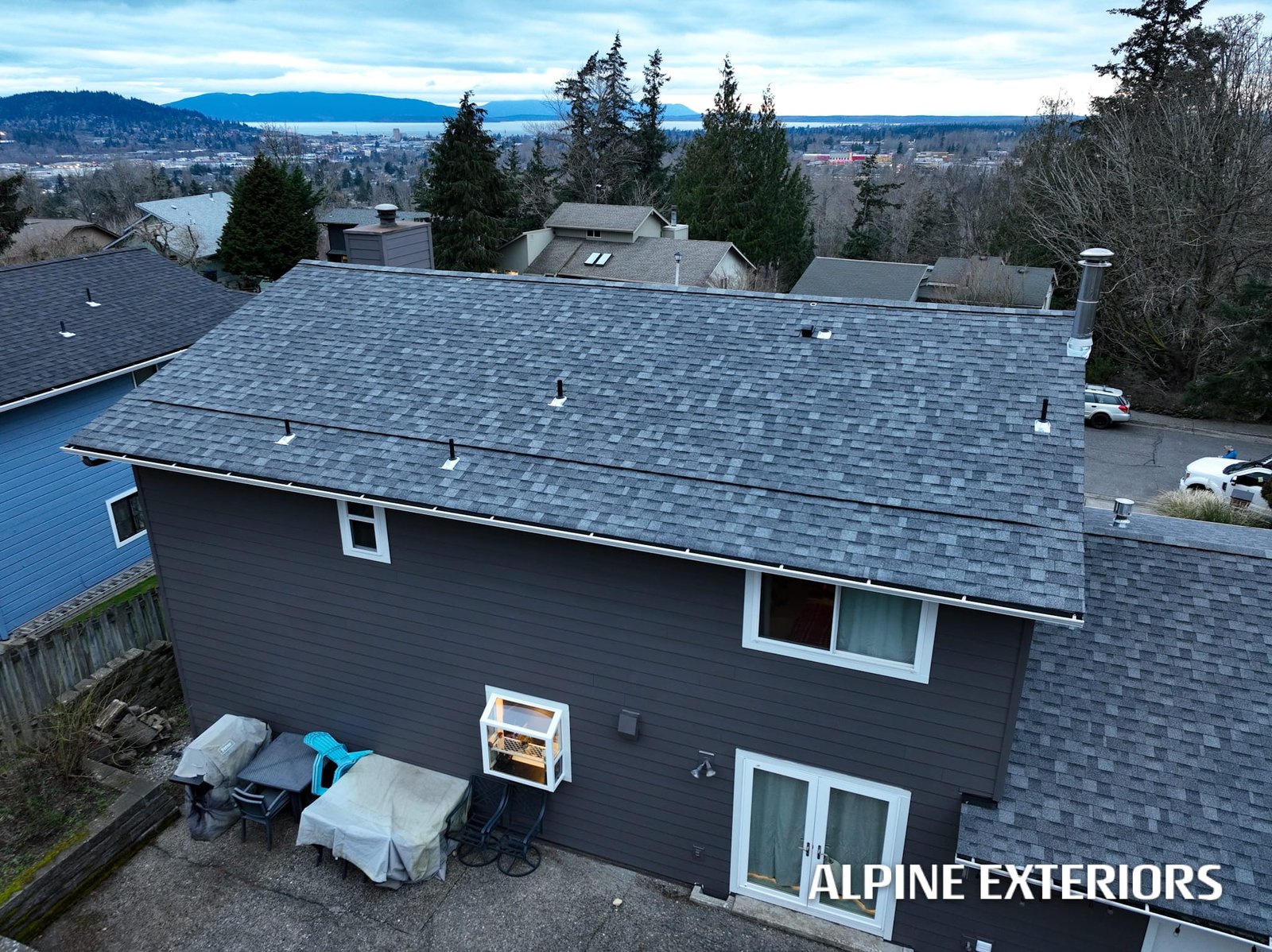
A sagging roofline rarely announces itself all at once. Most homeowners in Mount Vernon, Burlington, Anacortes and the surrounding area first notice it from the street or the driveway: the ridge that should run in a straight, level line instead shows a shallow dip or a gentle wave partway along its length. Standing across the street or backing your car out to look at the roof from a distance is still one of the most reliable ways to catch it early, especially on older farmhouses and mid-century homes common throughout Skagit and Whatcom counties.
Other signs show up closer to the roof plane itself. Look for a rippling or wavy texture between the ridge and the eaves, low spots where water and moss tend to collect even after the rest of the roof has dried out, and gutters or fascia boards that have pulled slightly away from the roof edge. Inside the attic, sagging often shows up as rafters or trusses that bow downward between their support points, daylight or gaps where framing members no longer sit tight against the sheathing, and insulation that has slumped into a low spot. Inside the living space, cracked drywall near an interior wall that meets the roofline, door and window frames that have gone out of square, and doors that stick or no longer latch cleanly can all point back to a roof structure that has started to move.
Not every uneven-looking roof is structurally compromised. Some older homes were built with a slight camber or with roof lines that were never perfectly true, and a few shingle courses that look wavy from certain angles can simply be a cosmetic quirk of the original framing. The distinction matters, which is why a visual check from the ground is a starting point, not a diagnosis.
Skagit, Island and Whatcom counties put a specific combination of stresses on a roof over time, and sagging is usually the result of more than one of them acting together rather than a single dramatic event.
Heavy winter rain is the most consistent factor. Months of sustained wet weather, common from late fall through early spring in Mount Vernon, Burlington, Sedro-Woolley and La Conner, keep roof sheathing and framing damp for long stretches if ventilation or flashing details aren't doing their job. Wood that stays wet season after season slowly loses strength, and that loss shows up first as a soft spot or a shallow sag rather than a sudden failure. Moss compounds the problem. Roof sections shaded by mature Douglas fir, cedar and big-leaf maple, which describes a large share of the tree canopy across this region, hold moisture against the shingles far longer than sun-exposed slopes. A thick moss mat acts like a sponge, keeping the deck beneath it wet even during dry spells and accelerating rot in exactly the spots least visible from the ground.
Wind is a second regional factor, though it looks different here than in other parts of the country. The flat, open farmland around the Skagit River delta funnels wind with little to break it up, and homes closer to Rosario Strait and the Strait of Juan de Fuca near Anacortes and La Conner see regular gusts off the water. Over years, repeated wind loading can loosen fastener connections and stress older roof framing that was sized to lighter building standards decades ago, particularly in homes built before more current framing and connection practices were standard. On Camano Island and along the Anacortes waterfront, salt-laden air adds another layer, gradually corroding nails, roofing fasteners and metal flashing faster than it corrodes the same materials further inland, which can loosen the very connections that hold rafters and sheathing tight.
Snow and ice load are a smaller but real factor in the foothill areas east of Sedro-Woolley and toward the Cascade foothills, where occasional wet, heavy snow events add substantial weight to a roof that may already be carrying moisture damage. A roof that could handle that load when new can sag under the same snowfall once framing has been quietly weakened by years of dampness. Finally, some older homes in this region were reroofed multiple times without removing the original layer, and the added weight of two or three layers of shingles is enough on its own to stress rafters that were never designed to carry it, especially once combined with inadequate attic ventilation, an area the Washington State Energy Code addresses directly because trapped moisture in an unventilated attic degrades framing and insulation performance over time.
Urgency depends on where the sag is and how far it has progressed. A shallow, cosmetic wave concentrated over a shaded, moss-heavy section, with no interior signs of movement, is worth scheduling an inspection for but is not typically an emergency. It's a signal to get eyes on the roof before the next wet season rather than a reason to call at night.
A sag that shows up between trusses or rafters when viewed from inside the attic is a different situation. That kind of localized dip usually means the wood itself has lost strength, whether from rot, an undersized original design, or added weight it was never meant to carry. Left alone through another Skagit County winter, that section only gets weaker, and a heavy, saturated moss mat or an unusual snow event can be enough to push a marginal section past its limit.
Some signs do call for a same-week or same-day response: doors or windows that have visibly changed how they fit within the past few weeks, cracking or popping sounds from the attic during wind or heavy rain, an active leak tracking to the sagging area, or a visible dip you can see from inside a room without going into the attic. Any of those suggest the framing has moved recently rather than settled long ago, and a professional assessment shouldn't wait. Alpine Exteriors can generally tell within a single visit whether a sag is a watch-and-plan situation or one that needs temporary shoring and prompt repair.
Once a sag is confirmed structural, the decision between a targeted repair and a broader roof replacement comes down to a few honest questions rather than a one-size answer.
In rough terms, a contained repair with rafter sistering and localized re-decking tends to run from a few thousand dollars into the low five figures depending on access and the extent of hidden rot found once the roof is opened up, while a full replacement is a larger investment but resets the clock on the whole roof rather than leaving other aging sections to fail on their own schedule. Neither option is automatically the right call; it depends on what's actually found once the shingles come off.
Most sagging rooflines in this region trace back to years of moisture exposure rather than a single event, which means most of the prevention is straightforward maintenance rather than anything dramatic.
None of this guarantees a roof will never sag, but consistent attention to moisture and ventilation is the single biggest factor separating roofs that reach their full service life from roofs that develop structural problems well ahead of schedule.
No. New shingles improve the weather-facing surface, but if the sag is coming from weakened rafters or rotted sheathing underneath, a reshingle job installed over that same compromised framing will simply sag again, and it hides the problem from easy view in the process. The framing and decking need to be evaluated and repaired first.
A cosmetic wave is usually shallow, consistent along its length, and shows no matching signs inside the attic or the living space below. A structural sag is more often localized to one section, corresponds to a visible dip or gap when you look at the rafters from inside the attic, and may come with interior clues like sticking doors or new cracks near the roofline. When in doubt, an in-person inspection is the only reliable way to tell the two apart.
It depends on the cause and your specific policy. Damage from a sudden, covered event, such as a wind storm that breaks framing outright, is more likely to be covered than gradual sagging that developed over years from ongoing moisture exposure or lack of maintenance, which most policies treat as a maintenance issue rather than a covered loss. Reviewing your policy's language on gradual damage and maintenance exclusions before filing a claim can save time.
Both, in most cases. A moss mat itself doesn't weigh enough to bend rafters, but it holds moisture against the deck for extended periods, and that sustained dampness is what weakens the wood underneath over time. Moss also tends to collect in the same low spots created by an early, subtle sag, so a mossy patch is often both a contributing cause and one of the first visible symptoms in the same location.
A sagging roofline is easier and less expensive to address the earlier it's caught, especially heading into another wet Pacific Northwest winter. Alpine Exteriors (WA contractor license ALPINI751OW) inspects roofs, decks, windows and gutters across Mount Vernon, Anacortes, Burlington, Sedro-Woolley, La Conner, Stanwood, Camano Island and Bellingham, and can walk you through what's actually happening on your roof, in plain terms, before recommending a repair or replacement. If you've noticed a dip in your roofline or want a second opinion on one a home inspector flagged, contact Alpine Exteriors to schedule an assessment.