
Anyone who has stood under an eave in Mount Vernon or Bellingham during a January atmospheric river event knows local gutters do real work. Between November and March, this part of northwest Washington sees long stretches of steady, soaking rain rather than short bursts, and roofs shaded by fir and cedar collect moss that sheds into the gutter system every time it rains hard. On top of that, wind off the Skagit flats and the Strait of Juan de Fuca pushes rain sideways during storms, and homes on Camano Island, near La Conner, or close to Anacortes' waterfront deal with salt-laden air that shortens the life of unprotected metal fasteners and hangers. Sizing your gutters correctly for these conditions matters more here than in drier climates, and it's one of the most common questions we field at Alpine Exteriors when we're out measuring a roof.
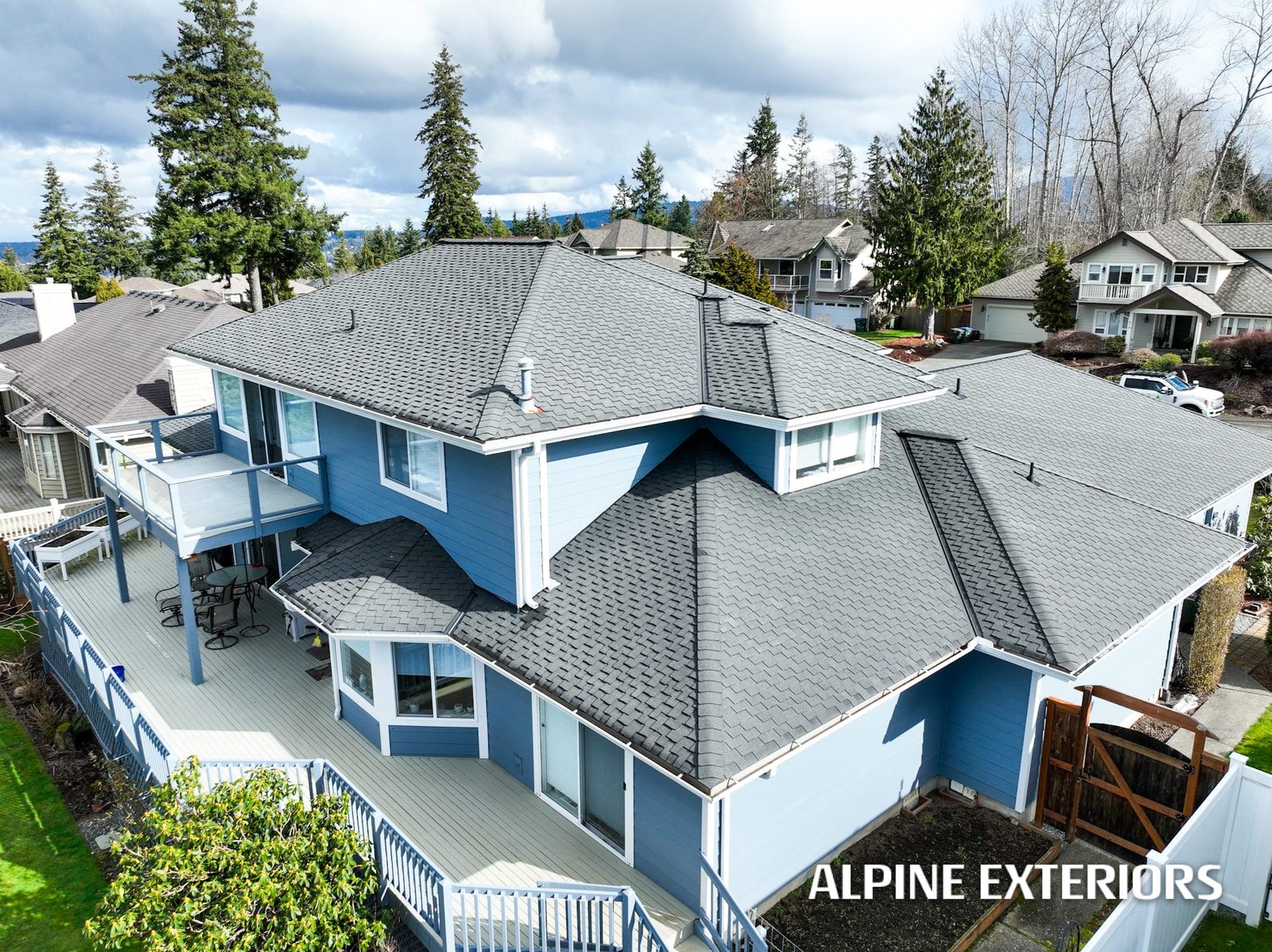
In broad terms, 5-inch gutters are a reasonable fit for smaller homes, single-story ranch layouts, additions, garages, and roofs with modest, simply-shaped planes that don't concentrate a lot of water in one spot. 6-inch gutters are the better call for larger roofs, homes with steep pitches or long roof runs, houses with multiple valleys that funnel water into one section of gutter, and almost any two-story home in this region given how much rain volume our winters produce. If your house sits under conifers that drop needles and cones, or you've had overflow at the corners during heavy storms in past winters, that's usually a sign the existing 5-inch system is undersized for the roof it's serving, and 6-inch is worth the upgrade even on a moderate-size house.
Five-inch K-style gutters are the standard size found on most production homes built in the region over the past few decades, and they remain a sound, economical choice for the right roof. They handle typical Pacific Northwest drizzle and moderate rain without issue, they're lighter to install and easier to source in a range of colors, and on a smaller roof footprint — a single-story cottage in Sedro-Woolley or a detached garage, for example — they'll carry the water load just fine for the life of the system.
The tradeoff shows up during the heaviest rain events of the season, particularly when a roof has more than one valley draining into a short run of gutter, or when a shaded roof is shedding moss and debris that partially blocks the trough. A 5-inch gutter has noticeably less cross-sectional capacity than a 6-inch one, so it reaches its limit faster, and once it does, water sheets over the front edge rather than reaching the downspout. That's a bigger issue in this region than it sounds, since overflow during a saturated winter can find its way behind fascia boards or into a crawlspace faster than homeowners expect. Five-inch systems also tend to need gutter guards or more frequent cleaning on tree-heavy lots, since there's less room for debris to sit without restricting flow.
Six-inch gutters hold meaningfully more water and move it to the downspouts faster, which is the main reason we install them on most of the larger and steeper roofs we work on from Burlington to Bellingham. On a two-story home, or any house where multiple roof planes and valleys concentrate runoff into a short stretch of gutter, the extra capacity is the difference between a system that handles a heavy December storm cleanly and one that overflows at the worst possible moment. Six-inch systems also pair well with larger 3x4 downspouts, which move water off the roof faster than the smaller downspouts typically paired with 5-inch runs — a real advantage when a storm rolling in off the Strait dumps an inch of rain in a few hours.
The downsides are modest but real. Six-inch gutters cost more per foot in material and labor, they're visually a bit heavier on a small or traditionally-styled home, and because they're less common on older houses, matching existing fascia brackets or trim during a partial replacement can take extra planning. They're also marginally more visible from the ground, which matters to some homeowners on a craftsman or cottage-style house where a slimmer profile fits the architecture better.
Here's how the two sizes compare directly on the factors that matter most to homeowners in this region:
| Factor | 5-Inch Gutters | 6-Inch Gutters |
|---|---|---|
| Typical installed cost | Lower — generally the more budget-friendly option per linear foot | Moderately higher, largely due to more material and heavier-duty hangers |
| Lifespan (aluminum, this climate) | Similar material lifespan, but corner and seam stress from repeated overflow can shorten effective service life on undersized systems | Similar material lifespan, with less stress from water volume, which tends to keep seams and end caps intact longer |
| Maintenance | Needs more frequent cleaning on shaded, moss-prone, or conifer-heavy lots since debris fills the smaller trough faster | More forgiving of moss and needle debris between cleanings, though it still needs seasonal maintenance |
| Appearance | Slimmer, lower-profile look that suits smaller or traditionally-styled homes | Slightly more visible from the ground; scales better on larger, two-story, or contemporary homes |
For most of the homes we see in Mount Vernon, Burlington, and Sedro-Woolley — particularly single-story houses with straightforward roof lines — a well-installed 5-inch system with a reasonable number of downspouts still performs well, and there's no need to spend more than the roof requires. Where we steer clients toward 6-inch gutters is on larger or multi-plane roofs, homes with several valleys, two-story houses anywhere in the service area, and almost any home on Camano Island, in La Conner, or along Anacortes' shoreline where salt air and wind-driven rain put extra stress on the drainage system. Properties near Stanwood and Bellingham that sit under mature fir or cedar cover are another case where the added capacity of a 6-inch gutter buys real breathing room between cleanings, since moss and needle debris eat into usable capacity faster than most homeowners expect. Homes closer to the foothills that see occasional freeze-thaw cycles and light snow in a cold winter also benefit from the larger system, since ice sitting in a narrow 5-inch trough restricts flow more severely once a thaw sends meltwater down the roof. When we quote a job, Alpine Exteriors looks at roof square footage, valley count, downspout placement, and tree cover before recommending a size — it's a decision that should be made from the actual roof, not a blanket rule.
Yes, and it's fairly common. A garage or single-story addition might do fine with 5-inch gutters while the main two-story roof gets 6-inch gutters and larger downspouts, as long as the transition points are flashed and fastened correctly.
No — larger gutters reduce how quickly debris restricts flow, but they don't prevent moss and needles from collecting. Homes under heavy tree cover in this region still need regular cleaning, or gutter guards, regardless of size.
Straightforward gutter replacement on an existing home typically doesn't require a separate building permit in most local jurisdictions, but downspouts and drainage still need to route water away from the foundation per the adopted Washington State Building Code. If gutter work is part of a larger reroof or structural project, check with your local building department before starting.
Not necessarily. On a small, single-story home with a simple roof and no history of overflow, 6-inch gutters are a reasonable upgrade but not a requirement — the extra cost is better justified on larger roofs, homes with multiple valleys, or properties dealing with heavy tree debris or wind-driven rain.
The right gutter size depends on your specific roof — its pitch, valleys, tree cover, and how it has performed during past winter storms — not a one-size-fits-all rule. Alpine Exteriors, WA contractor license ALPINI751OW, measures and assesses roofs across Skagit, Island, and Whatcom counties, from Mount Vernon and Anacortes to La Conner, Stanwood, Camano Island, and Bellingham, and can tell you plainly whether your home needs 5-inch or 6-inch gutters before any work begins. Reach out for an on-site assessment and a straightforward recommendation based on your roof, not a default size.