
Most of the dripping skylights, musty attic smells, and mystery ceiling stains we see on Camano Island come from the same root problem: warm, moisture-laden household air is getting trapped in the attic instead of moving back outside. Skylights make the symptom obvious because their shafts and glazing give that trapped moisture a cold surface to land on, but the real fix is almost always balanced attic airflow, correct insulation levels, and better skylight detailing working together — not just re-caulking whatever spot happens to be dripping today.
A healthy attic works like a chimney for excess moisture. Every household produces water vapor from showers, cooking, laundry, and simply breathing, and in winter that vapor wants to rise into the coolest part of the building envelope, which is usually the attic. If the attic has enough intake ventilation low at the eaves and enough exhaust ventilation high at the ridge, that moist air keeps moving and exits before it can condense. If either side of that airflow path is blocked, undersized, or missing, the air stalls, cools against the underside of the roof structure, and turns back into liquid water — the same physics that fogs a cold glass of water on a summer day, just running in reverse.
Skylights complicate this because a skylight shaft is essentially a tube of drywall running through the coldest part of the house, often with little or no insulation of its own around the light well. Warm indoor air condensing directly on the glazing is one thing — most double- and triple-pane skylights with a decent low-E coating and a built-in condensation channel handle that reasonably well — but the bigger issue is usually the shaft itself. Where the shaft framing meets the roof structure, insulation gets compressed, gapped, or skipped entirely, and that thin spot becomes a cold zone that condenses moisture and drips down the inside of the shaft, showing up as a stain around the interior trim even though the roofing above is bone dry and the flashing is doing its job perfectly.
How a skylight was installed in the first place matters here too. Curb-mounted skylights sit on a raised wooden curb that gets flashed like a small chimney, while deck-mounted units sit closer to the roof plane with a manufacturer-supplied flashing kit. Both can perform well when installed to spec, but a curb that isn't fully insulated on its interior faces, or a deck-mounted unit installed with a generic flashing kit instead of the one engineered for that model and roof pitch, both create the same kind of cold bridge that invites condensation regardless of how good the glass itself is.
This is also why so many suspected roof leaks that trace back to a skylight turn out not to be leaks at all. Water intrusion from a genuine flashing failure tends to show up during or right after a storm, tracks with wind direction, and often leaves a mineral- or dirt-tinged stain. Condensation shows up on cold, still mornings regardless of whether it rained, leaves a cleaner water stain, and is frequently worse after a shower, after cooking, or after a dryer that vents indoors by mistake. Telling the two apart before opening anything up saves a homeowner from paying for a re-flash when the real fix is a bathroom fan duct that was never actually connected to a roof or wall cap.
Attic conditions are also inseparable from indoor air quality and moisture below the main floor. On Camano Island's older homes especially, a damp, unvented crawl space pushes moisture up through the floor system the same way a poorly vented attic traps it at the top, and the two problems often show up together in the same house. An intact ground vapor barrier in the crawl space, paired with balanced attic ventilation, does more for whole-house comfort and energy efficiency than addressing either area on its own — an attic that's damp enough to condense is also damp enough to grow mold on the roof sheathing and any exposed insulation facing, and that air exchanges with living space more than most owners realize, through can lights, attic hatches, plumbing chases, and the top plates of interior walls.
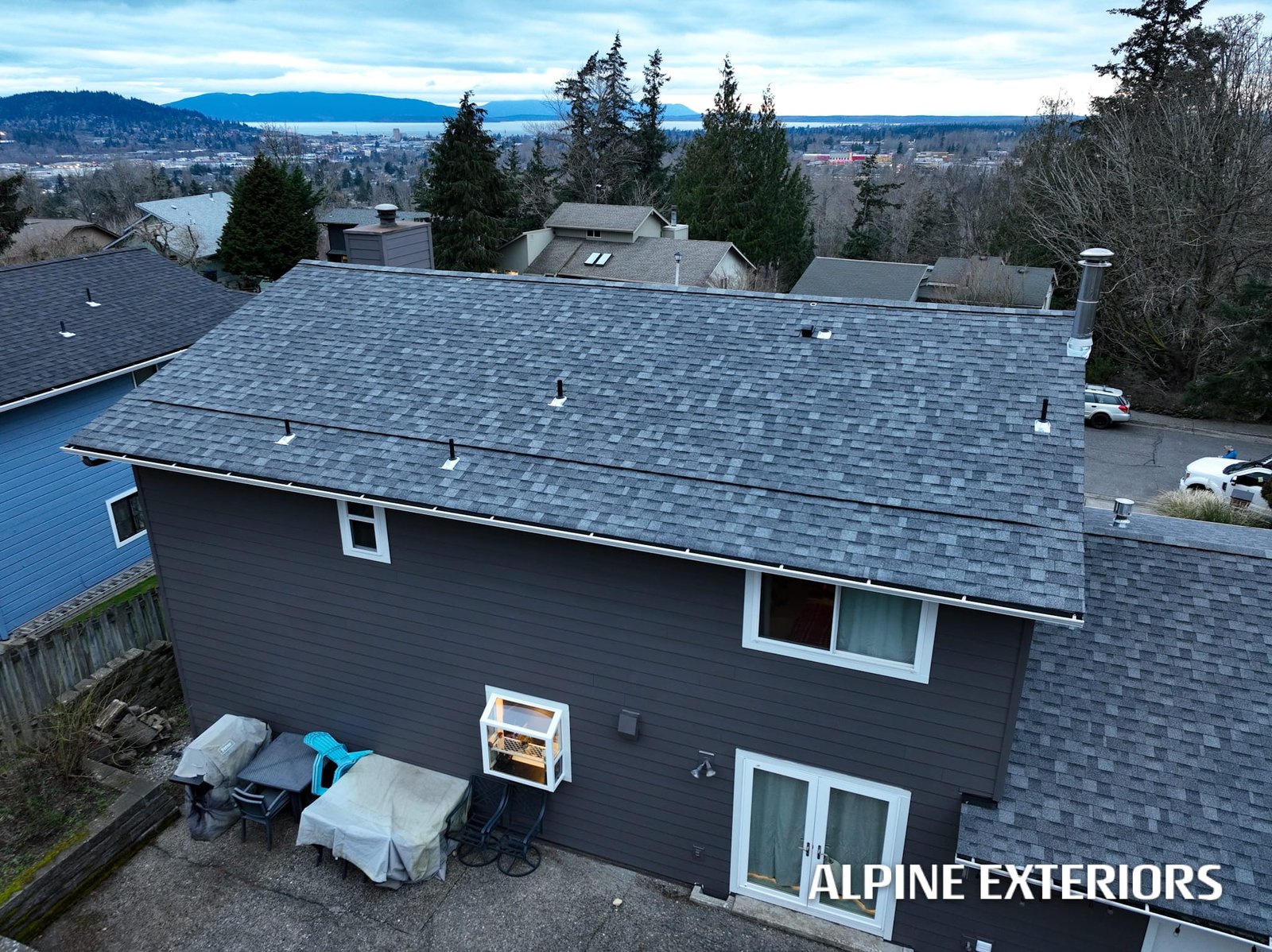
Camano Island and the rest of Island County sit inside the Puget Sound marine layer, which means the outdoor air itself carries a lot of moisture for a large share of the year — this isn't a dry-climate problem where opening a vent solves everything by itself. Relative humidity outside routinely runs high enough that ventilation alone can only do so much; it has to be paired with controlling moisture at the source — bath fans, dryer vents, crawlspace vapor barriers — rather than assuming outside air will always be drier than attic air.
The island's tree canopy is another local factor that doesn't come up in drier parts of the state. Homes tucked under fir and cedar cover around Camano, Stanwood, and Utsalady stay shaded and damp longer after a storm front passes through, which slows roof drying and encourages moss on north-facing and low-slope sections. Moss holds water against shingles and can work its way under tabs and around skylight curbs over a few seasons, and it also tends to clog the low-profile intake vents built into some soffit systems, quietly starving the attic of fresh air even while the ridge vent up top looks perfectly clear.
Salt air off Saratoga Passage and Port Susan is a real, if often underestimated, concern for waterfront and near-shore properties on Camano. It accelerates corrosion on unpainted or lower-grade metal ridge vents, skylight flashing, and fastener heads faster than the same products wear inland toward Sedro-Woolley or Burlington. We generally recommend coated or stainless fasteners and marine-rated flashing metals for anything within roughly a mile of saltwater, since the added cost up front is small compared to re-flashing a skylight after five or six years instead of fifteen.
Wind is a factor too, though it looks different here than the storm damage some national guides describe — there are no hurricanes in this part of Washington. What we actually deal with is sustained wind funneling down the Skagit flats and across open water around the island, which puts real uplift pressure on ridge vents, turbine vents, and skylight flashing edges that weren't fastened to spec. A vent or flashing detail that would hold up fine in a sheltered inland yard can work loose over a few winters on an exposed bluff-top or waterfront lot on Camano.
Snow and ice are occasional rather than routine here — Camano Island itself rarely holds snow for long, though nearby foothill areas toward the Cascade approach see it more often — but when a cold snap does hit alongside a poorly ventilated attic, the classic ice-dam pattern can still form: heat escaping through the roof structure melts snow near the ridge, that meltwater refreezes at the colder eaves, and it backs up under shingles right where a skylight curb often sits. It's not a yearly event, but it's common enough that we still detail eave protection and vent placement as if it could happen, rather than skipping that step because the last few winters were mild.
Finally, all of this sits inside the framework of the Washington State Energy Code, which sets minimum insulation R-values for attics and ceilings and expects a code-compliant approach to air-sealing and vapor control in the building envelope. Any attic re-insulation, skylight replacement, or significant ventilation upgrade on a Camano Island home should be planned with those code minimums in mind — not as a bureaucratic hurdle, but because the code's requirements are aimed at preventing exactly the condensation and heat-loss problems described above.
Start with a careful look rather than a demolition project. Most attic and skylight condensation problems can be diagnosed from a detailed, comprehensive inspection before anyone cuts into drywall or pulls roofing, and a lot of the fix is airflow correction, air-sealing, and targeted repair rather than a full insulation tear-out.
| What you're seeing | Most likely cause | What usually fixes it |
|---|---|---|
| Drip or stain around a skylight only on cold, calm mornings | Condensation on the shaft or glazing, not roof leakage | Insulate and air-seal the shaft; confirm nearby fan ducting vents outdoors |
| Musty smell in upstairs bedrooms | Attic air exchanging with living space through gaps and fixtures | Air-seal attic penetrations; confirm balanced intake and exhaust venting |
| Moss buildup on the north-facing roof slope | Shade, slow drying, and possibly blocked soffit intake vents below | Moss treatment plus a soffit vent check, not a roof cleaning alone |
| Stain that appears only during or right after a storm and tracks with wind direction | Actual flashing or shingle water intrusion | Flashing repair or replacement at the specific entry point |
| Rusting or streaking at ridge vent or skylight flashing | Salt air corrosion on standard-grade metal or fasteners | Replace with coated or stainless components |
Alpine Exteriors works through this same sequence on every Camano Island attic and skylight call: a comprehensive assessment of ventilation, insulation, and skylight detailing together, consistent communication about which findings are cosmetic and which affect the roof structure, and a written scope before any repair work begins. Because comfort, energy efficiency, and moisture control are all tied to the same airflow system, we'd rather explain the whole picture below the shingles than sell a single patch that only addresses the symptom a homeowner happened to notice.
In most cases it's condensation, not a leak — the giveaway is timing. Condensation tends to appear on calm, cold mornings whether or not it rained recently, and it's often worse after a shower or when the heat has been running. A true flashing or shingle leak usually shows up during or shortly after a storm and tracks with wind direction. A quick way to narrow it down without opening anything is to note whether the moisture shows up on dry, cold days — if it does, look at insulation and airflow around the shaft before assuming the roofing itself has failed.
The right amount depends on the attic's square footage, roof pitch, and whether the insulation includes a vapor retarder, which is why the Washington State Energy Code and standard building practice use a net free area ratio rather than one fixed number for every house. What matters just as much locally is balance: on a shaded, moss-prone Camano lot, it's common to find a ridge vent that looks adequate on paper paired with soffit intake vents that are painted over, insulated over, or clogged with debris, which defeats the whole system even though the exhaust side looks fine from the ground.
It's occasional rather than routine here, since the island rarely holds snow for long compared to areas closer to the Cascade foothills, but a poorly ventilated attic combined with even a short cold snap can still produce ice damming at the eaves. Because it doesn't happen every winter, it's easy to underestimate — we still recommend detailing eave protection and vent placement as if a cold snap could hit, since retrofitting after the fact is more disruptive than building it in during a re-roof or skylight replacement.
Usually not by itself. More insulation reduces the heat reaching the roof structure, which helps, but if intake and exhaust ventilation are unbalanced, or a bathroom fan is still venting into the attic instead of outside, moisture will keep finding the coldest available surface to condense on. The most reliable results come from addressing insulation, airflow, and moisture sources together, based on the specific needs and conditions of your attic, rather than treating any single one of them as a complete fix.
If you're dealing with a damp attic, a sweating skylight, or a ceiling stain you can't quite explain, Alpine Exteriors can walk your roof and attic in person and tell you honestly whether you're looking at a ventilation and moisture issue, an aging skylight that needs replacing, or an actual flashing repair — and what it would take to fix whichever one it turns out to be. We're a licensed Washington contractor, license ALPINI751OW, serving Camano Island alongside the rest of Island, Skagit, and Whatcom counties, including Stanwood, Mount Vernon, Anacortes, La Conner, Burlington, Sedro-Woolley, and Bellingham. Reach out for a detailed, no-pressure inspection before the next wet season sets in.