
If your property sits inside Mount Vernon's city limits, the City of Mount Vernon Building Division is the office that reviews and issues your roofing permit. If your address is just outside the city line in unincorporated Skagit County — much of the land between Mount Vernon, Burlington, and La Conner — Skagit County Planning & Development Services handles it instead.
Many homeowners assume a Mount Vernon mailing address means the city handles the permit, but the city's boundaries have grown in patches over the decades, so a property can carry a Mount Vernon zip code and still fall under county jurisdiction. The fastest way to confirm which office applies to you is to look up your parcel on the county's online parcel viewer, or simply call whichever office is closer and ask — they can tell you in a minute whether you're inside city limits. Sedro-Woolley, Burlington, Anacortes, and La Conner each run their own building departments too, so if a job sits near one of those town lines, it's worth double-checking rather than assuming.
In Washington, roofing work is regulated under the state building code — locally adopted versions of the International Residential Code and International Building Code, as amended by the Washington State Building Code Council — and most jurisdictions in Skagit County require a permit any time you tear off and replace roof covering, not just when you're altering the structure. A full re-roof, a partial re-roof that exposes the sheathing, replacing damaged decking, adding or enlarging a skylight, installing rooftop solar, or changing the roofline itself (a new dormer, a raised ridge, converting a low-slope section to conventional framing) — all of these typically require a permit, and in most cases the licensed roofing contractor pulls it before work starts.
Small maintenance items are usually the exception: patching a localized leak, replacing a handful of damaged shingles in one section, clearing moss and debris, or resealing a run of flashing generally doesn't rise to the level of a permitted project. But the line between "repair" and "re-roof" is judgment-based, and it's the building official who draws it — not the contractor and not the homeowner. If a roofer proposes stripping the roof down to the deck and starting over, that's a permit every time, regardless of which material goes back on.
One thing that catches people off guard: once the deck is exposed on a full tear-off, the Washington State Energy Code can come into play. If the project exposes ceiling insulation, adds insulation, or changes attic or roof ventilation, the inspector may check that insulation levels, air sealing, and ventilation meet current energy code minimums for that assembly. This tends to matter more on older Skagit County farmhouses and 1970s-80s houses than on homes built to a more recent code cycle.
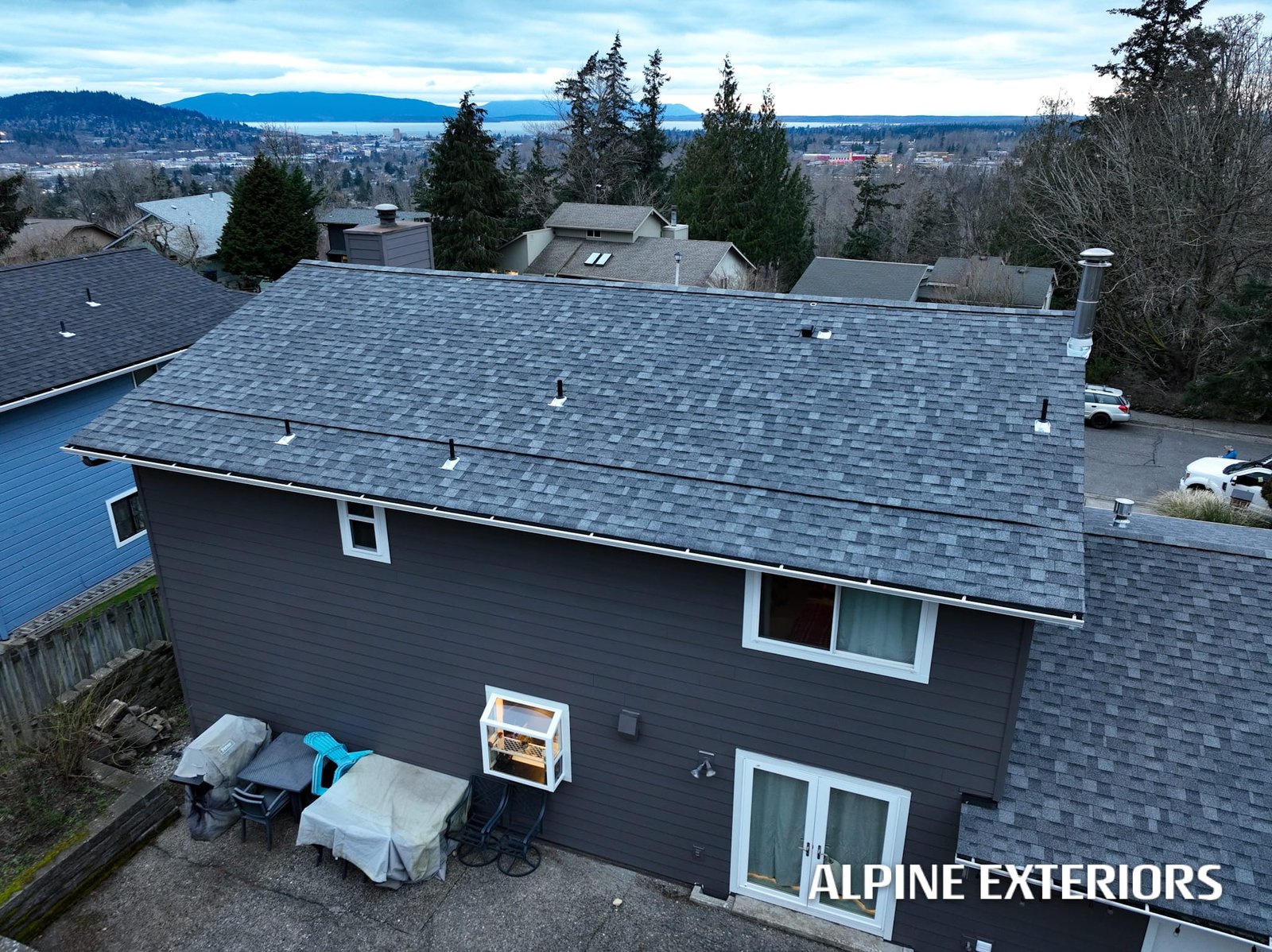
Skagit, Island, and Whatcom county roofs deal with a specific combination of stresses that shapes both the permitting conversation and the inspection itself. Winters here bring long stretches of steady rain rather than isolated storms, so underlayment, flashing details, and eave protection matter more than they would somewhere drier. Inspectors pay close attention to how valleys, chimneys, and roof-to-wall transitions are flashed, because a mistake there shows up as a leak within a season, not years later.
Moss is a constant issue on shaded roofs, especially north-facing slopes and anything under fir or cedar canopy — common in Mount Vernon's older neighborhoods, on Camano Island, and around Anacortes. Moss itself isn't a permit trigger, but moss damage that has worked its way under shingles and rotted the decking underneath often turns a "just clean it" job into a full re-roof once a contractor gets a real look, which is usually when the permit conversation starts.
Wind is the other regional factor. The Skagit flats are open farmland with little to break the wind, and gusts channel across that open ground and off the Strait of Juan de Fuca and Puget Sound with real force during fall and winter storms. Out on the islands — Camano and the water-facing parts of Anacortes and La Conner — that wind carries salt air, which accelerates corrosion on exposed fasteners, flashing, and metal roofing when the wrong materials are used. None of this is hurricane-country wind loading, but it's enough that fastening patterns, underlayment class, and edge metal choices are worth getting right, and it's part of why inspectors look closely at the fastening schedule on steep-slope work.
Snow and ice are occasional here rather than constant, showing up more toward the foothills than right in Mount Vernon or out on the islands, but a hard freeze after a wet stretch can still create ice damming at the eaves of shaded, poorly ventilated roofs. Many local building departments ask for a self-adhering ice and water membrane at eaves and valleys as a result, particularly on lower-slope sections — worth confirming with your contractor before the permit application goes in.
Before signing a contract, confirm which jurisdiction covers the property — the City of Mount Vernon Building Division inside city limits, Skagit County Planning & Development Services just outside it. The county's online parcel viewer will settle it in under a minute if the mailing address alone leaves you guessing. From there, a few practical steps keep the project out of trouble:
Alpine Exteriors pulls permits directly as part of every roofing contract in Mount Vernon and the surrounding area, and walks homeowners through which inspections to expect before the crew ever shows up — not after the fact.
In most cases, yes, if the work is a full or substantial re-roof rather than a small repair. Replacing the roof covering — even shingle-for-shingle with no structural changes — typically requires a permit in Mount Vernon and in unincorporated Skagit County, because the building department wants to confirm the new underlayment, flashing, and ventilation meet current code. Patching a small damaged section is usually treated differently than a full tear-off, but that call is made by the building official, not the contractor.
Timelines vary with the office's current workload and whether the application is complete, so it's worth asking directly rather than assuming a fixed number of days. A straightforward residential re-roof with no structural changes generally moves faster than a project that also touches framing, adds a skylight, or changes the roofline, since those require more plan review. Submitting a complete application with accurate roof area, material specs, and site information the first time is the biggest factor in avoiding delays.
Most residential re-roofs in this area get at least one inspection while the roof is open — checking deck condition, underlayment, flashing at valleys and penetrations, and ventilation — plus a final inspection once the new roofing material is installed and the job is complete. Larger or more complex projects, such as ones involving structural repairs or added skylights, may require additional inspections at framing or rough-in stages. Your contractor should schedule these directly with the building department and let you know when each one is happening.
Unpermitted roofing work can create real problems later even if the roof looks fine today. It can complicate or delay a home sale when it surfaces during inspection or title work, it can give an insurer grounds to deny a claim tied to the roof, and the building department can require the work to be opened back up and inspected after the fact — which costs more than doing it right the first time. It's rarely worth the risk to skip a step that a licensed contractor should be handling as part of the job anyway.
Alpine Exteriors handles roofing, window, deck, and gutter work across Skagit, Island, and Whatcom counties — Mount Vernon, Anacortes, Burlington, Sedro-Woolley, La Conner, Stanwood, Camano Island, and Bellingham — and holds Washington contractor license ALPINI751OW. If you're planning a re-roof in Mount Vernon or anywhere else in Skagit County and want a clear answer on permits, inspections, and what your roof actually needs before you commit, contact Alpine Exteriors for an on-site look and a written estimate — before any work, or any permit, gets pulled.