
When a windstorm blows through the Skagit Valley, the fastest way to limit damage is a prompt roof and exterior inspection, because missing shingles, lifted flashing and clogged gutters keep letting water into the house long after the wind itself has died down. Alpine Exteriors repairs storm-damaged roofs, gutters, siding and decks for homeowners across Skagit, Island and Whatcom counties, from Mount Vernon, Burlington and Sedro-Woolley out to Anacortes, La Conner, Stanwood, Camano Island and Bellingham.
Wind damage rarely looks dramatic from the ground. A few shingles curled up at the tab, a strip of ridge cap gone missing, a gutter pulled half off its hangers, a section of fascia board with a gap behind it. None of that stops rain, and it does not have to be a named storm to do it — a sustained afternoon blow off the flats is often enough. The problem is what happens over the following days and weeks, once the wind has stopped being the story.
Asphalt shingles are rated for a range of sustained wind speeds, but that rating assumes the shingles were installed correctly, sealed down, and are not already brittle from age or sun exposure. A gust does not need to tear a shingle off outright to cause a leak; it only needs to break the adhesive seal along one edge. Once that seal is broken, the shingle can lift again in the next gust, and wind-driven rain can work its way underneath even when the shingle looks intact from the driveway. This is why storm damage often shows up as a stain on a bedroom ceiling two or three rainstorms later, not as an obvious hole in the roof the day after the wind event.
Flashing is usually the second failure point. Step flashing along a chimney or dormer, and the counter-flashing over a deck ledger board, both rely on a tight mechanical fit plus caulking that degrades over years of weather exposure. Wind that flexes a roof plane even slightly can work a flashing edge loose, and once it is loose, water finds the gap on the very next rain. Gutters take damage a different way: wind loads a gutter full of fir needles and maple leaves, and a gust catches the whole run like a sail and pulls the hangers out of the fascia. A gutter hanging at the wrong pitch, or torn off a section entirely, dumps water straight down the siding and against the foundation instead of carrying it away, which is its own slower kind of damage.
Decks and siding see wind damage less often than roofs, but not never. Loose deck boards, a railing post that has worked free of its anchor, or lap siding with a nail that has backed out enough to let a board flap in a gust — all of these get worse with repeated wind events even if none of them look urgent after the first one.
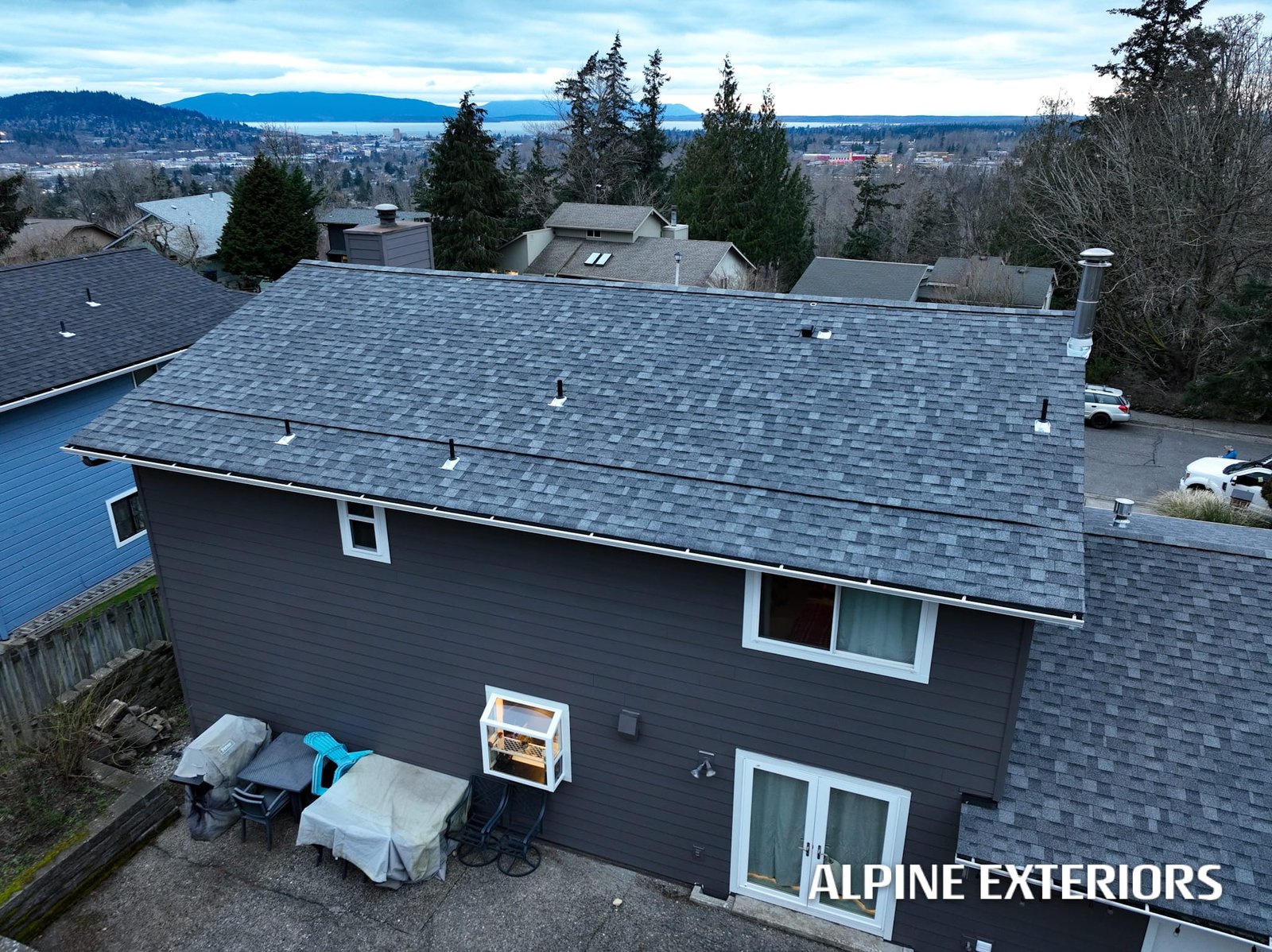
Skagit, Island and Whatcom counties are not hurricane country, and it is a mistake to treat storm-damage repair here the way a Gulf Coast or Atlantic coast contractor would. The wind that matters most locally comes off the open flats between Mount Vernon and Burlington, where there is little to break a gust before it hits a roofline, and off the Strait of Juan de Fuca and Rosario Strait around Anacortes and the San Juan approaches, where marine winds can arrive with little warning. On Camano Island and the western edge of Island County, that same marine air carries salt, which accelerates corrosion on exposed fasteners, gutter hangers and metal flashing faster than it would a few miles inland — a roof or gutter system near saltwater needs corrosion-resistant hardware, not just wind-rated shingles.
What compounds nearly every wind event here is what follows it. This region gets long stretches of heavy winter rain, and a wind-loosened shingle or flashing seam that would sit dry for months in a drier climate gets tested by rain again within days here. North-facing and heavily treed roof sections, common on lots around Sedro-Woolley and the wooded areas outside Burlington, hold moss and shade that keep the roof surface damp for longer, and damp shingles are more brittle and more prone to wind lift than dry ones. Up toward the foothills near the eastern edge of Skagit County, occasional ice and snow add a freeze-thaw cycle that can widen a wind-opened gap in flashing or shingle seal before anyone notices it. None of this is hurricane-force wind, but it is a specific, repeatable pattern: wind opens a small gap, regional rain finds it, and moss or freeze-thaw keeps it from closing on its own.
The Washington State Energy Code also matters here in a way it would not in a drier or milder climate. Roof and attic assemblies in this region are built and insulated to manage a lot of moisture, and a storm-opened gap that lets bulk water past the roofing layer can soak insulation and create condensation problems inside the assembly that go well beyond the visible leak. Repairs that only patch the surface without checking the underlayment and ventilation underneath can leave that moisture problem in place.
Costs for wind-damage repair in this region vary widely depending on the extent of the damage — a handful of shingles and a resealed flashing run is a modest repair, while a gutter system torn loose along one whole side of a house, or a roof section that needs new underlayment, is a larger job. Anyone quoting an exact number without seeing the roof first is guessing.
Most standard Washington homeowners policies cover sudden, wind-caused damage to a roof, siding, gutters or a deck, but the specifics depend on your policy — some carriers apply a separate wind or storm deductible, and older roofs may be subject to depreciation or an actual-cash-value settlement rather than full replacement cost. Read your declarations page or call your agent before assuming a repair is fully covered.
Within a few days is reasonable if there is no obvious active leak, and immediately if you see water inside the house. The risk with waiting longer is not the wind itself but the rain that follows it here — a loosened shingle seal or flashing gap that would sit fine in a dry week gets tested the moment the next Pacific system moves through.
Yes, in a specific way. Moss holds moisture against the shingle surface longer, which makes that section of roofing more brittle and more prone to lifting or cracking in wind, and it can also lift shingle edges just enough on its own to give wind something to catch. A roof with heavy moss, especially on a shaded north-facing slope common in this region, is worth inspecting even after a moderate wind event.
It depends on the scope. Straightforward like-for-like repairs, such as replacing a run of shingles or a section of gutter, typically do not require a permit in most jurisdictions across Skagit, Island and Whatcom counties. Structural repairs, deck rebuilds, or work that changes the roof assembly can require one. Your local building department, not a contractor's estimate, is the authoritative source, and a licensed contractor should be able to tell you when a permit applies to your specific job.
If a recent windstorm has left shingles missing, a gutter hanging loose, or a stain spreading across a ceiling anywhere from Mount Vernon to Bellingham, Anacortes to Camano Island, it is worth having someone look at it before the next round of Skagit Valley rain finds the gap. Alpine Exteriors is a licensed Washington contractor, license ALPINI751OW, and inspects and repairs storm-damaged roofs, gutters, siding and decks throughout Skagit, Island and Whatcom counties. A straightforward inspection can tell you whether you are looking at a small repair or something that needs a fuller look at the roof assembly underneath.