
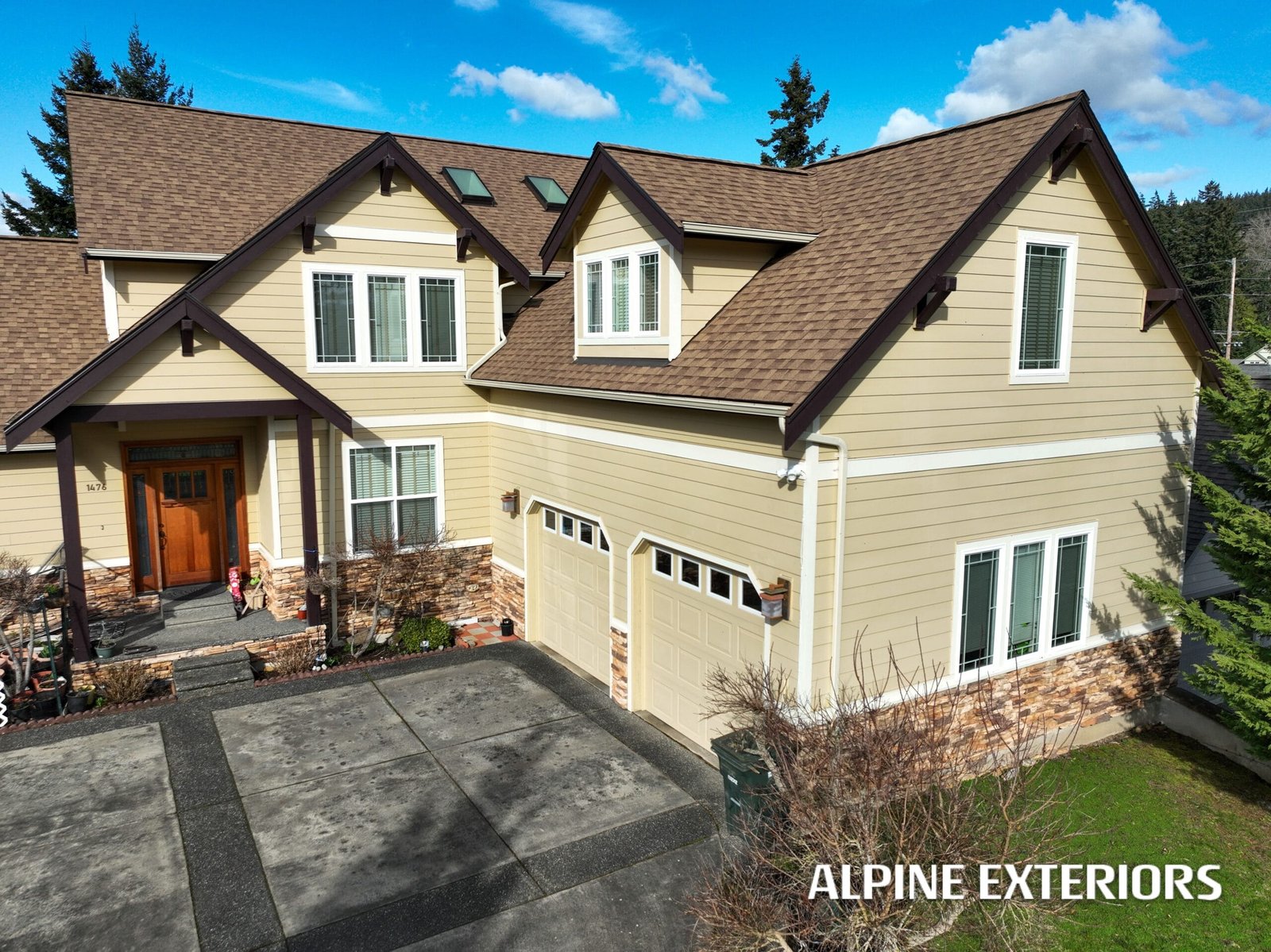
Coupeville sits on Whidbey Island in Island County, right on Penn Cove, which means every roof in town takes a steady diet of salt-laden air off the water, wind that funnels through the cove and across the open bluffs, and the long, wet winters that define this part of Washington. Homes here are often older farmhouses, bungalows, and craftsman-style houses with roofs that have already been through a few decades of that weather. Knowing the difference between a roof that needs a repair and one that has reached the end of its service life can save you from a much bigger, more expensive problem down the road. Below is a practical guide to the warning signs Alpine Exteriors sees most often on Coupeville and greater Island County roofs, what causes them locally, and how to decide what to do next.
Asphalt shingles are coated with small mineral granules that shield the underlying asphalt from UV light and rain. As a roof ages, those granules wear off and wash into the gutters, where you'll often find a gritty, sand-like buildup near the downspout outlets or in the splash zone below them. A little granule loss after a shingle roof is brand new is normal — it's leftover manufacturing debris. But steady, ongoing granule loss on a roof that's ten, fifteen, or twenty years old is a sign the shingles are thinning and losing their ability to protect against Island County's near-constant winter rain. Once the granule layer is significantly worn, the asphalt underneath dries out and becomes brittle faster, which speeds up the whole aging process.
Look at your roof from the ground or from a neighbor's driveway (never climb onto a wet or mossy roof yourself). Shingles that curl upward at the corners, cup in the middle, or look like they're lifting away from the roof deck have lost flexibility. In Coupeville's marine climate, shingles cycle through repeated wetting and drying, and salt air can accelerate the breakdown of the asphalt binders that keep shingles pliable. Curled or lifted edges are a direct entry point for wind-driven rain, and they're also more vulnerable to being torn off completely the next time wind funnels through Penn Cove or across the open bluffs above the water.
Moss is one of the most common roofing complaints on Whidbey Island, especially on north-facing roof planes, roofs shaded by fir and maple trees, and homes tucked into wooded lots away from direct sun. Skagit and Island County winters bring long stretches of overcast, damp weather that rarely lets a shaded roof fully dry out, which is exactly the environment moss needs to take hold. A light dusting of moss on a few shingles isn't an emergency, but thick moss mats holding moisture against the roof surface are a different story — they trap water under the shingle tabs, work their way under the edges as they grow, and can lift shingles enough to let water in. Dark streaking, which is usually algae rather than moss, is mostly cosmetic but can be a sign the roof is retaining more moisture than it should.
If you go into the attic on a sunny day and can see pinpricks or larger gaps of daylight coming through the roof deck, that's a clear sign the roof sheathing or flashing has failed somewhere. This often shows up first around nail pops, old skylight curbs, or places where flashing has separated from age or from the freeze-thaw cycling that occasionally happens during cold snaps in the Whatcom and Skagit foothills. Even small gaps let in wind-driven rain during a Puget Sound storm, and over time that moisture can rot the decking and framing, which turns a roofing project into a structural repair.
Brown or yellow stains on a ceiling, bubbling paint, or a musty smell in an upstairs closet usually mean water has already gotten past the roofing and underlayment. Sometimes the leak is coming from directly above the stain; other times water travels along a rafter or the underside of the decking and shows up several feet away, which makes leaks tricky to pinpoint from inside alone. Given how much rain Island and Skagit counties see between October and April, a leak that starts small in November can do real damage to insulation, drywall, and framing by the time spring arrives if it isn't traced and addressed.
Coupeville and the rest of Whidbey Island catch wind off both Puget Sound and the Strait of Juan de Fuca, and gusts funneling across Penn Cove or down the Skagit flats can be strong enough to lift or tear shingles, especially on roofs that were already showing curling or granule loss before the storm hit. After a windy night, walk the property line and look for shingle pieces or granules in the yard, and check the roofline for shingles that look out of place, torn, or missing outright. A roof that loses a cluster of shingles in one storm is often telling you the rest of the roof isn't far behind, even if the undamaged areas still look fine from the ground.
A roofline that dips, sags, or looks wavy when viewed along its length — rather than straight — is one of the more serious signs on this list. It can point to rotted decking, failed rafters, or, on some older homes, undersized framing that's been overloaded by accumulated moisture over the years. Soft or spongy spots you can feel when walking a flat or low-slope roof section (common on additions and porch roofs in this area) usually mean the decking underneath has absorbed water and is losing structural integrity. Sagging isn't something to wait on; it needs to be evaluated in person.
Flashing is the metal that seals the roof around chimneys, plumbing vents, skylights, and where two roof planes meet. It's often the first thing to fail on an otherwise sound roof, since it's held on with sealant and fasteners that degrade faster than the shingles around them. In Coupeville's salt air, metal flashing can corrode or rust years before it would inland, and cracked or dried-out sealant lets water track in around penetrations even when the shingle field itself still looks decent. Flashing problems are sometimes fixable without a full roof replacement, but they need to be caught before the leak spreads to the decking.
Most asphalt shingle roofs in this region are built and rated for somewhere in the range of 20 to 30 years, depending on the product and how the roof was ventilated and installed. A roof's actual lifespan in Island County can run shorter than the rating if it's heavily shaded, holds moss, or sits under trees that drop debris, and longer on a well-ventilated, sun-exposed roof with good maintenance. If your roof is approaching or past its expected service life and you're starting to see two or three of the other signs on this list together, that combination is usually a stronger signal than any single sign on its own.
Not every warning sign means the same thing, and it helps to sort them by how quickly they need attention.
Urgent — schedule an inspection soon: active leaks, daylight through the roof deck, a sagging or soft roofline, missing shingles after a storm that expose bare decking, or flashing that has visibly separated. These situations let water into the building envelope and can worsen quickly through a wet Island County winter.
Can be monitored: light-to-moderate moss on shaded areas, early granule loss on a roof that's mid-life, minor curling on a handful of shingles, or cosmetic algae streaking. These are worth tracking and addressing with roof cleaning or spot repairs, but they usually don't require an emergency response. That said, "can wait" doesn't mean "ignore" — conditions that are monitored today should be checked again each season, since moss and curling tend to spread rather than stay static.
The most useful first step is a roof inspection from someone who can get on the roof and in the attic, rather than trying to fully diagnose things from ground level. An inspection should look at the shingle condition across all slopes (not just the ones visible from the street), the flashing at every penetration, the state of the decking from inside the attic, and the ventilation, since the Washington State Energy Code's insulation and air-sealing requirements make proper attic ventilation more important than it used to be — a roof that traps moisture from poor ventilation ages faster no matter how good the shingles are. From there, a straightforward repair (a section of flashing, a cluster of shingles, a moss treatment) may solve the problem, or the inspection may show enough widespread wear that a full replacement is the more cost-effective path rather than repeatedly patching an aging roof. Either way, get a written scope of what was found and what's being recommended, and ask about the material and labor warranty being offered — a roof replacement is a meaningful investment, and it's reasonable to want to understand what you're covered for and for how long. Alpine Exteriors, licensed in Washington under ALPINI751OW, provides roof inspections and both repair and replacement work for homes throughout Coupeville and the rest of Island County, and can walk through what's actually needed before any work begins.
Cost depends heavily on the roof's size, pitch, the material chosen (standard asphalt shingles versus architectural shingles or metal), how much of the decking needs to be replaced, and site access on the property. Because of that variation, a fair estimate comes from an in-person inspection rather than a phone quote — but as a general range, homeowners in this region should expect asphalt shingle replacements to run from the mid four figures for a small, simple roof up to the low or mid five figures for a larger or steeper roof, with metal roofing typically costing more than shingles.
Sometimes, yes. If the damage is limited to one area — a flashing failure, a cluster of storm-damaged shingles, or a moss patch — a targeted repair can be the right call, especially on a roof that's otherwise mid-life and in decent shape. The calculation changes once a roof is old enough or worn enough across multiple slopes that repairs would just be treating one symptom at a time; at that point, a full replacement usually ends up being the more economical choice over the following several years.
Moss starts as mostly a cosmetic issue, but it doesn't stay that way if left unchecked. As moss mats grow, they hold moisture against the shingle surface far longer than the roof would otherwise stay wet, and their root-like structures can work under shingle tabs and lift them slightly, creating small gaps for water to enter. In a climate like Coupeville's, where shaded roofs can stay damp for days at a time in winter, moss that's been growing for a few years can meaningfully shorten a roof's service life even if no leak has shown up yet.
An annual inspection, ideally in fall before the wet season sets in, is a reasonable baseline for most roofs in this area, with an additional check after any unusually strong windstorm. Roofs near the water or under heavy tree cover — both common situations in Coupeville — can benefit from checking twice a year, since salt exposure and moss growth tend to progress faster than on a roof that's more sheltered and sun-exposed.
If your roof is showing one or more of the signs above, it's worth having it looked at before the next round of Island County winter rain arrives. Alpine Exteriors serves Coupeville and the surrounding Whidbey Island communities along with the rest of Skagit, Island, and Whatcom counties, and can provide a straightforward inspection, an honest read on repair versus replacement, and a clear estimate for whichever path makes sense for your home. Reach out to Alpine Exteriors to schedule a roof inspection and get a clear picture of where your roof actually stands.