
A roof on Camano or Whidbey Island has to handle salt-laden wind, long stretches of winter rain, and moss more than any single dramatic event. The roofs that fail early out here almost always fail for the same three reasons: fasteners that corroded faster than expected in marine air, moss that held moisture against shingles for months at a time, and flashing that was patched instead of replaced. None of that requires exotic materials to fix — it requires choosing the right materials for a marine climate and keeping up with maintenance a mainland roof could skip.
Camano and Whidbey don't get the intense, short-duration downpours some regions do. What they get instead is rain that falls in long, low-intensity stretches from roughly October through April, sometimes for days without a real break. That kind of moisture doesn't overwhelm a roof all at once — it finds the weak points over time. Flashing around chimneys, skylights, and roof-to-wall transitions is usually where a slow leak starts, because sealant ages and metal flashing that wasn't rated for coastal exposure begins to corrode from the edges in.
Moss is the other constant. Douglas fir, cedar, and madrona shade a lot of island roofs, especially on north- and east-facing slopes, and moss thrives in that combination of shade and moisture. It doesn't just look bad — moss holds water against the roofing material, and on asphalt shingles that constant dampness shortens the life of the granule layer that protects the shingle underneath. Left long enough, moss can lift shingle edges and give wind something to grab.
Salt air is the variable a lot of roofing crews from further inland underestimate. Galvanized fasteners and standard flashing that would last decades in Mount Vernon or Burlington can start showing corrosion within a handful of years on a waterfront lot on Camano or Whidbey, especially on the west-facing side that catches spray off the Strait. Alpine Exteriors specs stainless steel or heavy hot-dip galvanized fasteners and coastal-rated flashing on island jobs for exactly this reason — it costs a little more up front and pays for itself by not needing a fastener replacement job in year eight.
Camano and Whidbey rarely see the snow load or freeze-thaw cycling that inland foothill roofs deal with — the surrounding water keeps temperatures milder — but the islands aren't entirely immune to it. An occasional Arctic outflow event can bring a hard freeze and a skim of ice to exposed roof edges and gutters for a day or two, and that's more about drainage than structure: a gutter already clogged with moss debris is far more likely to ice over and back water up under the roof edge than a clean one.
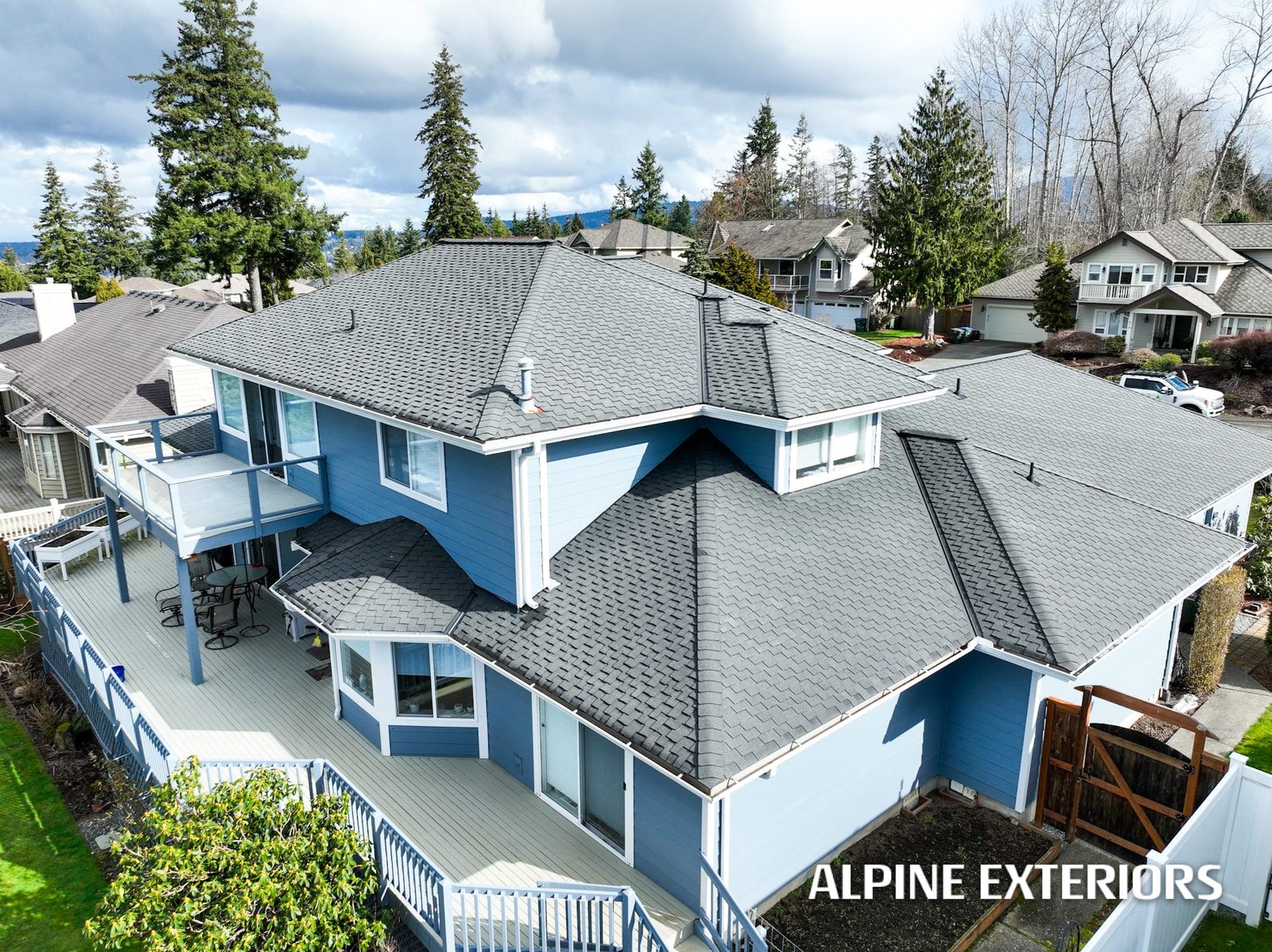
Ten miles can matter more here than it does almost anywhere else Alpine works. A roof on the Skagit flats near Burlington deals with open, sustained wind moving across flat farmland with very little to break it up. A roof on a Whidbey bluff facing the Strait of Juan de Fuca, or a Camano waterfront home facing Port Susan or Saratoga Passage, deals with wind carrying salt spray directly onto the roofing material — a different kind of stress that ages metal and fasteners faster than wind alone would.
Tree cover adds another layer. Inland lots in Sedro-Woolley or the foothills toward the Cascades occasionally see snow load and the freeze-thaw cycles that come with elevation; the islands almost never do, since the marine layer keeps temperatures moderate year-round. What the islands trade snow for is shade — mature conifer cover over many older island homes creates the damp, low-light conditions moss needs, in a way that open farmland roofs don't experience.
Logistics matter too, in a way that's easy to overlook. Whidbey Island is reachable by bridge from Deception Pass or by the Clinton-Mukilteo ferry, and Camano connects by a single bridge from Stanwood. Material deliveries, dump runs, and crew scheduling all have to account for that — a same-day fix on the mainland can turn into a multi-day job on the islands if materials or a specific part have to be brought over. Planning a reroof with some flexibility in the schedule matters more here than it does in Mount Vernon.
Most of what protects an island roof is unglamorous and preventable:
Reroofing costs vary by material and roof complexity, but as a rough guide, a standard asphalt shingle reroof on an island home typically falls somewhere in the $9,000–$20,000 range depending on size, pitch, and how much of the old roof has to be torn off. Metal roofing generally runs higher up front, often one and a half to two and a half times an asphalt job, but holds up longer against wind and salt exposure, which can make sense on a particularly exposed bluff or waterfront lot.
Alpine Exteriors works island jobs regularly enough to plan around the ferry and bridge logistics rather than get surprised by them, and to spec materials for salt exposure by default rather than as an upsell.
Once a year is a reasonable baseline for most island homes, with an extra check after any significant windstorm. Waterfront and bluff-facing homes exposed to direct wind off the Strait or Saratoga Passage benefit from a closer look, since salt spray accelerates fastener and flashing wear in ways that aren't always visible from the ground.
It's more than cosmetic. Moss holds moisture against the roofing surface for extended periods, which on asphalt shingles wears down the protective granule layer faster than normal weathering would, and thick moss growth can lift shingle edges enough for wind to get underneath them. It's worth treating even on a roof that otherwise looks fine.
There's no single material that's immune to marine exposure — what matters more is the grade of fasteners and flashing paired with it. Quality asphalt shingle systems, metal roofing, and composite products can all perform well on Camano or Whidbey when installed with stainless steel or heavy hot-dip galvanized hardware and flashing rated for coastal use; the failure point is almost always the hardware, not the field material.
In most cases, yes. Island County and Skagit County both require permits for reroofing work, and a licensed contractor pulling the permit means the finished roof gets inspected against current code rather than relying on the installer's word alone. It's worth confirming permit status in writing before work begins.
If you're weighing a repair versus a full reroof on a Camano or Whidbey Island home, an on-site look tells you more than any general guide can — every lot's tree cover, wind exposure, and roof age are different. Alpine Exteriors, WA contractor license ALPINI751OW, serves Camano Island and the surrounding Skagit, Island, and Whatcom county communities and can walk your roof, flag what's actually a problem versus what's cosmetic, and give you a straightforward assessment of what it would take to fix it right.