
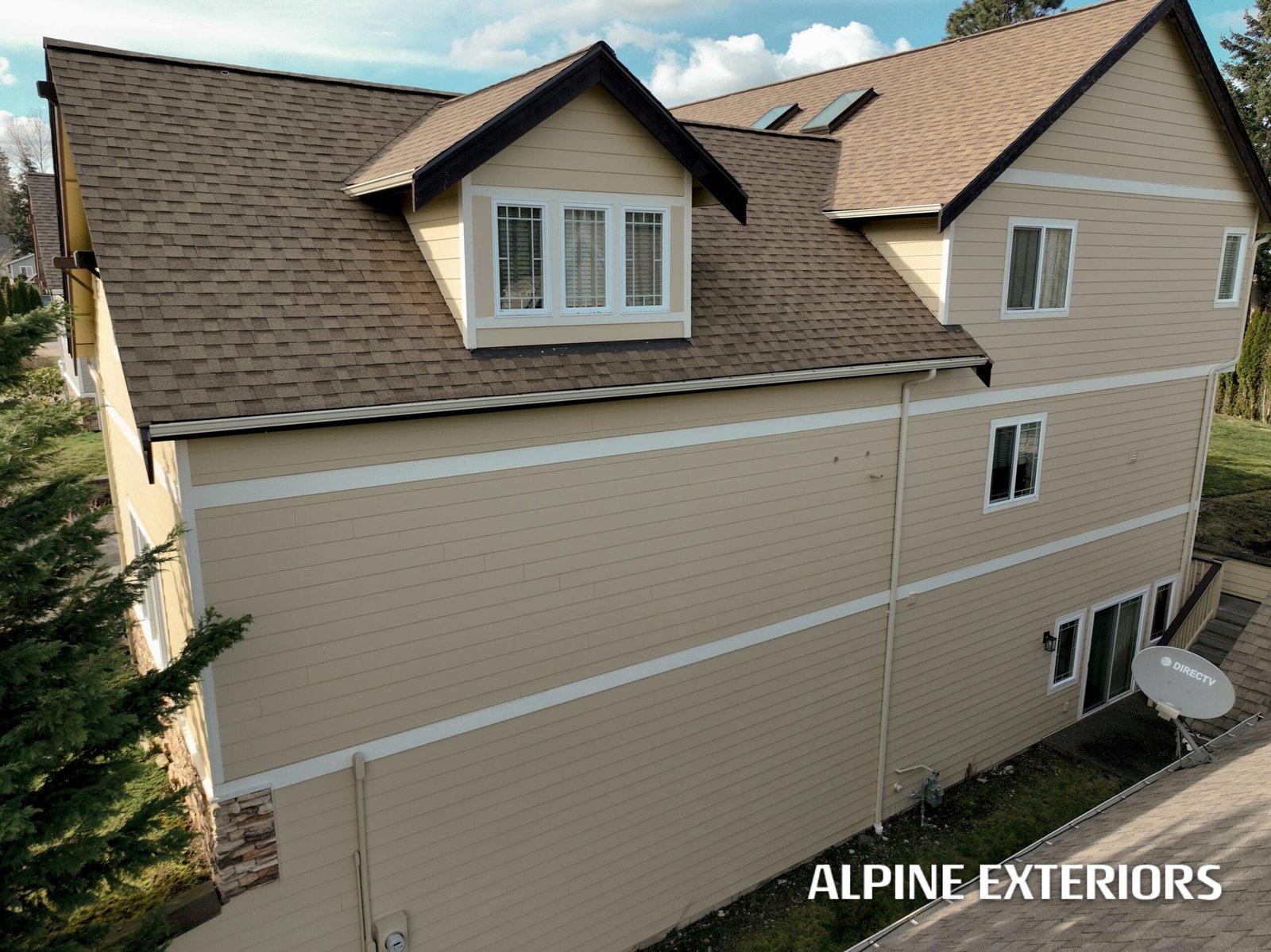
In Sedro-Woolley, the roofs that fail early almost never fail because the shingles simply wore out — they fail because moss held moisture against the roof deck for months at a time, or because gutters couldn't keep pace with a wet Skagit County winter and water backed up under the roofing material. Deal with both of those — moss control and real drainage capacity — and most of what goes wrong with a roof in this part of Washington becomes preventable rather than inevitable.
That's the practical takeaway. The rest of this guide explains why moss and rain behave the way they do in Sedro-Woolley specifically, what's different about this stretch of Skagit County compared with the coastline or the open flats nearby, and what a homeowner can realistically do about it — including the limits of what's worth doing yourself.
Moss needs three things to establish itself on a roof: shade, organic debris, and moisture that doesn't dry out between rain events. Sedro-Woolley checks all three boxes more consistently than most of the towns Alpine Exteriors serves. The town sits close to the timbered foothills of the Cascades, and a large share of its homes — especially older ones on wooded lots along the Skagit River corridor — sit under or near stands of Douglas fir, cedar, and bigleaf maple. Those trees drop needles and leaf litter into roof valleys and behind chimneys year-round, and that debris does two things: it holds water against the shingle surface, and it gives windborne moss spores something to root into.
Once moss gets a foothold, it behaves differently than most people expect. It doesn't just sit on top of the shingles — its rhizoids work down into the granule layer and lift shingle tabs slightly as it grows, which breaks the shingle's seal against wind-driven rain. Underneath a moss mat, the roof deck stays damp far longer than an exposed section of the same roof, because the moss itself is retaining water like a sponge. On a roof that gets afternoon sun, that moisture evaporates off within a day or two. On a north-facing slope shaded by conifers — extremely common on Sedro-Woolley lots — it can stay damp for a week or more after a storm, right through the next round of rain. Over several winters, that sustained dampness is what leads to soft, rotted decking and premature shingle failure, not simply the number of years since installation.
Gutters compound the problem. Needle debris that washes down from a mossy roof collects in the gutter troughs, and a gutter that's even partially clogged during a heavy rain event backs water up under the shingle edge or the ice-and-water shield at the eaves. That's a slower, quieter form of damage than a dramatic leak, and it's often not visible from the ground — which is exactly why it tends to go unaddressed until there's staining on an interior ceiling.
Alpine Exteriors works across Skagit, Island, and Whatcom counties, and roofs behave differently from one town to the next depending on exposure, elevation, and tree cover — not just rainfall totals. Sedro-Woolley's profile is distinct in a few specific ways.
First, it's inland and closer to the foothills than Anacortes, La Conner, or Camano Island, so it doesn't get the salt-laden air off the Strait of Juan de Fuca or Puget Sound that accelerates corrosion on fasteners, flashing, and metal roofing along the waterfront. That's one less thing to worry about here. What Sedro-Woolley trades that for is more consistent tree shade and, at times, colder overnight temperatures than the open Skagit flats around Mount Vernon or Burlington — cold air tends to settle and linger in the river valley on clear winter nights, which means roofs here see more frost and, in occasional cold snaps, a light freeze-thaw cycle that open, wind-exposed roofs elsewhere in the county don't experience as often.
Second, because Sedro-Woolley sits nearer the Cascade foothills, it's more likely than Mount Vernon or Stanwood to pick up an occasional snow or ice event in a given winter — not every year, and rarely heavy by regional standards, but enough that roofs with inadequate attic insulation or ventilation can develop small ice dams at the eaves during a cold snap following a wet stretch. That's a different failure mode than the wind-driven rain problems more common on exposed sites near the Skagit flats or the Strait, and it's worth homeowners here knowing the difference.
Third, wind matters less here than it does on the flats or the islands — Sedro-Woolley's tree cover and terrain break up the kind of sustained wind that comes off the open Skagit flats or funnels down the Strait toward Anacortes and Whatcom County's coastline — but falling and rubbing tree limbs are a bigger practical issue for roofs here than wind uplift on the shingles themselves.
Finally, attic ventilation and insulation aren't optional extras — they're governed by the Washington State Energy Code, and they matter more in a shaded, moisture-heavy town like Sedro-Woolley than in a drier climate. Warm, moist household air that reaches a cold roof deck through inadequate insulation or blocked soffit and ridge venting condenses on the underside of the sheathing. That condensation adds to the moisture load a roof already carries from moss and rain, and over time it can rot decking from the inside even on a roof that looks fine from the street. A roof replacement or major re-roof is one of the more practical times to bring attic ventilation up to current energy code requirements, since the roof deck is already exposed.
None of this requires an elaborate maintenance program, but it does require doing the right few things on a schedule rather than waiting for a visible problem. In practical terms:
Worth being honest about: moss treatment isn't a one-time fix. On a shaded lot, moss will likely return within a year or two even after a thorough cleaning, which is why zinc/copper strips and a regular inspection schedule matter more than a single cleanup. And not every roof needs replacing just because it has moss on it — a lot of roofs with a moss problem are structurally sound underneath and just need cleaning, better drainage, and a maintenance habit going forward. Alpine Exteriors inspects for that distinction specifically, because recommending a full roof replacement when a cleaning and gutter fix would do isn't a service to the homeowner.
Steep or multi-story roofs, and any roof with moss established for more than a season or two, are not a safe DIY project — wet, moss-covered shingles are slippery in a way that's easy to underestimate, and conditions here stay wetter and shadier for longer stretches of the year than in most of Washington. That's the practical argument for having a licensed roofing contractor handle inspection and treatment on anything beyond a single-story, low-slope roof.
On a shaded, tree-covered lot — which describes a large share of Sedro-Woolley properties — plan on a moss inspection at least once a year and treatment roughly every one to two years, sooner if moss is visibly thickening on a north-facing slope. Open, sun-exposed roofs in town can often go longer between treatments. The right interval really depends on how much shade and debris a specific roof deals with, which is why a site-specific inspection is more useful than a fixed rule of thumb.
It's a real structural issue, not just an appearance problem. Moss rhizoids grow into the granule layer and lift shingle edges, which breaks the shingle's water seal, and the moss itself holds moisture against the roof deck for extended periods after rain. Left long enough, that sustained dampness leads to granule loss, shingle curling, and eventually soft or rotted decking underneath — the kind of damage that's expensive to repair precisely because it isn't visible until it's advanced.
It's not recommended. Pressure washing strips the protective granule coating off asphalt shingles, shortens the shingle's remaining life, and can force water up under the shingle edge or the underlayment, which creates the exact leak path homeowners are trying to avoid. A low-pressure treatment, hand removal on accessible sections, and zinc or copper strips near the ridge are safer and more effective for long-term moss control.
It matters more than most homeowners expect, especially in a shaded, damp town like Sedro-Woolley. Poor attic ventilation lets warm, moist indoor air condense on the underside of the cold roof deck, adding to the moisture load the roof already carries from rain and moss, and it can contribute to small ice dams at the eaves during an occasional winter cold snap. Bringing attic insulation and ventilation up to current Washington State Energy Code levels — often done at the same time as a re-roof, while the deck is already exposed — is one of the more cost-effective things a homeowner can do for long-term roof health.
Alpine Exteriors is a licensed contractor (WA license ALPINI751OW) serving roofing, window, deck, and gutter work across Skagit, Island, and Whatcom counties, including Sedro-Woolley, Mount Vernon, Burlington, Anacortes, La Conner, Stanwood, Camano Island, and Bellingham. If you're dealing with moss on a shaded roof, gutters that can't keep up with winter rain, or you just want an honest read on whether a roof needs cleaning, repair, or replacement, Alpine Exteriors can inspect the roof in person and lay out the actual options — including the ones that don't involve a full replacement. Reach out to schedule a roof inspection before the next round of fall rain sets in.