
If your home sits in or near Edison, on the flat farmland between the Samish River and Padilla Bay, your gutter system has three jobs it has to do well: hold up under sustained Pacific winter rain without overflowing, shed a near-constant drop of fir and cedar needles instead of a seasonal leaf-fall, and carry water far enough away from the foundation that it doesn't end up under the house. Most of the drainage problems we get called out for in this part of Skagit County trace back to one of those three getting missed, not to a defective gutter product.
Alpine Exteriors works on gutters, downspouts, roofs and siding across Skagit, Island and Whatcom counties, and Edison comes up often precisely because the ground here behaves differently than it does on higher, better-drained lots in Mount Vernon or Burlington. Getting gutter sizing and downspout routing right is inexpensive compared to what a chronically wet crawlspace costs to fix later.
Standard residential gutter is 5-inch K-style aluminum, and it's adequate for a lot of roofs. But on a typical Edison home with a moderate-pitch roof and full-length runs, heavy winter storm rainfall can exceed what a 5-inch gutter and a single undersized downspout can move before water starts sheeting over the front edge. Once that happens, water drops straight down along the foundation instead of into the downspout, which is exactly the pattern that leads to soggy planting beds and wet crawlspace access doors.
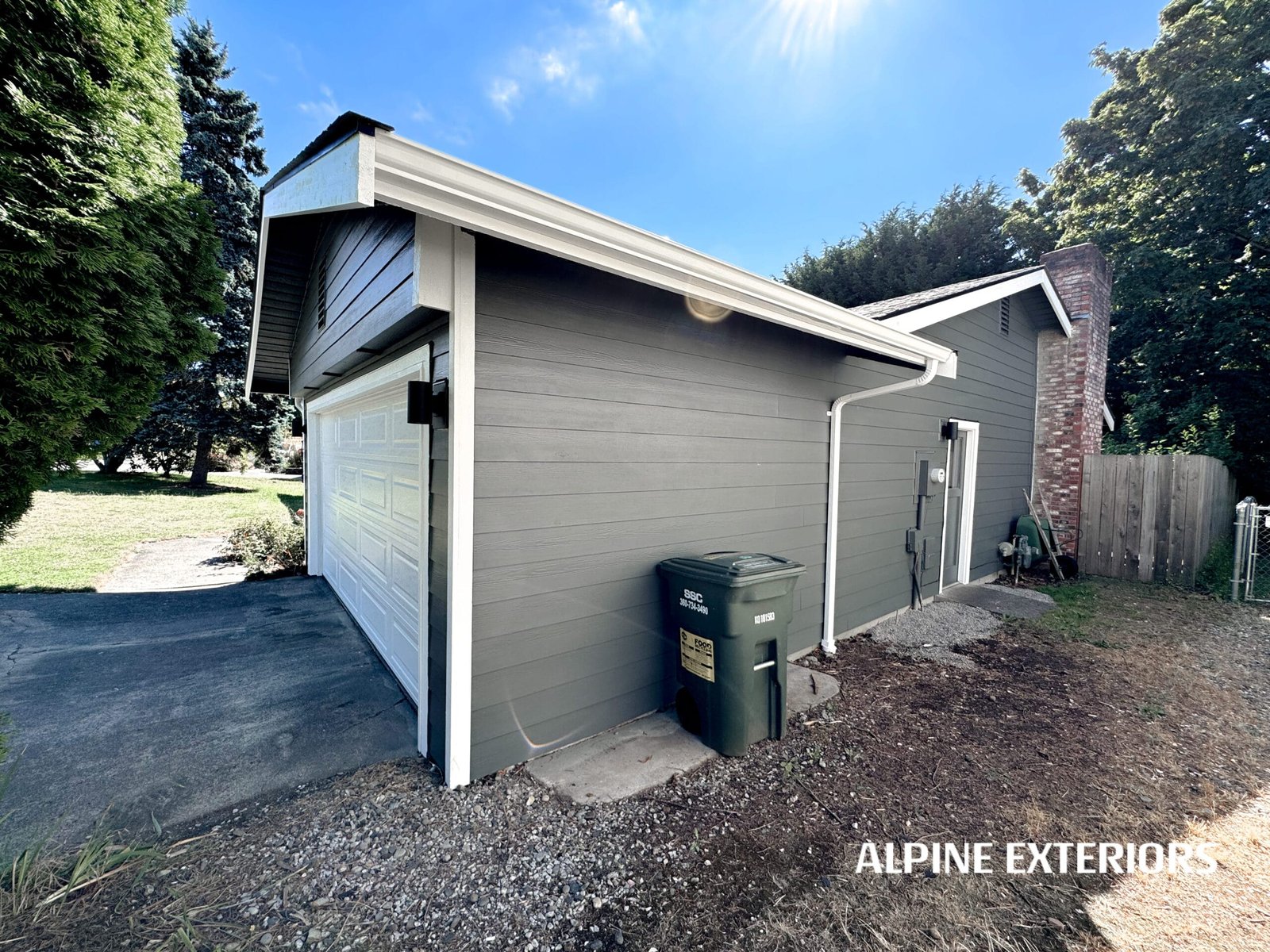
The fix is usually straightforward: 6-inch gutter on the runs that collect the most roof area (especially where two roof planes meet in a valley and dump double the water into one section of gutter), and downspouts sized and spaced to match. A 2x3-inch downspout is standard, but 3x4-inch downspouts move noticeably more water per minute and are worth the upgrade on long runs or valley-fed sections. As a rough rule of thumb, one properly sized downspout per 30 to 40 feet of gutter run, or roughly every 600 to 800 square feet of roof area, keeps most homes ahead of a heavy rain event — though steep roofs, metal roofing that sheds water fast, and valley-heavy roof lines all push that number down. We also see roofs where the downspouts were placed for looks rather than drainage math, tucked at a corner instead of at the low point of a run; moving them, even without changing gutter size, solves overflow on some homes by itself.
None of this is exotic work, but it does require actually measuring the roof and walking the runs rather than replacing like-for-like. A gutter system installed for a smaller, simpler roof and never re-evaluated after an addition or a re-roof is a common and easy-to-miss cause of chronic overflow.
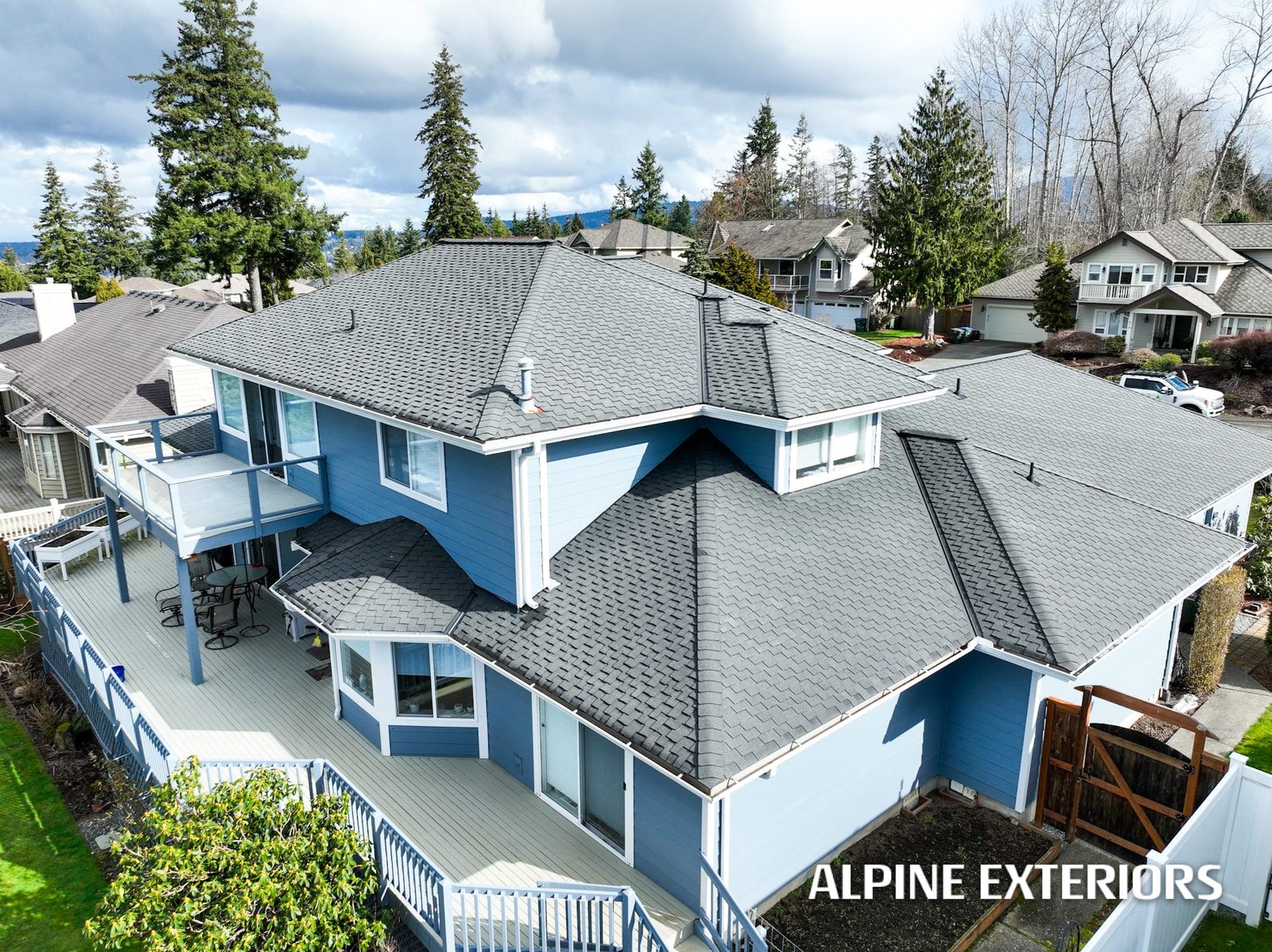
Edison sits low and flat, close to Edison Slough, the Samish River delta and the tidal farmland that runs out toward Samish and Padilla Bays. That geography changes the drainage problem compared to most of the rest of our service area in a few specific ways.
First, the water table is high and the ground is nearly level. In Mount Vernon or Sedro-Woolley, a downspout that dumps onto a splash block usually has enough natural slope to carry water away from the house. On the Edison flats, that same setup can just leave standing water pooled near the foundation because there's nowhere for it to run to. Drainage here often has to be engineered — piped to a ditch, a drywell, or a lower point on the property — rather than left to gravity and grade.
Second, tree cover in this area is dominated by Douglas fir and western red cedar rather than deciduous trees, which changes the maintenance calendar. Big-leaf maple and alder drop their leaves in a concentrated fall window that homeowners can plan a single cleaning around. Fir and cedar needles come down in smaller amounts nearly year-round, with a heavier push during summer dry spells and after wind events, so a single autumn gutter cleaning isn't enough on wooded lots. Needles are also narrow and dense enough to pack tightly in a gutter or clog a downspout outlet in a way broad leaves don't.
Third, homes closer to Samish Bay and the tidal flats see a bit of salt-tinged air off the water, which shortens the useful life of unprotected steel gutter brackets, screws and hangers faster than it would further inland toward Sedro-Woolley or Burlington. Aluminum gutter and stainless or aluminum fasteners hold up noticeably better here than bare galvanized steel hardware.
Fourth, the open flats around Edison give winter storm wind a long, unobstructed run, which drives rain sideways into fascia boards, soffits and gutter end caps more than it would on a sheltered, tree-lined lot. That wind-driven rain is part of why fascia rot and loose end caps show up here even on gutters that are otherwise clean and clear.
By contrast, some of the conditions that matter elsewhere in our service area barely apply in Edison. Homes up toward the Sedro-Woolley foothills or closer to Mount Baker occasionally deal with snow load and ice dams on the roof edge; Edison's low elevation rarely sees that, so the drainage risk here is almost entirely about rain volume and a high water table, not ice.
A handful of concrete steps cover most of what an Edison homeowner needs to manage:
Costs vary a lot by home size and how much drainage work is involved, but as a general range: a full gutter and downspout replacement on an average single-story home typically runs somewhere in the low thousands of dollars, gutter guard installation is usually a fraction of that, and a buried tightline drainage run to solve a standing-water problem can range from a few hundred dollars for a short simple run to a few thousand for a longer buried system with a drywell. A crawlspace vapor barrier and ventilation correction is a separate line item and depends heavily on crawlspace access and condition. None of these should be treated as fixed prices — get an actual look at the property before assuming a number.
Twice a year is a reasonable baseline for a property with fir or cedar cover — once in late fall after the heaviest storm season starts and again in late winter or early spring. Homes surrounded by mature conifers, or with gutters running under a specific overhanging tree, sometimes need a mid-year check as well, since needle drop here isn't confined to a single season the way leaf drop is.
Standard 5-inch K-style gutter with 2x3-inch downspouts is adequate for many homes, but roofs with valleys, steep pitches, metal roofing, or large connected roof areas often need 6-inch gutter and 3x4-inch downspouts to keep up during a heavy rain event. The right size depends on actual roof area and roof geometry, not just house size, so it's worth having someone measure the runs rather than assuming a standard size will do.
Sometimes, but not always. If water pooling near the foundation from overflowing or poorly routed downspouts is the main source, correcting the gutters and extending or piping the downspouts away from the house often resolves it. But on the Edison flats, a high water table can push moisture into a crawlspace independent of what the gutters are doing, so if the problem persists after fixing the gutters, the ground vapor barrier, crawlspace grading and ventilation need a direct look as well.
Micro-mesh guards handle fir and cedar needles better than open-mesh or screen-style guards, which tend to let fine needles through or catch them on the surface where they mat down. Even a good micro-mesh guard isn't zero-maintenance, though — expect to brush off accumulated needle debris and moss growth on top of the guard occasionally, particularly on north-facing or heavily shaded roof sections.
If you're in Edison, Bow, or anywhere else along the Skagit flats and you're dealing with overflowing gutters, a musty crawlspace, or you just want an honest read on whether your current setup can handle winter rain, Alpine Exteriors can walk the roof and the drainage path with you and tell you plainly what needs attention and what doesn't. Alpine Exteriors is licensed in Washington under contractor license ALPINI751OW and works across Skagit, Island and Whatcom counties, including Mount Vernon, Anacortes, Burlington, Sedro-Woolley, La Conner, Stanwood, Camano Island and Bellingham. Reach out for an inspection before the next round of winter storms rather than after water has already found its way into the crawlspace.