

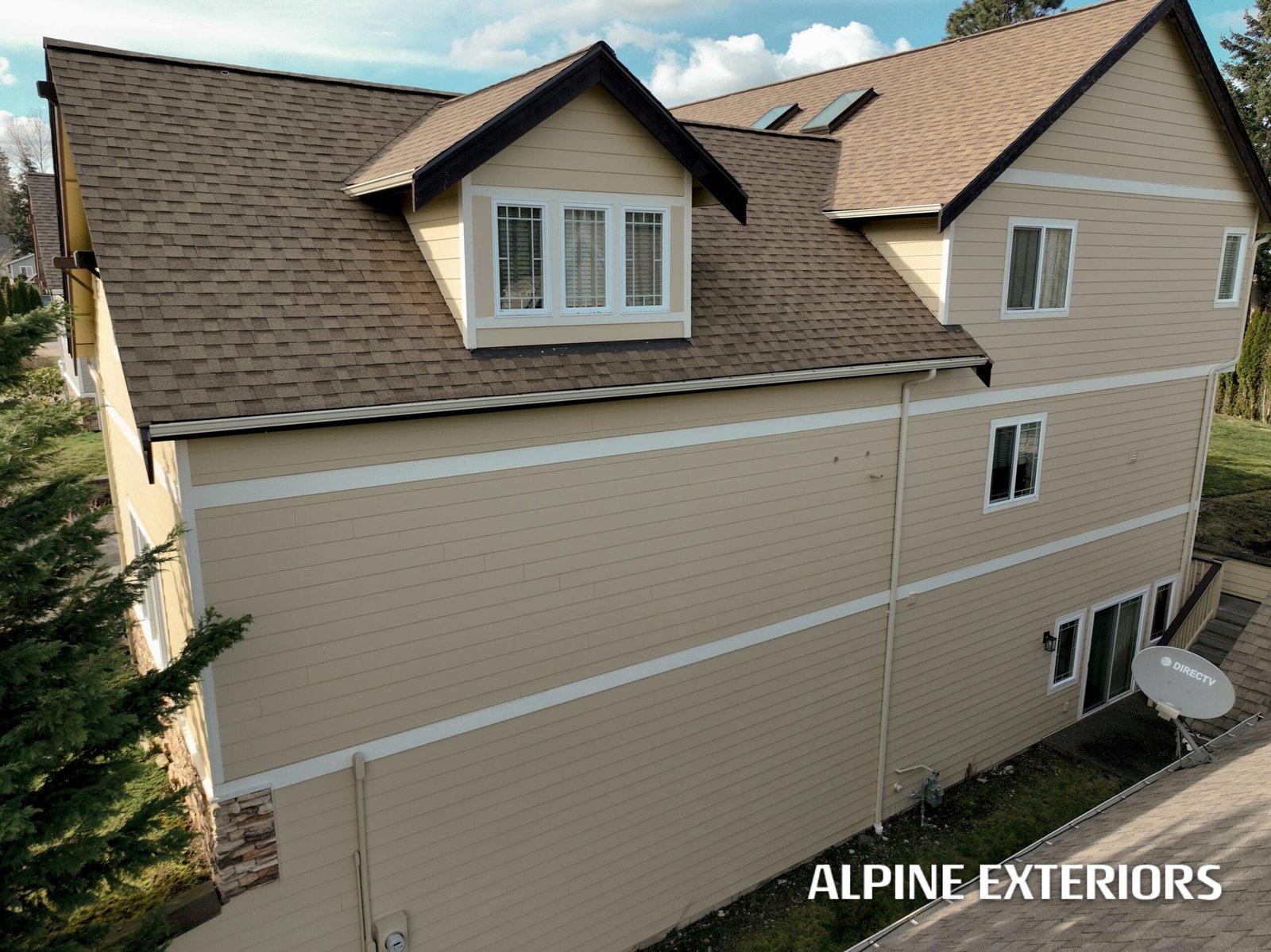
Most homes around Clear Lake need 5-inch or 6-inch K-style aluminum gutters sized to the actual roof area and the rainfall intensity Skagit County sees each winter, not whatever size happened to be on the truck. Beyond getting that size right, the two problems that generate the most repeat calls out here are Douglas fir and cedar needles clogging the system every fall, and gutters that dump water a foot from the foundation instead of carrying it well away from a home that already sits over a damp crawlspace.
This page covers the sizing math, the local conditions that make Clear Lake different from a subdivision in Seattle or Spokane, and what a homeowner should actually do about it — from choosing a gutter width and downspout count to protecting a crawlspace through a wet Pacific Northwest winter. Alpine Exteriors installs and repairs gutter systems throughout Skagit, Island and Whatcom counties, and Clear Lake is one of the areas where drainage mistakes show up fastest because of how flat the ground is and how much tree cover surrounds most lots.
Gutter sizing isn't guesswork, or shouldn't be. It comes down to three numbers: the square footage of roof draining into a given run of gutter, the local rainfall intensity used for design (the Cascade foothills and the marine air off the Strait of Juan de Fuca combine to produce sustained, heavy winter rain rather than short bursts), and the width and depth of the gutter and downspout carrying that water away.
A standard 5-inch K-style gutter, installed with proper slope, can typically handle the runoff from roughly 5,500 to 6,000 square feet of roof area under the rainfall intensities common to western Washington — but that number drops fast if the roof has multiple valleys feeding into one run, if the gutter is under-sloped, or if debris is already sitting in the trough reducing usable depth. A 6-inch K-style gutter paired with 3-inch by 4-inch downspouts pushes that capacity meaningfully higher, which is why Alpine Exteriors defaults to 6-inch on steeper roofs, taller two-story homes where added roof height increases water velocity by the time it reaches the gutter, and any home with a lot of valley or dormer complexity. On a simple single-story ranch with a modest roof footprint, 5-inch gutters and 2-inch by 3-inch downspouts are often still adequate, and there's no reason to oversize a system that doesn't need it — bigger isn't automatically better, it's just more metal and more cost for a job that a correctly sized 5-inch run would have handled fine.
Downspout placement matters as much as gutter width. The rule of thumb Alpine Exteriors uses is one downspout for roughly every 30 to 40 linear feet of gutter run, or more often if the roof pitch is steep enough to accelerate water velocity in the trough. A long, unbroken run with only one downspout at the end will overflow in a heavy storm even if the gutter itself is the right size, because the water simply can't reach the downspout fast enough. On homes with a lot of roofline — L-shaped floor plans, wraparound porches, attached garages — that often means adding a downspout or two beyond what the original builder installed, especially on homes built before Skagit County tightened its drainage expectations.
Slope is the detail most often gotten wrong on both new installs and repairs. Gutters should run at roughly a quarter-inch of drop for every 10 feet of length toward the downspout, angled just enough to move water without being so steep that it looks crooked from the ground. Too little slope and water sits in the trough, breeding algae and adding weight that pulls fasteners loose over a few winters. Too much slope on a long run can leave the high end sitting too far below the roof edge, letting water sheet off the shingles and behind the gutter instead of into it.
| Gutter size | Typical roof area served* | Recommended downspout | Best fit |
|---|---|---|---|
| 5-inch K-style | Up to ~5,500–6,000 sq ft | 2 in. x 3 in. | Single-story homes, simple rooflines, modest rainfall exposure |
| 6-inch K-style | ~6,000–9,000+ sq ft | 3 in. x 4 in. | Two-story homes, steep pitches, multiple valleys, heavy tree cover |
| 6-inch half-round | Similar to 6-inch K-style, slightly less due to shape | 3-inch round | Older or historic-style homes wanting a traditional profile |
*Figures are general guidance based on regional rainfall intensity and standard slope; every home's actual roof area, valley count and pitch should be measured on site before finalizing gutter and downspout size.
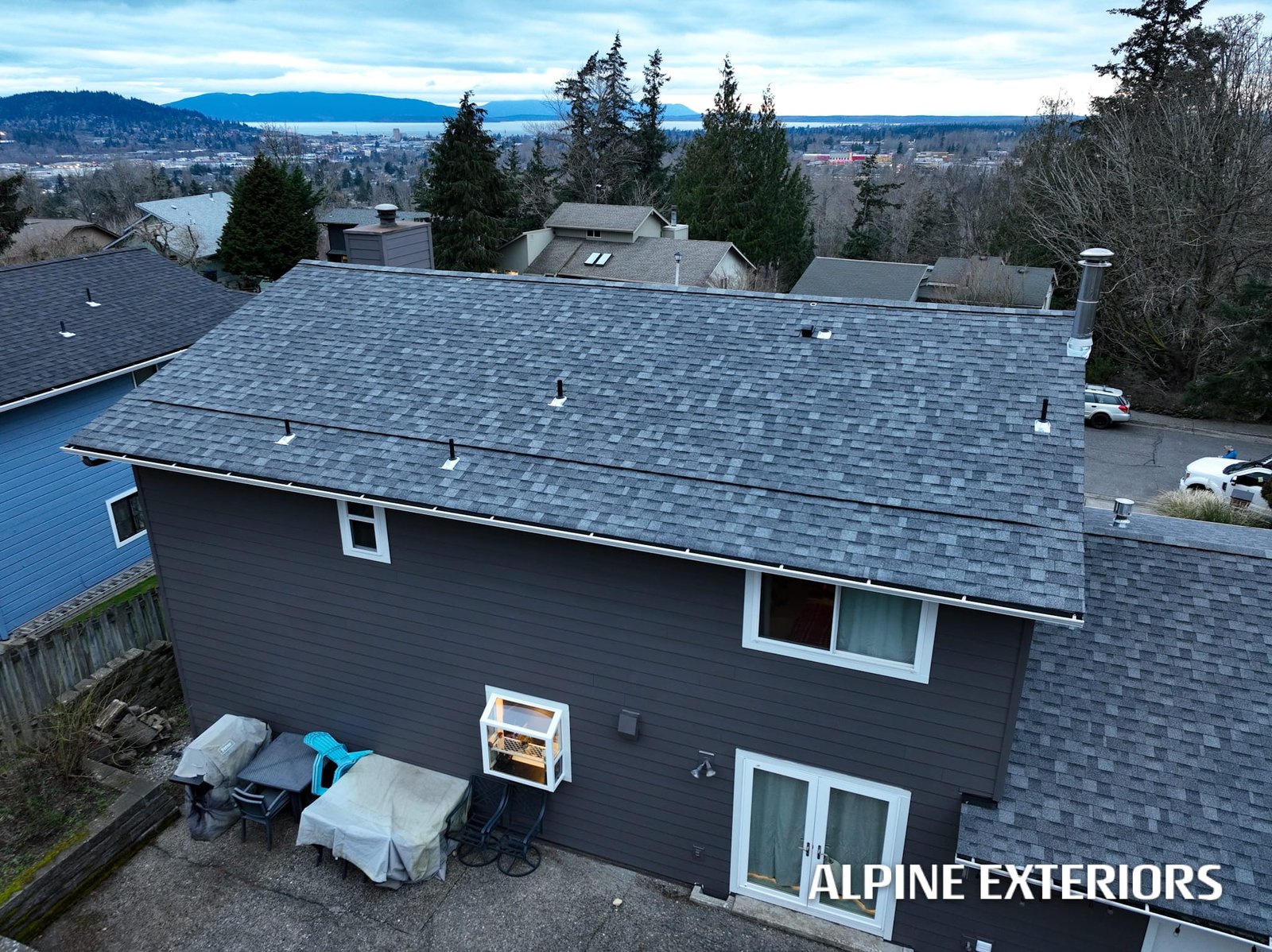
Clear Lake sits in a part of Skagit County where several conditions stack on top of each other in a way that doesn't happen in drier or more urban parts of Washington. None of it is hurricane weather — this is a wind-and-rain climate, not a wind-and-storm-surge one — but the combination still punishes an undersized or poorly maintained gutter system faster than most homeowners expect.
Heavy, sustained winter rain. The lowland areas around Clear Lake, Sedro-Woolley and the Skagit River valley catch a lot of the moisture pushed inland off the Pacific, and winter storms here tend to be long, soaking events rather than brief downpours. A gutter system that copes fine with an average storm can still overflow during an atmospheric river event that dumps rain steadily for two or three days straight, which is exactly the scenario gutter sizing needs to account for rather than the average day.
Fir and cedar needle debris. Much of Clear Lake and the surrounding foothill neighborhoods sit close to stands of Douglas fir, western red cedar and bigleaf maple. Needles are worse than leaves in a gutter because they're small, they pack tightly, and they wash into downspout openings instead of sitting on top where they'd be easy to spot and scoop out. A gutter that looks clear from the ground can have a downspout throat packed solid with needles a few feet down, which is often the real cause of an overflow that looks like a sizing problem but is actually a maintenance problem.
Moss on shaded, north-facing roofs. Homes tucked under tree cover or facing away from the sun hold moisture longer, and moss growth on those roof sections sheds grit and organic debris into the gutters below every time it rains. That debris settles at the bottom of the trough and, over a few seasons, can reduce a gutter's effective depth by an inch or more — which matters a lot when the whole system was sized around using its full depth.
Wind off the Skagit flats. The open agricultural flats between Clear Lake and the Skagit River funnel wind in a way that more sheltered neighborhoods don't experience, and that wind drives rain sideways against fascia boards and gutter backs. Fasteners and hangers on the windward side of a home take more repeated stress than the same hardware on a sheltered wall, which is one reason hidden hangers spaced correctly matter more here than in a calm inland town.
Salt air on the islands and near the Sound. Homes closer to Camano Island, the Whatcom coastline or the Strait get periodic salt-laden air that accelerates corrosion on lower-grade steel hardware and fasteners. It's a smaller factor at Clear Lake itself, which sits further inland, but it's worth knowing about for anyone comparing notes with a relative or neighbor closer to the water.
High water tables and crawlspace moisture. This is the one that separates Clear Lake from a lot of the rest of the service area. The terrain around the lake and the nearby valley floor is relatively flat, drainage is slow, and many homes — especially older ones — sit on crawlspace foundations rather than full basements. When gutters overflow or downspouts discharge right at the foundation instead of being carried away, that water has nowhere to go but down and in, and a crawlspace with poor ventilation or a failed vapor barrier can hold that moisture for weeks. The Washington State Energy Code and the state building code both address crawlspace ventilation and ground vapor barriers for exactly this reason — moisture trapped under a house drives mold, wood rot in floor joists, and higher heating bills as damp insulation loses its R-value. Good gutters and downspouts are the first line of defense against that chain of problems, not a cosmetic afterthought.
Occasional ice in the foothills. Clear Lake sits close enough to the Cascade foothills that a cold snap can bring brief icing on gutters and downspouts a few times a winter, more than a homeowner would see right on the Whatcom County waterfront. It's not the ice-dam problem homes in the Cascades or the Midwest deal with regularly, but a downspout that's already partly frozen when a warm rain hits will back up fast.
A few signs show up consistently on Clear Lake homes before a full gutter failure. Water sheeting off the roof edge during a storm instead of running into the trough usually means the gutter has pulled away from the fascia, is undersized for that roof section, or is packed with debris below the visible surface. Streaking or staining on siding below the gutter line points to overflow at that spot, often right where a downspout should have been added but wasn't. Sagging sections, visible gaps at seams, or hangers pulling loose are straightforward wear signs, especially on the windward side of a home. Indoors, a musty smell near a crawlspace access, visible dampness on foundation walls, or condensation on crawlspace framing are the downstream signs that whatever is happening at the roofline is now a moisture problem underneath the house — and by the time those show up, the gutters have usually been failing quietly for a season or two already.
Before ordering material, the roof should actually be measured — total square footage per drainage section, valley count, pitch, and the length of each gutter run. This is where a lot of do-it-yourself and even some low-bid contractor jobs go wrong: they replace a failing 5-inch gutter with another 5-inch gutter because that's what was there, without checking whether the roof was ever properly served by that size to begin with. On a resize or a full replacement, it's worth asking directly whether the existing downspout count and gutter width match the current roof — additions, garage conversions, or dormer changes since the home was built can shift a roof's real drainage needs well beyond what the original gutters were sized for.
A straightforward Clear Lake gutter job starts with an on-site measurement of every roof plane, valley and run length, followed by a walk of the fascia boards to check for rot before new gutters ever go up — hanging new gutter on soft or water-damaged fascia just moves the failure point, it doesn't fix it. From there, seamless gutter is formed on site to the exact length of each run so there are no field-cut seams to leak, hung with hidden hangers spaced to hold up against wind off the flats, and pitched to the calculated slope toward each downspout. Downspouts get routed to discharge well clear of the foundation, tying into splash blocks, extensions or buried drain line where the lot calls for it, and the job wraps with a walkthrough showing the homeowner where each downspout empties and what routine cleaning will look like given the tree cover on that particular lot.
Aluminum is the standard choice for most Clear Lake homes, and for good reason: it doesn't rust, it's lightweight enough that fascia boards don't take on unnecessary load, it's available in a wide range of colors, and it's the most cost-effective option for a full gutter replacement. Seamless aluminum gutter, formed on site to the exact length of each run, avoids the leak-prone joints that sectional gutter develops over time, and it's what Alpine Exteriors installs on the large majority of jobs in this area. Well-maintained aluminum gutters typically hold up for fifteen to twenty years in this climate, though on a heavily treed lot with a lot of needle load, expect to be doing more frequent maintenance well before the ten-year mark to keep that lifespan on track.
Steel gutters, typically galvanized or galvalume, hold up to impact and heavy debris load better than aluminum and are worth considering on a home with a lot of overhanging fir branches that regularly drop limbs, but they're heavier, cost more, and — if the coating is ever scratched through — can rust, which matters more near salt air than it does at Clear Lake itself. Copper gutters are the premium, long-lifespan option, developing a natural patina over years and holding up extremely well, but the material cost is well above aluminum or steel and it's usually reserved for homes where the architectural style calls for it. Vinyl gutter is the lowest-cost option on the shelf at a hardware store, but it becomes brittle in cold snaps, its seams are the weakest point in the entire system, and Alpine Exteriors generally doesn't recommend it for a full home installation in this climate — it's a short-term patch material at best, not a system built to last through Skagit County winters.
K-style gutter, with its flat back and decorative front profile, is the standard on the vast majority of Clear Lake homes because it holds more water per inch of height than a half-round gutter of the same width and mounts flush against fascia trim. Half-round gutter is a smoother, curved profile that some older farmhouses and Craftsman-style homes around Skagit County use for a more traditional look; it drains debris a little more easily since there's no flat bottom for needles to settle into, but it holds less water for a given size and usually needs hangers spaced more tightly. Neither profile is objectively better — it's a question of what matches the home's existing trim and roofline, and for most standard residential construction in this area, K-style remains the practical default.
Getting water off the roof is only half the job — where it goes after it leaves the downspout matters just as much, especially on a Clear Lake lot with a crawlspace foundation and flat terrain. Downspouts should discharge at least 5 to 10 feet from the foundation, either onto a splash block, into a solid extension, or ideally into buried drain pipe that carries the water to a lower point on the lot, a dry well, or an approved storm drainage connection. A downspout that simply ends a few inches above grade right next to the foundation is one of the most common — and most fixable — causes of crawlspace moisture in this area. On flatter lots where gravity alone won't carry water far enough, a sump or pop-up emitter at the end of a buried run can help, though any buried drainage work should account for where the water table sits during the wettest months so the system doesn't just relocate the problem a few feet away.
Gutters and downspouts are the first defense, but a Clear Lake home benefits from a second layer: confirming the crawlspace itself has adequate foundation vents (or a properly installed and sealed conditioned crawlspace system, where that approach was used) and an intact ground vapor barrier, consistent with Washington's building and energy code requirements for crawlspace moisture control. A home can have flawless gutters and still develop a damp crawlspace if the vapor barrier has torn or the vents have been blocked by landscaping, insulation debris, or a previous renovation. It's worth checking both systems together rather than assuming new gutters alone solve an existing moisture problem.
Given how much fir and cedar debris falls in this area, a twice-a-year cleaning schedule — once in late fall after most needles have dropped, and again in late winter or early spring before the heaviest rain — catches most problems before they cause an overflow. Gutter guards can reduce how often cleaning is needed, but no guard product fully eliminates fine needle debris; they cut down on the frequency and mess of cleaning rather than removing the need for it entirely. On heavily treed lots, it's worth budgeting for that maintenance as an ongoing cost of the home rather than a one-time task to check off.
A local contractor who works Skagit County regularly has seen how gutters actually perform through a full winter here — where the wind off the flats hits hardest, which neighborhoods carry the most needle debris, and which lots have chronic crawlspace moisture regardless of what the previous owner did. That local knowledge shows up in sizing decisions, downspout placement, and material choice that a generic national formula or a one-time DIY install often misses. Alpine Exteriors holds Washington contractor license ALPINI751OW and works this specific region — Clear Lake, Mount Vernon, Burlington, Sedro-Woolley, Anacortes and the surrounding areas — often enough to know which details actually matter here versus which ones are just upsells.
Twice a year is the realistic minimum for most Clear Lake properties with significant tree cover — once after the bulk of fall needle drop and again before the heaviest late-winter rain arrives. Homes on lots with especially dense conifer cover, or gutters that have already shown signs of slow drainage, may need a mid-season check as well. Skipping a season entirely is one of the more common ways a correctly sized gutter system starts overflowing and gets misdiagnosed as a sizing problem when it's really just packed with needles below the surface.
It depends on the roof's total drainage area, its pitch, how many valleys feed into each run, and the length of that run — not a flat rule that applies to every house. As a starting point, a simple single-story roof with modest square footage is often well served by 5-inch K-style gutters and 2x3 downspouts, while a larger two-story home, a steep roof, or one with several valleys usually needs 6-inch gutters and 3x4 downspouts, sometimes with an added downspout beyond what the original builder installed. The only way to know for certain is to have the roof measured section by section, since two houses of similar size can have very different real drainage needs depending on layout.
They're connected far more often than homeowners expect, especially on the flatter terrain around Clear Lake where water doesn't drain away from a foundation on its own. When gutters overflow or a downspout discharges right next to the house instead of well away from it, that water saturates the soil against the foundation and can work its way into a crawlspace through vents, cracks, or simply rising ground moisture. Fixing the crawlspace's vapor barrier or ventilation without addressing the gutters that are still dumping water at the foundation only treats half the problem, and the moisture usually comes back.
Clear Lake's mix of heavy winter rain, tree cover and flat, moisture-prone terrain doesn't leave much room for an undersized or poorly maintained gutter system — problems here tend to show up underneath the house before they're obvious from the yard. Alpine Exteriors installs and repairs seamless aluminum, steel and copper gutter systems throughout Skagit, Island and Whatcom counties, sizing every job to the actual roof rather than defaulting to whatever was there before, and pairing gutter work with downspout and drainage planning that accounts for where the water actually needs to go on a given lot. The company holds Washington contractor license ALPINI751OW and serves Clear Lake alongside Mount Vernon, Anacortes, Burlington, Sedro-Woolley, La Conner, Stanwood, Camano Island and Bellingham.
If gutters are overflowing, a crawlspace smells musty after storms, or it's simply been a while since anyone checked whether the current system was ever sized correctly, reach out to Alpine Exteriors for an on-site look at the roof, the gutters, and how water is actually moving away from the foundation — and for more info on sizing a specific roof, ask for the measurements to be walked through in person rather than quoted over the phone. Getting the sizing, material and drainage plan right once is a lot less costly than repeating a repair every winter.



