
Langley sits on the south end of Whidbey Island, close enough to the water that salt air, wind, and heavy winter rain shape almost every roofing decision homeowners make here. A roof that performs well in Mount Vernon or Burlington, thirty minutes inland, doesn't automatically perform well a few blocks from Saratoga Passage. This guide breaks down the roofing systems that actually hold up in Langley and the rest of Island County, what to avoid, and how to think about the decision whether you're patching a leak or planning a full replacement. Alpine Exteriors serves Langley as part of our broader Island, Skagit and Whatcom County service areas, and this page reflects what we see on real roofs in this region, not a generic national list.
For most single-family homes in Langley, a well-installed architectural (dimensional) asphalt shingle roof is still the best balance of cost, durability, and appearance. It handles the region's wind and rain well when the wind rating, underlayment, and ventilation are specified correctly for a coastal lot. For homes directly exposed to wind off the water, or for owners who want the longest possible service life and don't mind the higher upfront cost, standing-seam metal roofing is the stronger pick — it resists wind uplift, sheds moss better than most materials, and tends to outlast shingles by decades. For additions, porches, dormers, and other low-slope sections that are common on older Langley homes, a membrane system such as TPO or EPDM is usually the right call rather than trying to force a shingle roof onto a near-flat plane.
There isn't a single "best" answer that fits every roof — a heavily shaded, tree-lined lot near town has different problems than a wide-open bluff-front property, and a 1920s farmhouse with a low-slope porch addition needs a different system than a new build. The sections below explain the trade-offs so you can match the roof to your actual site conditions, whether you're planning new construction, a repair, or a full replacement while your current roof still has some life left.
We evaluated each roofing option against the conditions that actually show up on Whidbey Island and across our Island County service areas — not generic national criteria. The factors that matter most here:
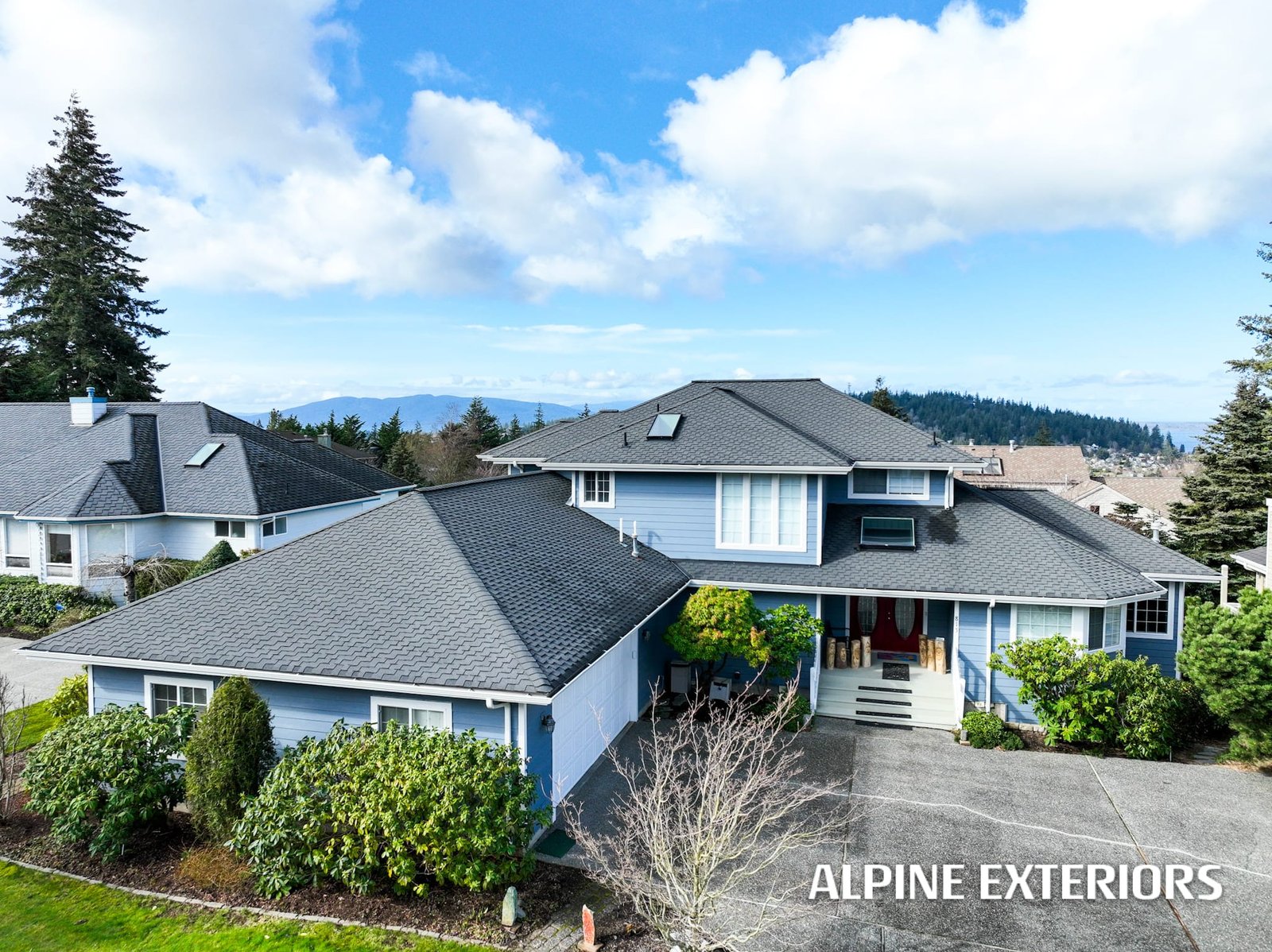
Architectural shingles are the default choice for a reason: they're a proven system throughout the Pacific Northwest, competitively priced, and available in higher wind ratings and algae-resistant (AR) formulations that hold up reasonably well against the region's moss and rain. On a typical Langley home, this is where most reroofing projects land.
Pros: Lower material and labor cost than metal; a wide range of colors and profiles that work with both craftsman-style homes and newer builds; AR-rated shingles resist algae and moss growth noticeably better than older shingle products; straightforward for local crews to repair a section without replacing the whole field; typical manufacturer warranties in the 25–30 year range for mid-grade products.
Cons: Standard shingles are only rated for moderate wind unless you specifically upgrade to a high-wind product and install with the enhanced nailing pattern — this matters on roofs facing open water. Shaded, north-facing slopes still grow moss over time even with AR shingles, just more slowly. Shingles have a shorter realistic service life here than metal, typically 20–25 years in practice given our rain exposure, versus the 30 years often quoted on the package. They're also more vulnerable to wind-driven granule loss on exposed, open lots.
Metal has become increasingly common on new construction and full reroofs on Whidbey Island, particularly for homes with direct water exposure or owners planning to stay long-term. The concealed-fastener standing-seam profile is the version worth considering — exposed-fastener metal panels are a different, lower-cost product with more long-term maintenance risk.
Pros: Excellent wind uplift performance when properly installed and clipped; sheds moss and debris far better than shingles because there are no exposed granules or overlapping seams for organic matter to catch on; strong corrosion resistance in coastal environments when you specify a marine-grade coating, which matters for homes exposed to salt air near the shoreline; realistic 40–60 year service life; performs well shedding rain quickly during heavy winter storms.
Cons: Significantly higher upfront cost than shingles, often two to three times as much depending on panel profile and finish. Noise during heavy rain is a real consideration unless the assembly includes solid decking and proper insulation. Fewer local crews are trained to install and repair standing-seam correctly, so sourcing quality installation and future repairs takes more research. Dissimilar-metal corrosion is a risk if fasteners, flashing, and gutters aren't matched — a common mistake on lower-bid metal installs.
Many Langley homes, especially older farmhouses and cottages, have porch roofs, dormers, additions, or bay window roofs that are too flat for shingles or metal panels to shed water reliably. These critical areas need a true low-slope membrane system, not a shingle roof forced onto an inadequate pitch.
Pros: Purpose-built for slopes under roughly 3:12 where shingles would leak; TPO and modified bitumen systems handle standing water and ponding far better than composition shingle; relatively fast to install on smaller sections like porches and additions; can be tied into a full roof replacement or restored on its own without touching the rest of the roof.
Cons: Membrane roofing is a specialized trade — not every general roofing crew installs it correctly, and a poor seam weld is where most low-slope leaks originate. Membrane surfaces need periodic inspection since debris and standing water aren't always visible from the ground. Aesthetically, membrane roofing is utilitarian, which is fine for a porch or addition but isn't a substitute for the primary roof on a traditional home.
Cedar shake has deep roots in Pacific Northwest residential architecture, and it still shows up on older Langley homes and some historic-style renovations. It's worth being honest about where it fits today.
Pros: A distinctive regional look that suits craftsman and farmhouse-style homes; a breathable material that can perform well when properly ventilated; a legitimate choice for homeowners prioritizing historic accuracy or resale character in certain neighborhoods.
Cons: This is the material most prone to moss and algae growth in our climate, and moss on cedar accelerates rot rather than just sitting on the surface the way it does on shingles or metal. It requires more frequent maintenance — periodic cleaning, occasional shake replacement, and vigilant gutter and valley upkeep — than any other option on this list. Insurance considerations and higher installation cost are also factors. We generally only recommend cedar shake to owners who understand and accept the maintenance commitment going in.
Composite shingles, made from engineered polymers designed to mimic cedar shake or slate, have become a middle-ground option for homeowners who want a distinctive look without cedar's maintenance burden.
Pros: Good wind resistance ratings on quality products; resistant to moss and rot in a way natural cedar isn't; lighter weight than slate with a similar high-end appearance; typically comes with strong manufacturer warranties.
Cons: Higher cost than architectural asphalt; fewer local installers have deep experience with every composite product line, so warranty-backed installation matters more here than with shingles; long-term performance data in our specific climate is still shorter than asphalt's decades-long track record.
Some choices that are perfectly reasonable in other parts of the country are genuine mistakes here.
Across our service areas on Whidbey Island and the broader region — Langley, Oak Harbor, and the smaller communities in between — a handful of issues account for most of the repair calls we get:
Whether you're dealing with an active leak or planning ahead, the right next step depends on your roof's actual condition, not just its age. A few honest guidelines:
Repairs make sense when the damage is localized — a section of lifted shingles, a failed flashing detail, or an isolated leak — and the rest of the roof still has useful life left. A competent local contractor should be able to assess and repair these without pushing you toward a full replacement you don't need yet.
Roof cleaning and maintenance extends the life of almost every material on this list. Annual or biannual inspection, gutter clearing, and professional moss treatment (not aggressive pressure washing) catches small problems — a lifted shingle, a cracked pipe boot, a clogged valley — before they become interior leaks. This is especially important on shaded Langley lots where moss returns year after year if left untreated.
Full replacement is the right time to consider when a roof is showing widespread granule loss, multiple past repairs, soft decking, or when it's simply reached the end of its realistic service life for the material — typically 20–25 years for asphalt shingles in this climate. Replacement while the underlying decking is still sound is far cheaper than waiting until water intrusion causes structural damage, so a proactive project almost always costs less over the life of the home than a reactive one.
Emergency leak response matters most during the heaviest winter storms, when a damaged roof section needs to be tarped or temporarily sealed before water reaches the interior. If you're dealing with an active leak, describe the condition of your roof as specifically as you can when you reach out to a contractor — where the water is showing up inside, whether it tracks with wind direction or storm intensity, and whether you can see visible damage from the ground. That information helps a crew triage the call and bring the right materials the first time.
Langley's downtown businesses, inns, and the multi-family and mixed-use buildings scattered through nearby communities have different needs than a single-family home. Low-slope membrane systems dominate here for the same reason they work on porches and additions — flatter commercial rooflines need a system built for standing water and long-term UV exposure, not a residential shingle product. Timing matters more for commercial and multi-family projects too: a business or apartment building often can't fully close during a reroof, so phased work and coordinated access planning matter as much as the roofing material itself. If you manage a commercial or multi-family property in Langley, Oak Harbor, or elsewhere across our service areas, plan a roof project around a shoulder season when possible, and get an inspection well ahead of the wettest months so a full system failure doesn't force an emergency decision.
Concealed-fastener standing-seam metal with a marine-grade coating holds up best against direct salt air exposure, because it avoids the exposed fasteners and granule surfaces that corrode or degrade fastest near the shoreline. For homes set back from the water, or where budget is the deciding factor, a high-wind-rated architectural shingle with algae-resistant granules is a reasonable and more affordable alternative — it just needs closer periodic inspection than metal would.
Localized problems — a section of missing shingles, one failed flashing detail, an isolated leak — usually point to a repair. Widespread granule loss, soft or spongy decking, repeated leaks in different spots, or a roof approaching 20–25 years of age on asphalt shingles usually means replacement is the more cost-effective path, since further repairs on an aging roof rarely stop new leaks from appearing elsewhere. A physical inspection is the only reliable way to tell the two apart.
Yes. Any roof section under roughly a 3:12 pitch needs a true low-slope membrane system — TPO, EPDM, or modified bitumen — rather than composition shingles. Shingles are designed to shed water down a steep slope; on a near-flat porch or dormer roof, they trap water and fail early. This is one of the most common issues we find on older Langley homes where a porch roof was shingled instead of properly membraned.
Late spring through early fall is the most reliable window, since drier, more stable weather gives shingles, membrane seams, and flashing sealants time to cure properly before the heavy winter rain arrives. That said, roofing work continues through the shoulder seasons here, and reputable local crews can install correctly outside that window when necessary — the key is scheduling with enough buffer before the wettest months if your roof is already showing signs of failure, rather than waiting until a storm forces an emergency call.
Every roof on Whidbey Island faces a slightly different mix of wind exposure, shade, and salt air, and the best system for your home depends on those specifics more than any general ranking can capture. Alpine Exteriors is a licensed Washington contractor, license ALPINI751OW, serving Langley alongside Skagit, Island, and Whatcom County communities including Oak Harbor, Mount Vernon, Anacortes, Burlington, Sedro-Woolley, La Conner, Stanwood, Camano Island, and Bellingham. If you want an honest, on-site assessment of what your roof actually needs — whether that's a targeted repair, a moss treatment plan, or a full replacement — reach out and we'll walk the roof with you, cover what our inspection finds, and lay out the real options and information before you commit to anything.