

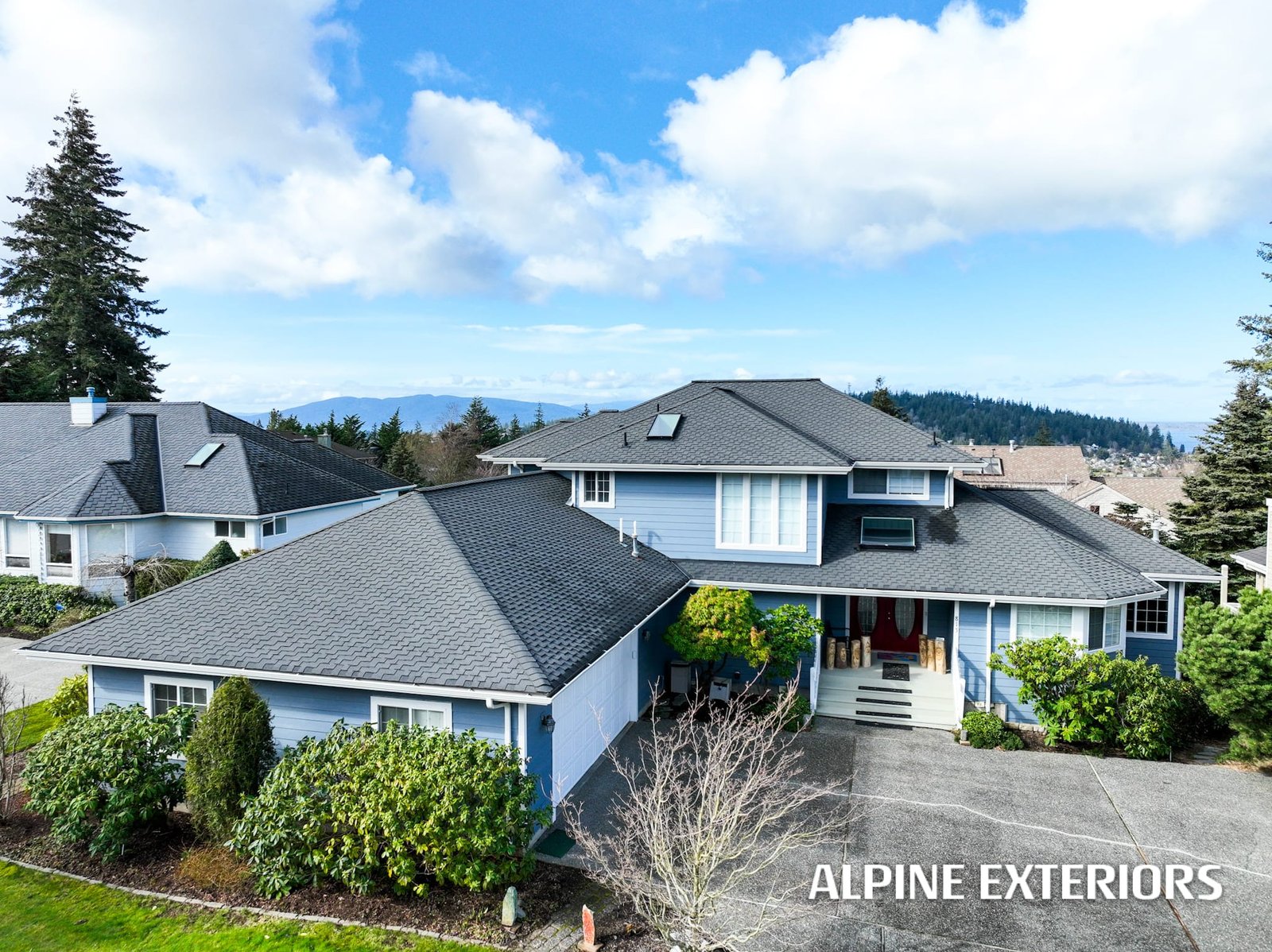
For most homes in Concrete, the two materials that hold up best over time are architectural (dimensional) asphalt shingles rated for high wind, and standing seam metal roofing. Concrete sits in the Cascade foothills along the Skagit River, and that changes the calculus compared to a roof going on a house down on the flats near Burlington or out on Camano Island. Lots here tend to be wooded with fir, cedar and big-leaf maple, which means more shade, more falling debris, and more moss pressure than an open, sunny lot. Winters bring heavier, wetter rainfall than the lowlands see, and in a cold snap the foothills catch snow and freezing rain that the valley floor often misses entirely. A roof that shrugs off algae and moss, sheds heavy rain fast, and tolerates an occasional snow load without needing babying is the one that earns its keep here. Architectural shingles with algae-resistant granules are the practical, budget-friendly default for most roof shapes. Standing seam metal is the upgrade pick for steep pitches, homes tucked under heavy tree cover, or owners who want to stop thinking about the roof for a few decades. Everything else on this page has a place, but those two cover the majority of Concrete homes well.
Ranking roofing materials in the abstract isn't useful — what matters is how each one performs against the specific conditions Concrete throws at it. We weighed four things:
We did not weigh curb appeal heavily on its own — nearly every material below can be made to look good. What separates the options is how they age over 15, 20, or 30 years of Skagit County weather.
Architectural (also called dimensional or laminated) asphalt shingles are the most common roof covering on homes throughout Skagit, Island and Whatcom counties, and for good reason: they're a known quantity, reasonably priced, and easy for most licensed roofers to install and repair. For Concrete specifically, the detail that matters most is choosing a shingle with algae-resistant (AR) copper-infused granules, since shaded, tree-covered roofs here are exactly the environment where black algae and moss streaking show up first. Look for a shingle rated for higher wind speeds and make sure the installer uses six nails per shingle rather than four, which matters more on exposed ridgelines and cleared building sites than on tightly wooded lots.
Pros: Lower material and labor cost than metal or shake; wide color and style selection; straightforward repairs if a branch or windstorm damages a section; most roofing crews in the area are well-practiced with the material.
Cons: Even AR-rated shingles will eventually show moss and algae on north-facing, shaded slopes and need periodic cleaning; typical lifespan (roughly 20–30 years for a quality architectural product) is shorter than metal; heavy wet snow can accelerate wear at the eaves if ice-and-water shield wasn't installed properly at the time of roofing.
Cost for a typical single-family roof in this material generally lands well below metal, though the exact number depends on roof complexity, tear-off scope, and decking condition — get a written estimate rather than relying on a per-square rule of thumb.
Standing seam metal has become a popular upgrade for homes in the Concrete area, and it earns that popularity honestly. The interlocking panel seams shed heavy rain fast, which matters on a property that sees more annual precipitation than the valley floor, and the smooth panel surface gives moss and moisture far less to grip onto than a shingle's textured surface. Metal also handles occasional snow load well — it sheds accumulated snow rather than holding it, which reduces the risk of ice damming at the eaves. On a steep-pitched roof under conifer cover, metal is often the material that ages the most gracefully.
Pros: Long service life, often 40-plus years with minimal maintenance; excellent snow-shedding; strong resistance to moss and algae compared to shingles; good match for the Washington State Energy Code's cool-roof and reflectivity considerations in certain color finishes; fewer repeat truck-rolls for cleaning over the life of the roof.
Cons: Meaningfully higher upfront cost than asphalt; snow sliding off a metal roof can dump onto walkways, decks or parked vehicles below, which needs to be planned for with snow guards near entries; noise during heavy rain is more noticeable than with shingles unless proper underlayment and decking are used; a mismatched or inexperienced installer can create seam and fastener problems that are expensive to fix later, so installer experience with metal specifically matters more here than with shingles.
Synthetic shake products are engineered to mimic the look of split cedar shake without the maintenance burden of real wood. For a wooded, rustic-feeling property in Concrete, this is often the material that satisfies both the aesthetic the owner wants and the practical need for something that won't rot in a damp, shaded setting the way real wood can.
Pros: Wood-shake appearance without the moss and rot vulnerability of real cedar; generally class-A fire rated, which some owners in wooded areas value; good impact resistance against falling branches and cones, which is a real consideration under mature conifers.
Cons: Costs more than architectural asphalt; fewer local installers have deep experience with the specific fastening and flashing details these products require, so ask about a contractor's track record with the material before committing; color fade over time varies by manufacturer and isn't always disclosed clearly.
Real cedar shake has a long history in the Pacific Northwest and still shows up on homes throughout Skagit County, including plenty of older properties around Concrete and Sedro-Woolley. It looks the part in a forested setting, but it is honestly the highest-maintenance option on this list for exactly the conditions Concrete has in abundance: shade and moisture.
Pros: Traditional, regionally appropriate appearance; breathable material that some owners prefer on principle; can be treated and maintained to extend service life.
Cons: Highest ongoing maintenance of any option here — shaded cedar shake needs regular moss treatment and periodic re-treatment against rot; shorter realistic lifespan on damp, tree-covered lots than on an open, sunny site; insurance considerations vary by carrier and should be checked before choosing this route; more expensive to install correctly than asphalt.
Not every roof surface on a Concrete home is a steep pitch — porch roofs, additions and outbuildings sometimes have low-slope sections where shingles aren't appropriate. For those areas, a modified bitumen or single-ply membrane system is the right call rather than trying to stretch shingle or metal products past their design limits.
Pros: Purpose-built for standing water and low-slope drainage; predictable performance on porch roofs and additions; can be integrated cleanly with the main roof's material at transitions when detailed correctly.
Cons: Not a substitute for a full roof system on a primary steep-slope roof; requires a contractor experienced with membrane detailing at transitions, or leaks at the tie-in are common.
A few choices that work fine elsewhere in the country cause predictable problems in Concrete's specific mix of shade, rain and occasional foothill snow.
Yes, to a meaningful degree. Concrete sits higher in the Cascade foothills, gets more annual rainfall, sees more tree cover and shade on the typical lot, and experiences occasional snow and freeze-thaw cycles that the Skagit flats and islands rarely see. The roofing materials that work well in both places are largely the same, but the detailing — ventilation, ice-and-water shield at eaves, snow-guard placement, and moss-resistant granules — should be adjusted for the wetter, shadier, higher-elevation setting.
There's no single number that fits every roof, since it depends on tree cover, roof pitch, and orientation, but a shaded roof here generally needs more frequent moss treatment than a sunny roof down in the valley. Soft-washing with a moss-appropriate treatment rather than pressure-washing protects the shingle granules, and trimming overhanging branches to let more light and airflow reach the roof surface reduces how often cleaning is needed in the first place.
For a lot under dense conifer shade, metal is one of the strongest arguments for spending more upfront. Its smooth surface resists moss far better than shingles, it sheds accumulated snow instead of holding it, and its long service life means fewer future re-roofs disturbing the property. It's not a requirement — a well-maintained architectural shingle roof with algae-resistant granules still performs acceptably — but metal is the option that needs the least ongoing attention on a shaded lot.
Yes. The Washington State Energy Code applies statewide, and roofing and attic assembly work on a Concrete home needs to meet the same insulation and building-envelope requirements as a home in Mount Vernon, Burlington or Bellingham. A licensed contractor pulling the appropriate permit will factor code compliance into the roofing scope, particularly around attic ventilation and insulation continuity at the roofline.
If you're weighing options for a roof in Concrete, the right material depends on your home's pitch, tree cover, and how long you want to go before thinking about it again. Alpine Exteriors works roofing, window, deck and gutter projects across Skagit, Island and Whatcom counties — including the foothill communities around Concrete and Sedro-Woolley, not just the flats — and can walk your specific roof, point out what's actually driving moss or wear on your property, and lay out honest cost ranges for the materials that make sense for your situation. Alpine Exteriors holds Washington contractor license ALPINI751OW. Reach out for an on-site look before your next re-roof, rather than guessing from a general price list.



