
Walk the outside of your home as soon as it's safe and look for missing or lifted shingles, dented or pulled-away gutters, and any limbs or debris resting on the roof, siding, deck or windows — take photos before you move or clean up anything. If water is actively entering the house or a limb has punched through the roof deck, call a licensed contractor the same day for emergency tarping rather than waiting for an insurance adjuster to schedule a visit.
Most storm damage in La Conner isn't dramatic. It shows up as a handful of shingles peeled back along a ridge, a gutter section torn loose by a branch, or a slow drip in the attic that started during the last atmospheric river event and only got noticed a week later. A quick, methodical check right after wind or heavy rain catches these before they turn into rot, mold or a bigger repair bill.
The damage pattern here is driven less by a single dramatic event and more by accumulation. A La Conner storm season typically means weeks of steady, saturating winter rain punctuated by wind events that come off the Skagit flats and the Strait of Juan de Fuca. Neither extreme is unusual on its own — it's the combination that causes problems. Ground that's already saturated from weeks of rain loosens tree roots, so a wind gust that a dry-soil tree would shrug off is enough to bring down a limb, or occasionally a whole tree, onto a roof or fence line.
Gutters take a similar compounding hit. A gutter sized and cleaned for an average year can still be overwhelmed by a sustained heavy-rain event, especially if it's already partly blocked by fir needles, maple leaves or moss debris from the fall. Once a gutter backs up, water finds the path of least resistance — under the drip edge, behind the fascia, or down the siding at a seam — and that's usually where homeowners find damage days or weeks after the storm itself has passed, not during it.
Wind damage on a flat-roofed or low-slope section, or along a roof edge with no wind clip, tends to start at an edge or corner where uplift is strongest and then peel inward if it isn't caught early. On steeper composition-shingle roofs, the more common failure is a shingle that was already loosened by age, heat cycling or moss intrusion finally letting go during a gust. That's an important distinction for a claims conversation: a shingle in poor condition that failed during a windstorm is a different insurance situation than a shingle blown off a roof that was otherwise sound, and an inspector should be able to tell the two apart.
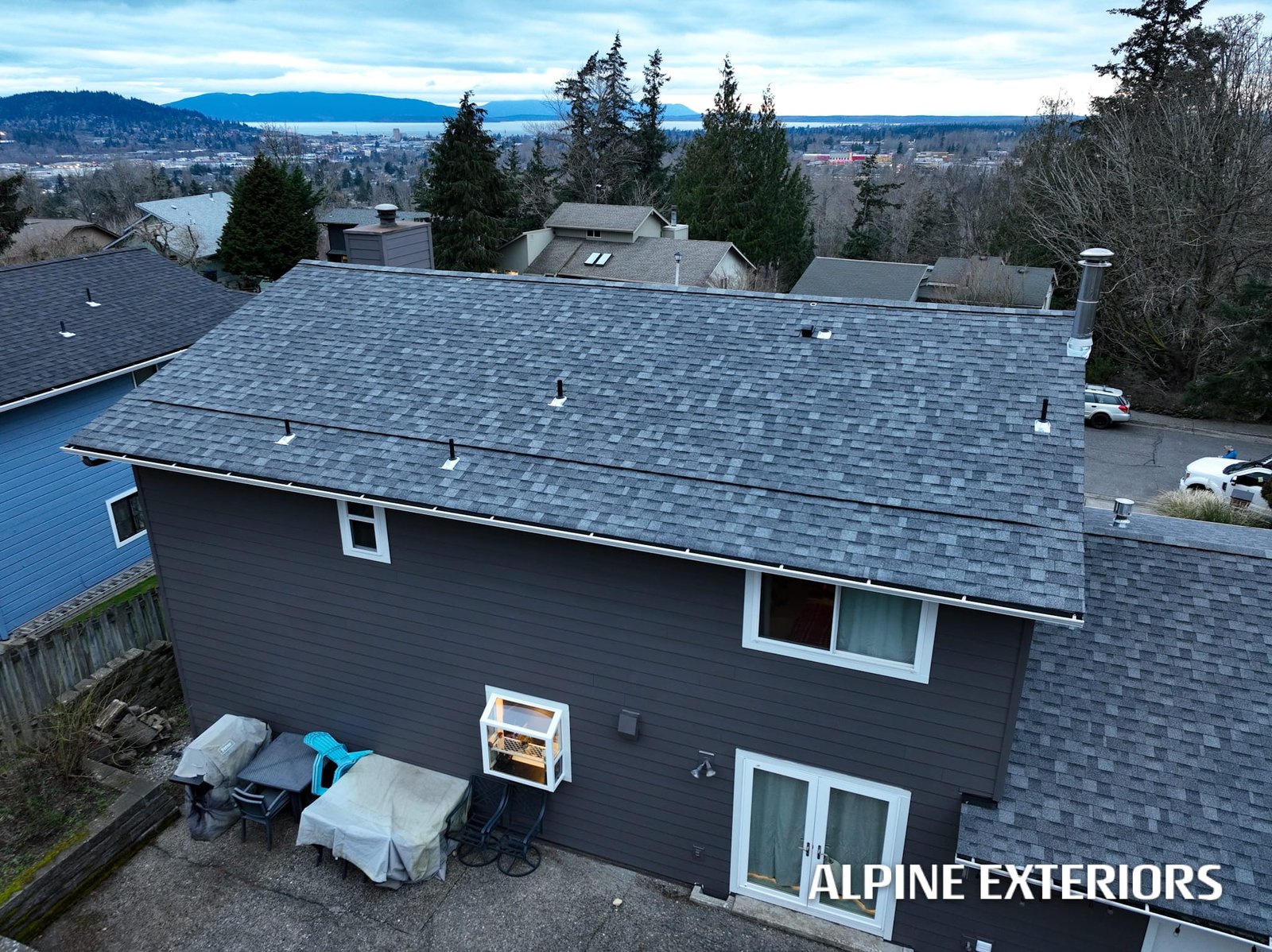
La Conner sits on the Swinomish Channel at the edge of the Skagit flats, and that geography shapes how storms behave here in a few specific ways.
Open, flat terrain funnels wind. Much of the land around La Conner, Mount Vernon and Burlington is farmland with little tree cover or windbreak. Gusts moving off the Strait and across the delta don't lose much energy before they reach a rooftop, which is why roof-edge and gable-end damage shows up here more consistently than it might on a lot tucked into denser forest closer to Sedro-Woolley.
Salt-tinged air accelerates wear on metal. Being close to Skagit Bay and the Swinomish Channel means the air carries more salt than it would further inland. Over years, that speeds up corrosion on gutters, flashing, fasteners and any exposed metal roofing components — something worth factoring in when deciding whether to repair a damaged section or replace it, since a fastener or flashing piece that's already partly corroded is more likely to fail again in the next storm.
Moss is a year-round factor, not just a storm-season one. Shaded, north-facing roof slopes near wooded lots and sloughs around La Conner hold moisture long after a rain event ends, and moss thrives in that environment. Moss does two things that matter for storm damage: it lifts shingle edges as it grows under them, giving wind something to catch, and it holds water against the roof deck longer than a clean roof would, which speeds up rot in the sheathing underneath. A roof with heavy moss buildup is simply more vulnerable to the next windstorm than a clean one, independent of its age.
Ice and snow are mostly a foothill concern, not a La Conner one. Homes further east toward Sedro-Woolley and the Cascade foothills see occasional snow load and freeze-thaw cycling that La Conner itself rarely experiences in a given winter. That means storm damage on the flats is overwhelmingly a wind-and-rain story, not an ice-dam story — which changes what to look for and, honestly, makes La Conner's storm risk somewhat more manageable than it is for homes further inland or at higher elevation.
The Washington State Energy Code can come into play during repair. If storm damage is limited to a patch or a handful of shingles, code generally doesn't get triggered. But if a roof needs to come off entirely, or if storm-damaged windows are being replaced rather than repaired, the Washington State Energy Code's current insulation and fenestration U-factor requirements apply to that scope of work. It's worth asking a contractor up front whether your repair crosses that line, since it affects both material choices and cost.
Once the immediate safety issues are handled, the practical work is mostly about documentation, sequencing and being a little skeptical of anyone who shows up uninvited.
Document before you clean up. Photos and, if possible, short video of the damage from multiple angles make the insurance conversation go faster and give a contractor a clear starting point. Don't get on a wet or moss-covered roof yourself to take these — a ladder shot from the ground or a photo from an upstairs window is safer and usually good enough.
Call your insurer promptly, and read your policy before you assume anything. Homeowner's policies vary on whether wind and rain damage fall under a standard deductible or a separate wind/storm deductible, and on whether your roof is covered at actual cash value or replacement cost — that distinction can mean a meaningfully different payout on an older roof, and it's worth knowing before repairs start rather than after.
Get a tarp on if there's an active leak, but treat it as temporary. Emergency tarping stops the bleeding; it isn't a repair. Alpine Exteriors handles emergency tarp-downs for La Conner homeowners specifically so the interior damage doesn't compound while the claim and permanent repair get sorted out.
Be cautious with contractors who go door-to-door after a storm. Widespread wind events tend to bring traveling repair crews through the area for a week or two. Some do fine work; others push same-day contracts, ask homeowners to sign over insurance proceeds before any inspection, or use low-grade materials that don't hold up to another Skagit Valley winter. It's reasonable to ask for a WA contractor license number, verify it, and get a second opinion before signing anything.
Check whether a permit applies. A full roof replacement, structural repair, or work affecting a load-bearing element typically requires a permit through Skagit County or the Town of La Conner depending on the property's location. A straightforward shingle repair usually doesn't, but it's worth confirming rather than assuming — an unpermitted structural repair can complicate a future home sale or insurance claim.
Set realistic expectations on timeline. After a widespread storm, every roofing crew in Skagit and Whatcom counties is dealing with a backlog at once, and shingle colors or specific window sizes can occasionally be back-ordered. A contractor who tells you a full repair will take a few weeks rather than a few days isn't being evasive — that's often just the reality after a regional storm event. Alpine Exteriors is upfront with La Conner customers about that kind of lag rather than promising a timeline it can't hold.
Most standard Washington homeowner's policies cover sudden wind and rain damage, but coverage details vary — some policies apply a separate wind/storm deductible, and payout may be based on actual cash value rather than full replacement cost depending on your roof's age and your specific policy. Damage from long-term neglect, like a roof that failed because of years of moss buildup rather than the storm itself, is often treated differently by an adjuster, so it's worth reading your policy language and asking direct questions before assuming full coverage.
Storm damage usually looks sudden and localized — a cluster of shingles missing near a roof edge or ridge, a gutter torn loose in one spot, or a fresh scrape and dent from a fallen branch. Moss and age-related wear tend to look gradual and spread out, showing up as thinning granules, curling shingles across a whole slope, or soft, spongy decking under a shaded section of roof — a licensed inspector can usually tell which pattern is present, and that distinction often matters for how an insurance claim gets handled.
A small, like-for-like repair — replacing a section of missing shingles or a damaged gutter run, for example — typically doesn't require a permit. A full roof replacement or any repair involving structural framing generally does, through either Skagit County or the Town of La Conner depending on your property's jurisdiction, so it's worth asking your contractor to confirm before work starts rather than finding out after the fact.
A minor, isolated repair can often be scheduled and completed within a week or two under normal conditions. After a widespread regional storm, expect longer waits — sometimes several weeks — because every local roofing crew is handling a backlog at once and specific materials can be temporarily out of stock; a contractor who gives you a longer, honest timeline right after a big storm is usually being realistic rather than slow.
If your La Conner home took wind, rain or fallen-limb damage, Alpine Exteriors can walk the roof, gutters, siding and deck, document what's storm-related versus pre-existing, and give you a straight answer on what needs emergency attention versus what can be scheduled. Alpine Exteriors holds Washington contractor license ALPINI751OW and works throughout Skagit, Island and Whatcom counties, including La Conner, Mount Vernon, Anacortes, Burlington, Sedro-Woolley, Stanwood, Camano Island and Bellingham. Reach out for an inspection before small storm damage turns into a bigger repair.