
For most homes in Conway and the surrounding Skagit River flats, a well-installed architectural (dimensional) asphalt composition shingle roof remains the most practical choice, with 24- or 26-gauge standing seam metal as the stronger long-term option for anyone planning to stay in the home for decades or dealing with a low-slope section. Both handle the two things that actually wear out a roof here — sustained winter rain and wind gusting off the open farmland between the Skagit River and Puget Sound — better than the alternatives below. Synthetic (composite) shake is a reasonable middle ground for homeowners who want a cedar look without cedar's maintenance burden. Natural cedar shake and clay or concrete tile both have real drawbacks for this specific setting that are worth understanding before you commit, which is why we cover them honestly rather than just listing them as options.
Conway sits low and flat, ringed by farmland with relatively few windbreaks close to the house, and many lots still carry mature fir and cedar trees that shade part of the roof year-round. That combination — open wind exposure on one side of a property and shaded, moss-prone slopes on the other — is the reason no single material is automatically "best" without asking what your particular roof faces.
We weighed each option against the conditions that actually degrade a roof in this part of Skagit County, not generic national ratings:
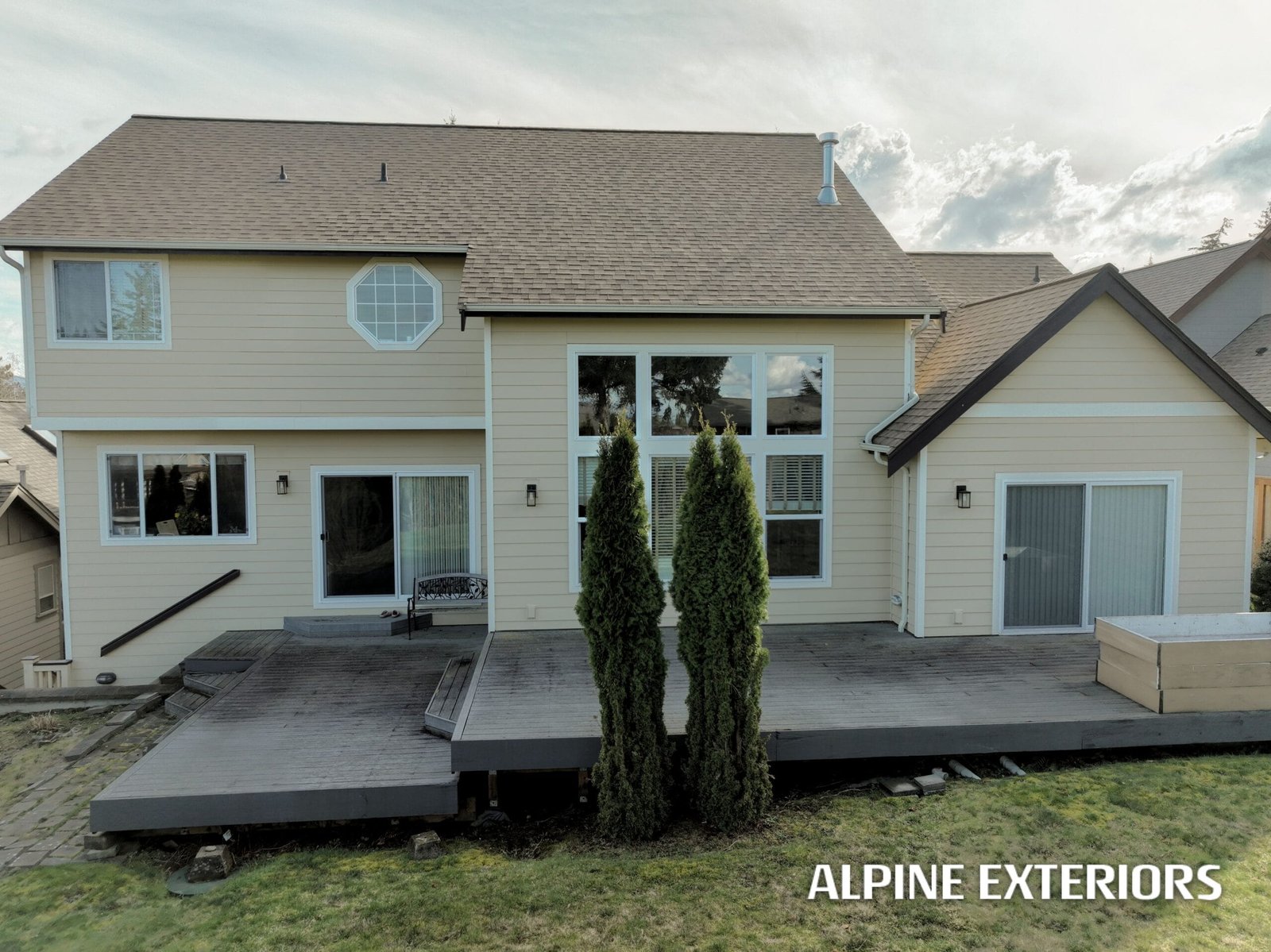
This is the roof on the majority of Skagit County homes for good reason: it balances upfront cost, availability, and performance in sustained rain reasonably well. Architectural shingles are thicker and heavier than older three-tab shingles, which gives them meaningfully better wind resistance at roof edges and hips — a real consideration on the open flats around Conway.
Metal has become far more common on newer builds and reroofs across Skagit and Whatcom counties, and for the open, wind-exposed lots typical of Conway, it's often the strongest technical choice. Standing seam panels shed sustained rain quickly, have no exposed fasteners for wind to work loose over time, and shrug off moss far better than any shingle product because there's no organic surface for it to root into.
Engineered composite products have improved substantially and now offer a genuine alternative for homeowners who like the look of cedar shake or slate without taking on those materials' maintenance demands.
Cedar has a long regional history here and there's no denying the aesthetic appeal, especially on older Skagit farmhouses. We're honest that it's a harder recommendation for most Conway roofs specifically because of the moss and rot risk on shaded slopes.
Tile is uncommon in Skagit County for practical reasons, and Conway's older housing stock generally doesn't change that calculation.
Many Conway properties have a low-slope porch, addition, or shop roof attached to a steeper main roof. For those sections specifically, a membrane system is usually the right call rather than trying to force shingles onto a slope they weren't designed for.
A few choices come up often enough in this area that they're worth calling out directly. Three-tab asphalt shingles, while cheaper upfront, are lighter and have a lower wind rating than architectural shingles, which makes them a poor fit for the open, gusty exposure many Conway lots have on the flats — we see them fail at ridges and edges well before an architectural shingle roof would. Skipping ice-and-water shield membrane at eaves and valleys is another shortcut we advise against; it's inexpensive relative to the whole job and is the main defense against the slow, sustained rain that defines a Skagit County winter working its way under shingles at the most vulnerable seams. Sealing off roof ventilation to save on insulation cost is also a mistake — the Washington State Energy Code assumes a ventilated or properly detailed unvented assembly, and cutting corners there traps moisture in the attic, which accelerates sheathing rot and undercuts the very insulation performance the code is meant to protect. Finally, untreated cedar shake left without a moss-prevention plan on a shaded, tree-lined lot is a recipe for early replacement; if you want the look, budget for the maintenance from day one rather than being surprised by it in year five.
It depends heavily on material and installation quality more than on the marketing figure printed on the shingle wrapper. A well-installed architectural asphalt shingle roof with proper ventilation typically performs well into its 20s in years under our sustained-rain pattern, while standing seam metal commonly reaches 40 years or more with minimal upkeep. The biggest variable isn't the brand — it's whether the underlayment, flashing, and ventilation were done correctly the first time.
Algae-resistant granules help reduce staining and slow moss growth, but they don't eliminate the risk on a heavily shaded, north-facing slope. Roofs under mature fir or cedar trees in and around Conway still benefit from periodic debris clearing and, on the shadiest sections, occasional moss treatment regardless of the shingle line chosen.
For homeowners planning to stay long-term, or for properties on more exposed, wind-prone lots on the flats, the lower lifetime maintenance and stronger wind performance often justify the higher installed cost. For a shorter ownership horizon, or a tighter renovation budget, a quality architectural shingle roof is still a sound, honest choice — it's not a downgrade, just a different cost-versus-lifespan tradeoff.
Reroofing and new construction scopes in Skagit County are subject to the Washington State Energy Code's requirements around insulation and ventilation at the roofline, and the specifics depend on the scope of work and whether the roof deck or insulation is being disturbed. Alpine Exteriors reviews the applicable code requirements with homeowners as part of scoping the project so there are no surprises at inspection.
Every roof in Conway faces its own mix of sun, shade, and wind depending on tree cover, orientation, and slope, so the honest answer to "what's best" really does depend on walking your specific roof. Alpine Exteriors, WA contractor license ALPINI751OW, serves Conway along with the rest of Skagit, Island, and Whatcom counties — including Mount Vernon, Burlington, Sedro-Woolley, Anacortes, La Conner, Stanwood, Camano Island, and Bellingham — and we'll give you a clear, no-pressure assessment of which roofing option actually fits your home, your budget, and how long you plan to stay in it. Reach out to Alpine Exteriors to schedule a roof evaluation and get a written estimate that spells out the material, the installation detailing, and the reasoning behind the recommendation.