
If you're planning a new deck anywhere from Mount Vernon to Bellingham, or out on Camano Island or La Conner, the decking material question usually comes down to two finalists: composite boards or cedar. Both can look great on day one. The difference shows up three winters later, after the boards have spent months soaking under low clouds, drying out for a week, then soaking again. That freeze-thaw-and-soak cycle, plus the shade many lots get from fir and cedar trees, is what actually separates a deck that ages well here from one that doesn't.
Composite decking is the better fit for shaded, low-airflow decks, rental or vacation properties where nobody is around weekly to sweep and treat the boards, and any deck near the water on Camano Island or around Anacortes where salt-laden air accelerates fastener corrosion and wood checking. Cedar is the better fit for homeowners who want a natural look and grain, are willing to do annual maintenance, and have a deck that gets reasonable sun and airflow — think open, south-facing decks in Burlington or Sedro-Woolley rather than a shaded space tucked under mature trees. Neither material is wrong; the mismatch happens when cedar goes on a shaded, damp deck and gets treated like a set-it-and-forget-it surface, or when composite goes on a budget that can't absorb the higher upfront cost.
Composite decking is manufactured from a blend of wood fiber and recycled plastic, usually with a plastic cap (capstock) bonded over the core. That cap is the whole point in our climate — it keeps the board's core from absorbing rainwater the way solid wood does, which matters when a deck can sit wet for days in November and December. Capped composite doesn't need to be sealed, stained, or oiled, and it resists the moss and algae growth that shows up fast on shaded wood surfaces around here. Boards are also dimensionally stable enough that they won't cup or crown the way a wet cedar plank can after repeated soak-and-dry cycles.
The tradeoffs are real. Composite costs more per square foot up front, it can get slick when a thin layer of algae forms on uncapped or textured low-traction boards left unwashed under a shade canopy, and if the capstock is ever punctured or cut through, that spot can wick moisture into the core over time. Color and grain patterns are also manufactured, so it doesn't have the natural variation of real wood — some homeowners like that consistency, others miss the character of cedar.
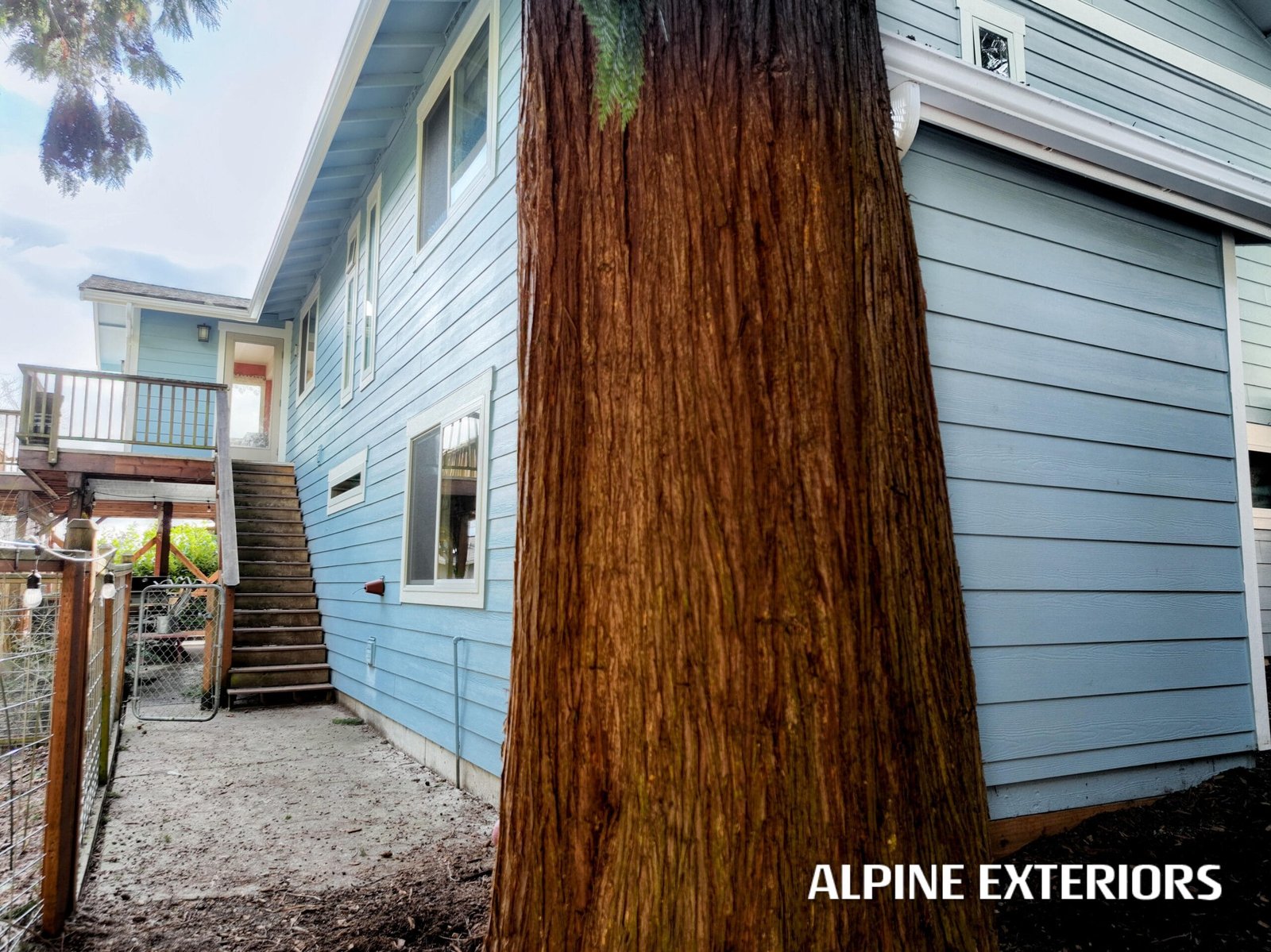
Western red cedar has a long track record in the Pacific Northwest for a reason: it's naturally resistant to rot and insects, it's lighter to work with, and it ages into a soft silver-gray if left unfinished or keeps its warm tone if it's oiled or stained regularly. It's also the material most likely to be sourced regionally, which some homeowners in Whatcom and Skagit counties prefer. Cedar takes stain and sealer well, and a well-maintained cedar deck has a warmth and grain that composite simply doesn't replicate.
The catch is maintenance, and it isn't optional here. A cedar deck exposed to our winter rain needs a water-repellent sealer or stain reapplied roughly every one to two years, sooner in shaded spots where moisture lingers longest. Skip that upkeep and cedar will gray unevenly, develop surface checking (small splits along the grain), and become a magnet for moss on any board that doesn't get afternoon sun. Fasteners can also stain the wood if they aren't stainless or coated for exterior use. Cedar is a good material for someone who wants a natural deck and is genuinely willing to maintain it — it's a poor fit for a deck nobody plans to touch after installation.
| Factor | Composite | Cedar |
|---|---|---|
| Upfront cost | Higher material cost, often roughly 1.5 to 2 times cedar per square foot | Lower material cost, though prices shift with lumber markets |
| Expected lifespan here | Often 20-30+ years with the cap intact, less affected by our wet-dry cycles | Commonly 10-20 years with consistent sealing; less with neglect in shaded spots |
| Maintenance | Occasional washing; no staining or sealing needed | Sealer or stain reapplied every 1-2 years, plus periodic moss and mildew treatment |
| Appearance | Consistent color and grain, limited style/color options, doesn't weather naturally | Natural grain and warmth, ages and weathers uniquely, can look tired if maintenance lapses |
For most homes we work on across Mount Vernon, Anacortes, Burlington, Sedro-Woolley, La Conner, Stanwood, Camano Island and Bellingham, we lean toward recommending composite for decks that are shaded by trees, tucked under a covered porch roof with little sun exposure, or exposed to salt air near the Sound or the Strait, since those are exactly the conditions that punish unmaintained wood fastest. The moss that grows on north-facing roofs in this region grows just as readily on a shaded, damp deck board, and composite simply doesn't feed it the way bare or under-sealed cedar does.
That said, we still install a fair amount of cedar, and we're upfront with clients about what it needs. If your deck gets good sun and airflow, and you're the type of homeowner who's fine putting a sealer on it every couple of years, cedar rewards that effort with a look composite can't fully match. Alpine Exteriors builds both, and our first conversation on-site is usually about sun exposure, drainage, and how the deck will actually be used and maintained, not just which material sounds nicer. Wind off the Skagit flats and the Strait also factors into railing and post spacing on either material, and any covered or enclosed deck area we build is detailed to meet current Washington State Energy Code requirements where the work ties into conditioned space.
It can, especially in heavily shaded spots where a thin film of algae builds up between cleanings. Most modern composite boards have a textured, slip-resistant surface, but they still benefit from an occasional wash with a deck cleaner or mild soap and water, particularly on the shadiest sections of a lot.
Cedar is naturally more rot-resistant than most softwoods, but it isn't rot-proof, and consistent winter rain will eventually take a toll on any board that isn't sealed and allowed to drain properly. Proper spacing between boards, good under-deck airflow, and a sealer applied on schedule are what keep a cedar deck sound for the long haul.
Plan on roughly every one to two years for most cedar decks in Skagit, Island and Whatcom counties, with shaded or low-airflow sections needing it closer to the one-year mark. South-facing decks with good sun exposure can sometimes stretch a bit longer between treatments.
For most rental and vacation homes, yes — the appeal of composite is that it doesn't rely on someone being on-site regularly to stain or clean it. Given how much rain and shade many properties see in this region, a maintenance lapse on cedar shows up fast, which is a real risk when nobody's checking on the deck between visits.
Every lot around Mount Vernon, Anacortes, Bellingham and the surrounding islands gets a different mix of sun, shade and wind, and that mix should drive the decking decision more than a general rule of thumb. Alpine Exteriors, WA contractor license ALPINI751OW, will walk your site, look at drainage and exposure, and give you a straight recommendation along with a real cost range for composite or cedar — reach out to schedule a visit.