

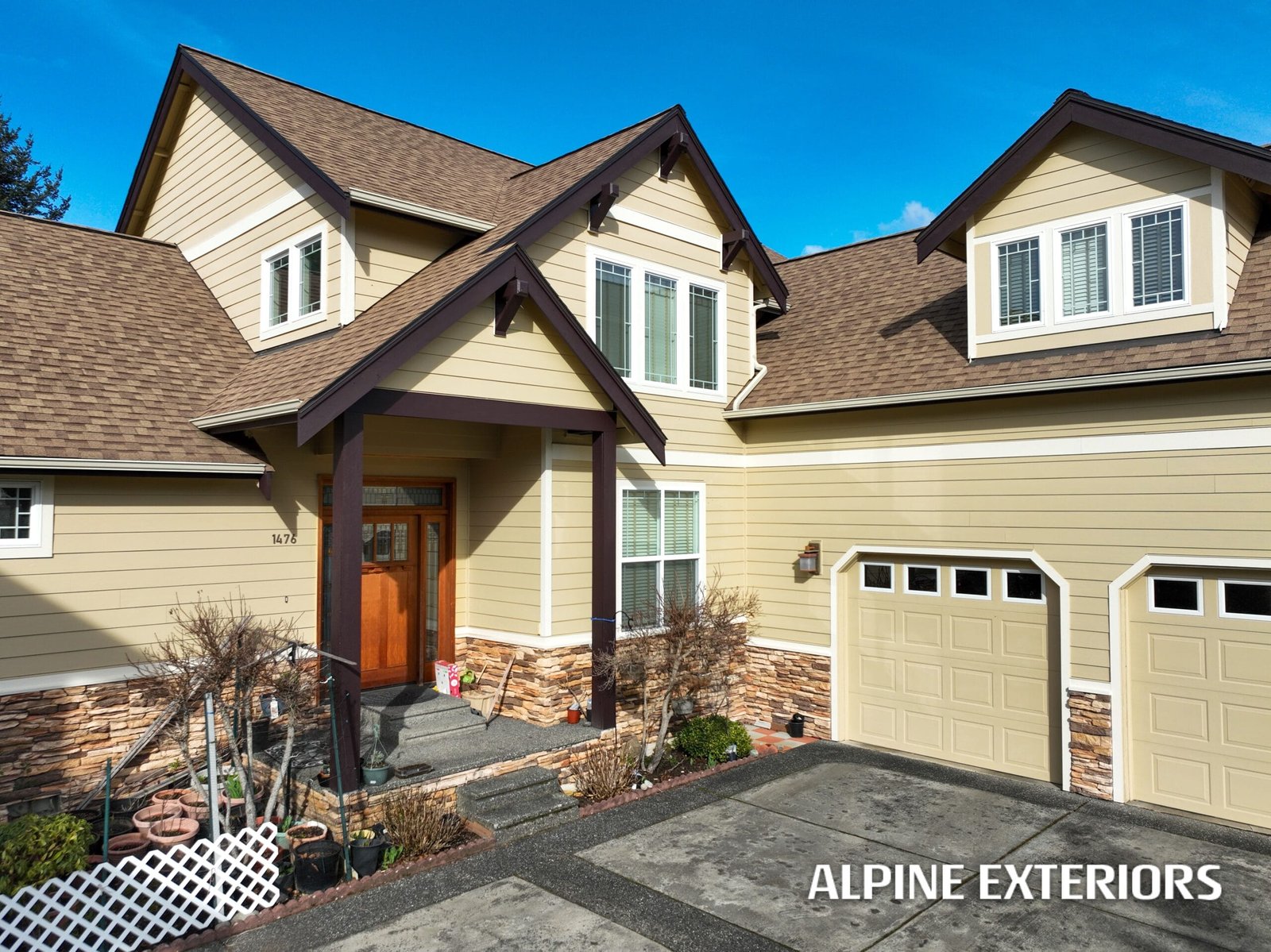
For most homes across Mount Vernon, Burlington, Sedro-Woolley, La Conner and Anacortes, seamless aluminum gutters are the right default. They resist corrosion in our wet climate, come in a wide range of colors to match trim, and cost less to install and replace. Steel gutters earn their place in more specific situations: homes tucked under mature fir and cedar stands where falling limbs and cones regularly hit the gutter line, properties near the Cascade foothills that see occasional heavy wet snow, or anywhere a homeowner has had repeated dent damage from ladders, roof rakes, or storm debris. Neither material is wrong here — the choice comes down to how much physical abuse the gutter line takes on a given roof, and how close the home sits to saltwater.
Aluminum is the standard gutter material installed on new construction and replacement jobs throughout Skagit, Island and Whatcom counties, and for good reason. It doesn't rust, which matters through our long wet season when gutters stay damp for months at a stretch. Most residential aluminum comes in .027" or .032" thickness — the heavier .032" gauge holds up noticeably better under ladder contact and is worth the modest upcharge on any home with a lot of tree cover. Aluminum is also light enough to run in continuous seamless lengths formed on-site from a roll-form machine, which cuts down on the joints where leaks and clogs tend to start.
The honest drawback: aluminum is a soft metal. A ladder set carelessly against the fascia, a heavy branch coming down in a windstorm, or an aggressive pressure-washing job can leave a visible dent that doesn't pop back out. It's also more prone to oil-canning (a wavy look along long straight runs) than steel if hangers are spaced too far apart. Neither issue affects function much, but they're worth knowing before you choose.
Steel gutters — usually galvanized or the more corrosion-resistant galvalume steel, finished with a baked-on paint coating — are noticeably more rigid than aluminum. They shrug off impacts that would dent aluminum, which is the main reason to consider steel: a heavily wooded lot in Sedro-Woolley or a foothills property that occasionally gets a wet, heavy snow load will put less-forgiving stress on the gutter system than a typical in-town lot. Steel also holds a straighter line over long runs and, in a properly installed system, will last many years.
The tradeoff is real, though. Steel is heavier and more expensive to buy and install, and it doesn't lend itself to seamless roll-forming the way aluminum does — most residential steel gutter is installed in sectioned lengths, which means more seams and more potential leak points over time. The bigger concern for this region is corrosion at any point where the factory coating gets scratched or the metal is cut on-site: exposed steel rusts, and that risk climbs the closer a home sits to saltwater. On Camano Island, around Similk Bay and Fidalgo Bay near Anacortes, and along the shoreline in La Conner, salt-laden air off the Sound will find any nick in the coating faster than it will inland in Burlington or Mount Vernon. Aluminum simply doesn't have that failure mode, since the base metal itself resists oxidation without relying on a coating staying intact.
| Aluminum | Steel | |
|---|---|---|
| Cost | Lower material and labor cost; seamless forming keeps installed pricing competitive on most homes | Higher material and labor cost, especially in heavier gauges; sectional installation adds labor time |
| Lifespan | Long service life when properly hung and kept clean; the metal itself doesn't rust | Long service life if the coating stays intact; shorter and less predictable if scratches or cut edges are left exposed near salt air |
| Maintenance | Standard debris clearing 1-2 times a year under fir and cedar cover; dents from impact are cosmetic but don't self-repair | Same debris-clearing needs, plus periodic checks for coating damage, scratches, and any rust starting at seams or cut ends |
| Appearance | Wide factory color range, clean seamless look with minimal visible joints | Fewer stock color options in most markets, but a crisper, straighter line on long runs and better resistance to visible dents |
For a typical home in Mount Vernon, Burlington or Sedro-Woolley without unusual tree exposure, seamless aluminum in the heavier .032" gauge is the practical choice. It handles our heavy winter rain without issue, the seamless installation reduces leak points, and the cost stays reasonable. The moss that builds up on shaded, north-facing roofs under conifer canopy is a roofing and gutter-guard issue more than a material issue — either aluminum or steel gutters will collect the same needle litter and grit washing off a mossy roof, so a gutter guard or leaf screen matters more here than which metal sits underneath it.
Wind off the Skagit flats and gusts funneling down the Strait toward Anacortes and Whidbey/Camano Island are more a function of how well the gutters and hangers are fastened than which metal you pick. A gutter hung on hangers spaced too far apart will pull loose in a windstorm whether it's aluminum or steel; proper hanger spacing and secure end-cap sealing matter more than material for wind resistance.
Where the decision genuinely tilts toward steel is on wooded, foothill-adjacent lots — the kind of property near Sedro-Woolley or the edges of Whatcom County where occasional heavy wet snow and falling limbs from tall fir and cedar put real physical stress on the gutter line. If a home has a documented history of dented gutters or sits close enough to the tree line that limb-fall is a recurring problem, the added rigidity of steel is worth the extra cost.
Where it tilts firmly toward aluminum is anywhere close to saltwater — Camano Island, the shoreline in La Conner, and the bay-facing sides of Anacortes. Salt-laden air accelerates corrosion at any break in a steel coating, and aluminum removes that risk entirely. It's also worth noting that keeping water moving away from the building envelope through functioning gutters and downspouts supports the moisture-management goals behind the Washington State Energy Code's building envelope requirements — a poorly draining or leaking gutter system that dumps water against siding and foundations works against the same moisture control the code is designed to protect, regardless of which metal is used.
Alpine Exteriors looks at each of these factors — tree cover, proximity to saltwater, wind exposure and existing damage history — during an on-site assessment before recommending a material, rather than defaulting to one option for every roof. Most homes in this service area end up with aluminum; a meaningful minority of wooded or foothill properties are better served by steel.
Properly coated steel gutters can go many years without rusting, but our long wet season means any scratch, nick, or cut edge that exposes bare steel has months of standing moisture to work with. Rust typically shows up first at end caps, seams, and spots where a ladder or tool has chipped the paint, so steel gutters do need an occasional visual check in a way aluminum doesn't.
Most of the immediate service area — Mount Vernon, Burlington, La Conner, Anacortes — sees occasional light snow that isn't a major factor in gutter selection. Homes closer to the Cascade foothills near Sedro-Woolley can see heavier, wetter snow loads more often, which is one of the situations where steel's added rigidity is genuinely worth considering over aluminum.
Mixing dissimilar metals in direct contact can accelerate corrosion through galvanic reaction, so it isn't recommended as a standard practice. If a home needs steel gutters in one high-impact area and aluminum elsewhere, the transitions should be planned and isolated properly rather than left to chance.
Gutter guards matter about equally with either material here, since the debris problem in this region — fir needles, cedar litter, and grit washed off mossy roofs — clogs guards and screens the same way regardless of what metal sits underneath. The bigger factor in guard selection is roof and tree cover, not gutter material.
If you're weighing aluminum against steel for a roof in Mount Vernon, Anacortes, Burlington, Sedro-Woolley, La Conner, Stanwood, Camano Island or Bellingham, Alpine Exteriors can walk your property, look at tree cover, wind exposure and salt-air proximity, and recommend a gutter system sized and specified for your actual conditions rather than a one-size-fits-all pick. Alpine Exteriors holds Washington contractor license ALPINI751OW and installs both aluminum and steel gutter systems across Skagit, Island and Whatcom counties. Contact us for an on-site assessment and a written estimate before your next round of fall storms.



