
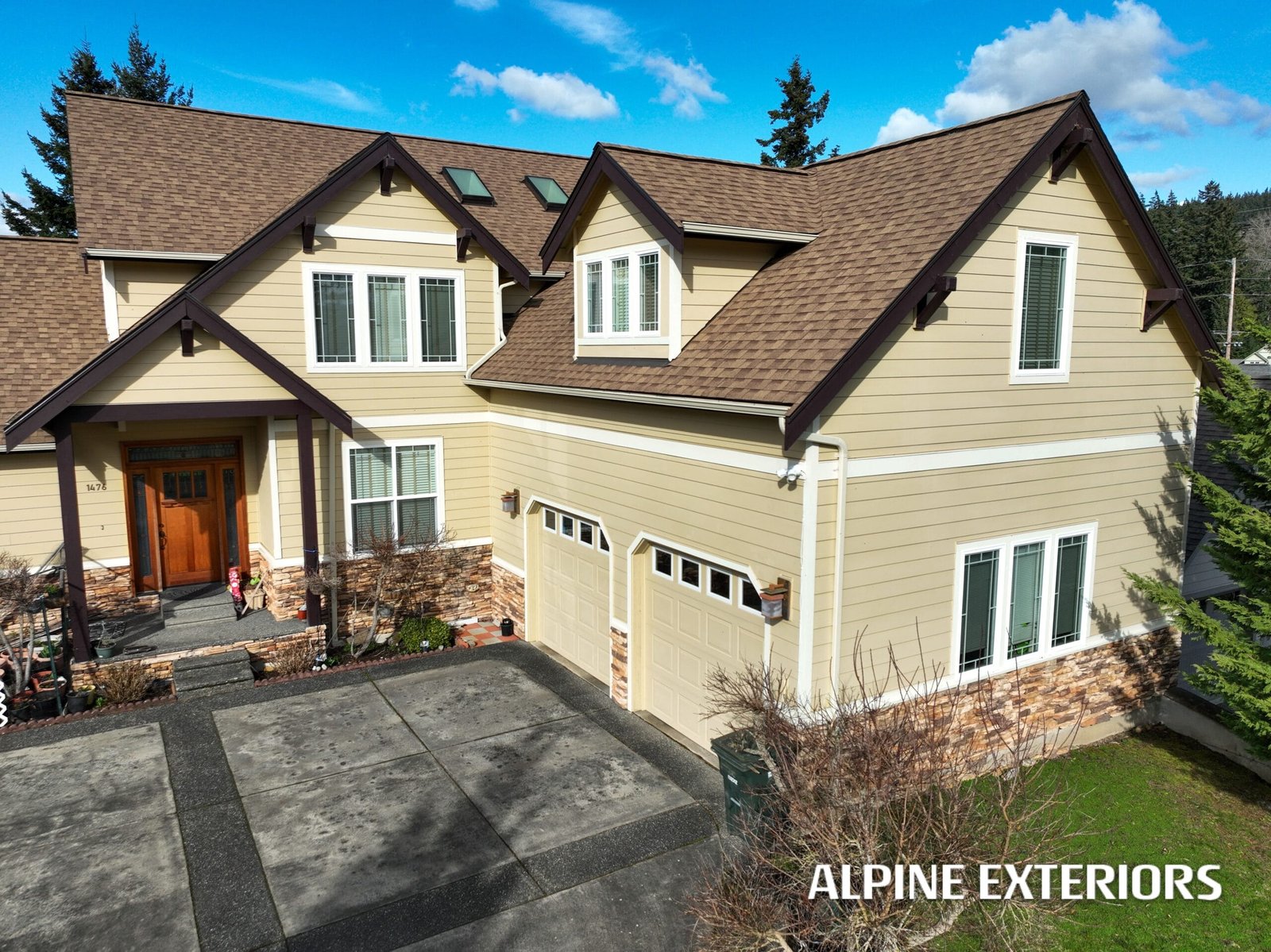
If you own a home in Mount Vernon, Anacortes, Burlington, Sedro-Woolley, La Conner, Stanwood, on Camano Island, or up toward Bellingham, you already know the trade-off of living here: mild winters, a lot of tree cover, and rain that barely lets up from October through May. That combination is close to ideal for moss, and moss on a roof is not just cosmetic. Left alone, it holds moisture against shingles, lifts tabs, and can shorten the life of an otherwise sound roof by years. This page walks through realistic cost ranges for roof cleaning and moss treatment in Skagit, Island and Whatcom counties, what actually moves the price up or down, and how to read a quote so you're comparing apples to apples.
Most single-family homes in this area fall into a broad range for a professional roof cleaning and moss treatment visit, with the final number shaped by roof size, pitch, moss severity, and how the crew accesses the roof safely. Steep, multi-story homes near the water in Anacortes or on Camano Island tend to land at the higher end because of rigging and fall-protection time, while a simple single-story ranch in Burlington with moderate moss is usually toward the lower end. Treating moss on a metal roof is a different process than a comp shingle roof, and cedar shake requires its own gentler approach, so material matters as much as square footage.
| Cost Factor | Low End | High End |
|---|---|---|
| Roof size and number of stories | Smaller, single-story footprint | Large or multi-story footprint |
| Moss severity and roof age | Light surface growth, recently treated | Heavy, thick moss mats built up over years |
| Roof pitch and access | Low-slope, easy walkable roof | Steep pitch requiring harnesses and staging |
| Cleaning method | Low-pressure soft wash / manual scrape | Extensive manual removal plus treatment |
| Roof material | Composition shingle | Cedar shake or specialty tile (more labor-intensive) |
| Added services | Roof treatment only | Gutter cleaning, zinc/copper strip install bundled in |
| Travel and ferry access | Mainland Skagit/Whatcom locations | Camano Island or other water-crossing routes |
These are ranges, not quotes. A homeowner who calls Alpine Exteriors for a Sedro-Woolley two-story with a north-facing roof shaded by fir trees should expect a different number than a neighbor with a sun-exposed, single-pitch garage roof, even on the same street. The only way to get an accurate figure is a look at the actual roof.
A handful of local, real-world factors push the price in either direction more than anything else:
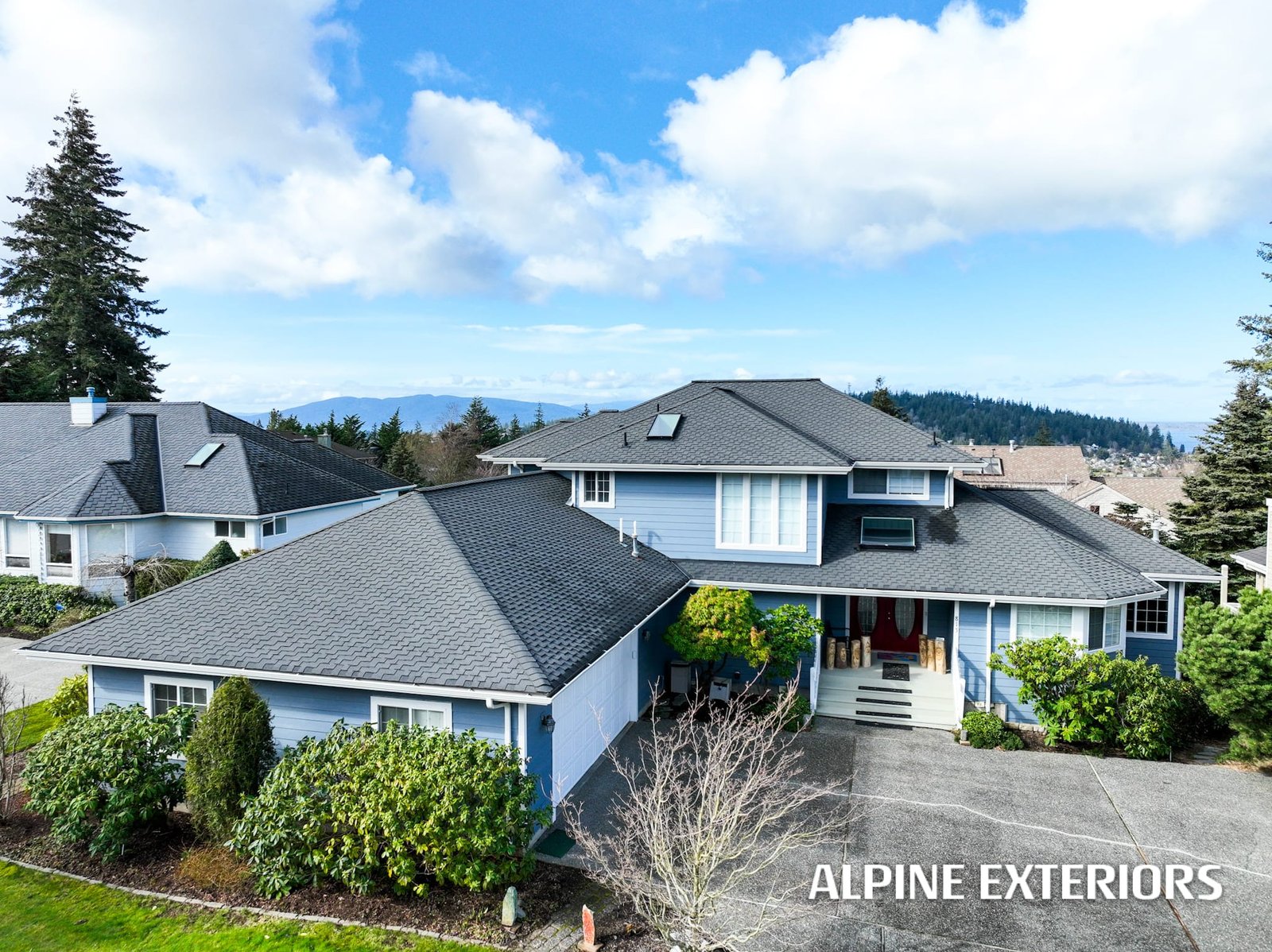
A written quote for roof cleaning and moss treatment should spell out the method being used — low-pressure soft washing and hand removal is standard for asphalt shingle roofs in this region, since high-pressure washing can strip granules and shorten shingle life. It should also specify whether gutters and downspouts are included, since moss and needle debris from nearby conifers clog gutters just as fast as it grows on the roof itself, and a clean roof draining into a clogged gutter doesn't solve the moisture problem. Ask whether the treatment includes a moss-inhibiting application and whether zinc or copper strips are quoted separately. A thorough contractor will also note what they found during the walk — soft spots, lifted flashing, exposed nail heads — even if that's outside the scope of the cleaning itself, because leaving those unmentioned just delays a bigger repair. Alpine Exteriors builds that walk-through into every roof cleaning estimate for exactly this reason: a moss job is also a chance to catch small problems before winter rain turns them into leaks.
When you're holding two or three bids side by side, resist the urge to pick the lowest number without reading what's behind it. A cheap quote that skips gutter cleaning, uses high-pressure washing instead of soft washing, or doesn't include a moss-inhibiting treatment will likely need to be redone sooner, which erases the savings. Confirm the contractor is licensed to work in Washington and carries liability insurance and worker's compensation coverage — roof work involves real fall risk, and that coverage protects you as the homeowner if something goes wrong on your property. Ask how they protect landscaping, gutters, and downspouts during the wash, and whether debris and moss are bagged and hauled off rather than left to wash into flower beds or storm drains. Finally, ask what warranty, if any, applies to the moss treatment itself — a reasonable regrowth window is a fair thing to expect, though no honest contractor will promise moss never returns in a climate this wet.
Roof cleaning and moss treatment is routine maintenance, so it's rarely covered by homeowner's insurance and isn't the kind of project most lenders finance on its own. Where insurance does come into play is on the repair side: if moss removal uncovers storm or wind damage — a real possibility after a hard blow off the Strait or the Skagit flats — that portion of the work may be a legitimate insurance claim, and it's worth documenting with photos before and after cleaning. Some homeowners choose to pair a moss treatment with a broader exterior project, like gutter guards or partial re-roofing, and finance that larger scope through a home improvement loan or a contractor payment plan; ask upfront whether financing options are available if you're bundling work. For straightforward cleaning and treatment with no repair component, most homeowners in Skagit, Island and Whatcom counties budget for it as a periodic maintenance expense rather than a financed purchase.
It depends heavily on shade and exposure. A sun-exposed roof with little tree cover might go several years between treatments, while a shaded roof near the Skagit River or under mature firs in Sedro-Woolley or Bellingham can need attention every year or two. Zinc or copper strips extend that interval by continuously releasing a mild moss-inhibiting runoff with every rain, which is common enough here that many roofers recommend it as a standard add-on rather than an upsell.
Moss holds water against the shingle surface and can lift tabs as it grows, which lets water track underneath rather than shedding off. Over a wet winter, that trapped moisture accelerates granule loss and, in the worst cases, contributes to soft decking underneath. It's not usually an emergency, but it's not purely cosmetic either — a moss-covered roof that's ignored for several seasons is more likely to need repair sooner than one that's been kept clean.
Generally, yes, for asphalt shingle roofs. High-pressure washing can blast off the protective granules that shield shingles from UV and weather, which shortens the roof's remaining life even as it makes the roof look cleaner in the short term. Soft washing with a lower-pressure method and appropriate cleaning solution, combined with hand removal of heavier moss mats, is the standard approach most reputable roofers use in Western Washington, and it's what Alpine Exteriors uses on shingle roofs across its service area.
Moss and trapped moisture themselves don't directly change attic insulation values, but a roof that's been compromised by long-term moss damage — lifted shingles, soft decking, or moisture intrusion — can undermine the ventilation and moisture-control assumptions that Washington State Energy Code compliance depends on when a roof is later replaced or an attic is re-insulated. Keeping moss under control is one of the simpler ways to avoid that becoming a bigger, code-relevant problem down the road.
Every roof in this region carries its own combination of pitch, shade, material, and moss history, which is exactly why the ranges above are a starting point rather than a quote. Alpine Exteriors, WA contractor license ALPINI751OW, provides on-site estimates for roof cleaning and moss treatment across Mount Vernon, Anacortes, Burlington, Sedro-Woolley, La Conner, Stanwood, Camano Island and Bellingham, with a straightforward walk-through of what the roof needs now and what can wait. If moss has taken hold on your roof, reach out for an estimate before the next round of winter rain gives it more time to work its way under the shingles.