

If you own a home on Camano Island, you already know your roof works harder here than it would a few hours inland. Marine air off Port Susan and Saratoga Passage, near-constant winter rain, and shade from mature Douglas fir and cedar canopy all take a toll on shingles, flashing, and fasteners in ways that are easy to miss until a small problem becomes an expensive one. This guide walks through the warning signs Alpine Exteriors sees most often on Island County roofs, explains what causes them locally, and helps you figure out whether you are looking at a routine roof repair or a roof nearing the end of its usable life.
Camano Island sits surrounded by saltwater on three sides, which means every roof here is exposed to a level of humidity and airborne salt that roofs in, say, Sedro-Woolley or Burlington simply don't deal with as much. That moisture doesn't evaporate off the roof surface as quickly as it would in a drier climate, and the fine salt content in coastal air can accelerate corrosion on exposed metal fasteners, flashing, and gutter hardware over time. Add in the island's heavy tree cover — much of Camano is wooded with Douglas fir, cedar, and big-leaf maple — and you get roof sections that stay shaded and damp for days after a storm passes, even when the rest of the property has dried out.
None of this means a Camano Island roof is doomed to fail early. Plenty of well-installed roofs here reach or exceed their expected lifespan. But it does mean the maintenance and inspection schedule that works for a roof in a drier, more open part of Skagit or Whatcom County isn't quite enough on the island. Roofs here benefit from more frequent moss treatment, more attention to flashing condition, and closer tracking of granule loss, because the combination of moisture, shade, and salt air compounds faster than any one factor alone.
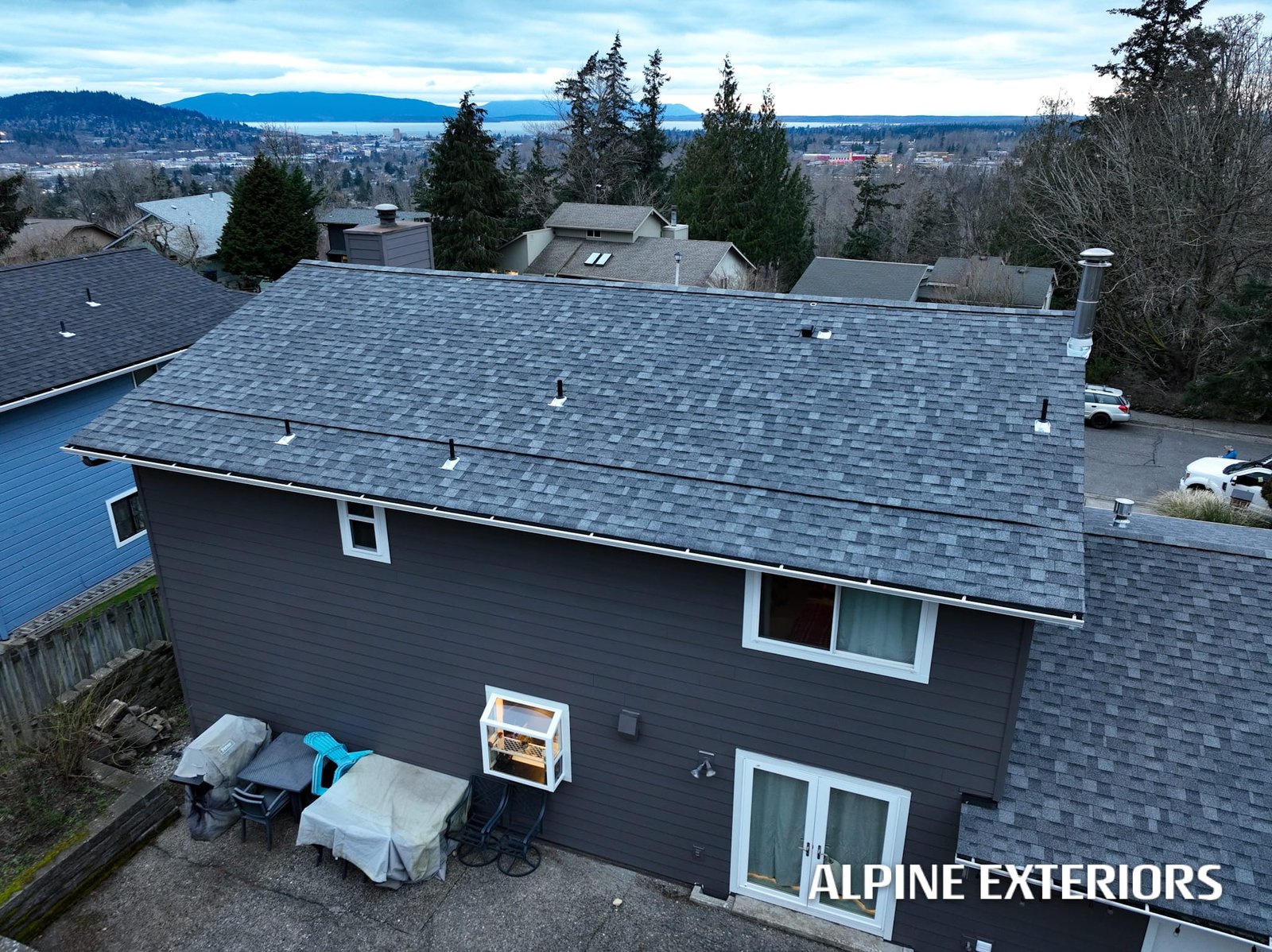
After years of roof inspections and repairs across Camano Island and the surrounding communities of Stanwood, Mount Vernon, and Anacortes, a handful of problems show up again and again. They aren't exotic — they're the predictable result of the same weather pattern hitting the same vulnerable spots on every roof, year after year.
The edges of a roof — the eaves, rake edges, and drip lines — take the brunt of wind-driven rain coming off the Strait and the Skagit flats. Wind in this part of Island County rarely reaches damaging speeds on its own, but it doesn't need to; steady wind pushes rain sideways and up under the first course of shingles, which is exactly where edge wear starts. What this actually looks like up close: shingle tabs that have curled upward at the corners, lifted or missing drip edge flashing, and granule loss concentrated in a band along the perimeter of the roof rather than spread evenly across the field. Left alone, edge wear lets water track back under the underlayment, which is how a cosmetic issue turns into a structural one.
Every roofing nail, screw, and staple on your roof is a small metal object sitting in a moist, salt-tinged environment for years at a stretch. Over time, fastener heads can back out slightly as the wood decking expands and contracts with seasonal moisture, and the exposed metal starts to corrode faster than it would inland. You'll often see this as a faint pattern of raised dots under the shingle surface, or as rust streaking running down from a fastener line after rain. Trim boards and fascia — especially painted wood trim — show similar stress: paint failure, soft spots, and nail pops are common where trim meets roofing material.
This is probably the single most visible roof issue on Camano Island, and it's almost entirely a function of shade and moisture retention. North-facing slopes and any section that sits under overhanging branches stay damp longer after rain, and moss spores that would dry out and die on a sun-exposed roof instead take hold. Left untreated, moss does more than look bad — its root structures work into the shingle surface and lift tabs, which breaks the shingle's ability to shed water. Algae staining, the dark streaking you sometimes see running down from ridge lines, is more cosmetic but is often a sign that moisture is sitting on the roof longer than it should. Repairs for moss and algae growth are one of the most common service calls we get on the island, and catching it early with a gentle treatment is far cheaper than replacing shingles that moss has already damaged.
Big-leaf maple and Douglas fir drop a steady stream of needles, leaves, and small branches onto Camano Island roofs for most of the year. When that debris collects in valleys, behind chimneys, against dormer walls, or in gutters, it holds water against the roofing material long after the rest of the roof has dried. That trapped moisture is what accelerates rot in the decking underneath and gives moss an ideal place to establish. Gutters clogged with debris also back water up under the shingle edge during heavy rain, which is a completely preventable cause of interior water damage and mold.
One of the more frustrating patterns we see is a small leak that shows up during one heavy storm, seems to dry out, and then reappears during the next one. That on-and-off pattern almost always means there's a failure point — a cracked flashing seal, a gap in the underlayment, a fastener that's backed out just enough — that only leaks under certain wind and rain conditions. Homeowners sometimes wait on these because the leak "isn't that bad," but a repeating leak is doing damage every time it happens, even if the visible sign dries up in between. By the time staining is obvious on a ceiling, water has usually been getting into the structure for longer than most people assume.
Most of the roof problems described above start small and start high up, which is exactly why they go unnoticed for so long. Standing in your driveway, you can see obvious problems like a missing shingle or a visibly sagging section, but you can't see granule loss, hairline cracking, or flashing that's lifted a quarter inch. Camano Island's tree cover makes this worse — a heavily shaded roof section might look fine from the ground simply because you can't get a clear sightline to it through the branches.
This is also why gutter condition is such a useful early warning sign. Granules collecting in the gutter or at the downspout outlet tell you the shingle surface is shedding its protective coating faster than normal, well before that wear becomes visible from below. Checking gutters after a hard rain, or having a contractor walk the roof directly, catches problems years before they'd otherwise be noticed — which is the difference between a simple roof repair and a full roof replacement.
Not every part of a roof ages at the same rate. Based on the repair calls and roof inspections we've done across Skagit, Island, and Whatcom counties, here's the rough order in which coastal Pacific Northwest roofs tend to show trouble first:
Notice that none of these are randomly distributed — they're predictable based on how water moves across a roof and where shade and debris collect. That predictability is useful, because it means a thorough roof inspection can focus on the highest-risk areas first rather than treating the whole roof as an unknown.
Not every warning sign means you need a crew on the roof this week. Being able to tell the difference saves money and avoids unnecessary disruption, but it also means not gambling with something that's actually time-sensitive.
Treat as urgent (schedule within days, not months): active interior leaking, daylight visible through the roof deck, soft or spongy decking you can feel underfoot or see sagging from below, storm damage that's exposed the underlayment or decking, or any leak that's appeared more than once in the same spot. Water intrusion during Camano Island's wet season doesn't pause while you wait for a convenient time — every rain event after damage occurs adds to the problem, and delayed action is how a modest repair becomes a much larger, costlier one.
Can reasonably wait for scheduling (weeks, with monitoring): light to moderate moss on shaded sections with no visible shingle lifting yet, minor granule loss without exposed matting, cosmetic algae streaking, small areas of gutter debris, and trim wear that hasn't compromised the roof edge. These are worth addressing on a normal service timeline, ideally before the next heavy rain season, but they're not actively letting water into your home right now.
The honest answer, though, is that "can wait" is not the same as "can be ignored indefinitely." A roof issue that's cosmetic today is often the thing that becomes urgent in twelve to eighteen months if conditions on that section — shade, debris, drainage — don't change. A roof inspection is the only reliable way to know which category you're actually in.
Homeowners often ask us to just look at a photo and tell them whether they need a repair or a whole new roof. That's usually not possible from a photo alone, because the same visible symptom — a stain on the ceiling, a patch of moss — can point to three very different underlying situations.
This is gradual, weather-driven aging spread across specific zones of the roof — edges, shaded slopes, valleys — rather than one isolated spot. It shows up as granule loss along the perimeter, moss on north-facing sections, and mild fastener corrosion, all developing at a similar pace because they're being driven by the same conditions: moisture, salt air, and shade. A coastal wear pattern usually means the roof is aging normally for its environment, and the right response is proactive maintenance — moss treatment, flashing recaulk, gutter clearing — on a regular schedule.
This is damage confined to one specific spot with an identifiable cause — a cracked flashing seal around one vent, a branch strike that cracked a handful of shingles, a single area where a fastener backed out. The rest of the roof looks and performs normally. This is the best-case scenario when a problem is found, because it's typically a straightforward, contained roof repair rather than something that points to a system-wide issue.
This is what it looks like when multiple failure points show up at once, independent of each other: granule loss across the whole field (not just the edges), multiple flashing points failing, decking that's gone soft in more than one location, and a roof age that's already near or past its expected service life. When we see this combination, it usually means the roofing system as a whole — not just one component — has reached the point where continued repair costs start to rival replacement costs, and replacement becomes the more financially sound path.
The distinction matters because the fix is completely different in each case. Treating a broader aging system concern with a series of one-off repairs tends to lead to a cycle of costly future repairs that never actually resolves the underlying issue, because you're patching individual symptoms of a roof that's simply worn out.
You don't need to climb on your roof to do a reasonable first-pass check. Most of what matters can be assessed safely from the ground, the attic, and your gutters:
If any of these checks turn up something you're not sure about, that's exactly what a professional roof inspection is for. It costs far less than guessing wrong in either direction — either replacing a roof that had years of life left, or patching a roof that actually needed a full tear-off.
If you've gotten to the point of collecting quotes, a few things separate a useful bid from one that will leave you guessing:
Price alone is a poor way to compare roofing bids, because two contractors pricing the "same" job can be quoting very different materials, warranty terms, and scopes of work. The lowest bid that skips coastal-rated underlayment or ventilation upgrades can end up costing more over a decade than a slightly higher bid that addresses the actual conditions on your property.
This is the question most homeowners are really asking when they call about roof issues, and there's no universal answer, but there are useful rules of thumb.
Repair generally makes sense when the roof is under roughly 15 years old, the damage is contained to one area, the decking underneath is still solid, and the rest of the roof shows only normal wear for its age. In these cases, a targeted repair — replacing a section of shingles, resealing flashing, addressing a moss patch — restores full function without disturbing a roof system that still has significant useful life left.
Replacement becomes the smarter call when a roof is approaching or past 20 years old and starting to show multiple, independent problems at once; when decking has gone soft or shown rot in more than one location; when repairs have already been made two or three times in recent years without resolving recurring leaks; or when the cost of the repairs being proposed starts to approach a meaningful fraction of what full replacement would cost. At that point, you're often paying repair-level money for a roof that's still going to need replacing within a few years anyway — and a full roof replacement lets you correct systemic issues, like ventilation, underlayment quality, and flashing details, all at once rather than patching around them indefinitely.
There's also a middle case worth naming honestly: a roof that's aging but not yet failing, where neither repair nor immediate replacement is clearly right. In that situation, the more defensible move is usually a proactive maintenance plan — moss treatment, flashing checks, gutter clearing — paired with a firm timeline for eventual replacement, rather than either extreme. A reliable roof doesn't have to mean a brand-new roof; it means a roof that's being actively managed based on its real condition, not its age alone.
If you're staring at moss, a stain on the ceiling, or a roof that's simply getting old and wondering which category it falls into, the fastest way to get a real answer is a roof inspection from someone who actually gets on the roof and looks, rather than someone estimating from a satellite photo. Alpine Exteriors has worked on roofs across Skagit, Island, and Whatcom counties long enough to recognize a coastal wear pattern the first time we see it, and we'll tell you plainly if a repair is genuinely enough, or if you're looking at a roof nearing the end of its service life.
Generally, yes, though it depends heavily on the specific property. The combination of salt-tinged marine air, heavy tree canopy, and higher ambient humidity from being surrounded by water on three sides puts more stress on shingles, flashing, and fasteners than a similar roof would experience further inland in Mount Vernon or Burlington. That doesn't mean every Camano Island roof underperforms its expected lifespan — good ventilation, quality materials, and regular maintenance close much of that gap — but it does mean the margin for skipping maintenance is smaller here than in a drier, less shaded location.
It's a real factor, though it's often misunderstood. Salt air itself doesn't dissolve asphalt shingles, but it does accelerate corrosion on exposed metal components — fasteners, flashing, gutter hardware — and the higher ambient moisture that comes with proximity to saltwater means roof surfaces take longer to fully dry out after rain. That extended damp period is what allows moss and algae to establish more readily than they would on a roof that dries quickly. The practical effect is less about the roofing material degrading directly from salt and more about salt air working alongside moisture and shade to speed up the same wear patterns that show up everywhere, just faster.
Edge and eave wear is typically the earliest visible sign, since wind-driven rain hits the perimeter of the roof hardest and most consistently. Close behind that, shaded and north-facing sections start showing moss or algae well before sun-exposed slopes do, simply because they stay damp longer. Flashing around chimneys, skylights, and wall transitions tends to be next, since these points depend most heavily on sealant and installation quality holding up over years of moisture cycling. Fastener corrosion and full-field granule loss usually show up last, once the roof is already well into its service life.
Cost varies significantly based on roof size, pitch, current material, how much decking needs replacing, and material choice, so any number given without seeing the roof is a rough guess at best. As a general range, straightforward asphalt shingle replacements on a typical single-family home in this area often fall somewhere in the low-to-mid five figures, with steeper pitches, extensive decking repair, multiple stories, or upgraded materials pushing costs higher. The only way to get a number that actually reflects your roof is a site-specific inspection and written estimate, which is worth getting from more than one contractor before deciding.
Alpine Exteriors, serving Camano Island along with Mount Vernon, Anacortes, Burlington, Sedro-Woolley, La Conner, Stanwood, and Bellingham, has seen enough coastal roofs to know that guessing costs homeowners money in both directions. If you're seeing any of the warning signs above — or you just want an honest opinion on where your roof stands — contact Alpine Exteriors for a roof inspection. We'll walk the roof, explain exactly what we find, and give you a clear recommendation on repair versus replacement, with no pressure either way.