
If you're seeing dripping skylights, musty smells in the attic, or dark streaks on the north-facing roof slope in Marysville, the root cause is almost always trapped moisture, not a single bad product. Warm, humid indoor air is finding its way into a cold attic space or a poorly insulated skylight shaft, condensing on cold surfaces, and either dripping back down or feeding the moss and mold that thrive in western Washington's damp climate.
Fixing it usually means balancing intake and exhaust ventilation, sealing the air leaks that let household moisture reach the attic in the first place, and making sure any skylights are flashed and insulated correctly for our climate zone. None of that is exotic work, but it does require someone to actually get up there and look, rather than guess from the ground.
Every house produces water vapor — showers, cooking, laundry, breathing, even houseplants. In a well-sealed, well-ventilated attic, that moisture either stays out of the attic entirely or passes through and exits at the ridge before it can condense. In a lot of Marysville homes, especially those built before current energy code updates, that balance is off in one of two directions.
The first problem is air leakage from the living space into the attic: gaps around can lights, bath fan housings, top plates, and attic hatches let warm, moist air rise into the attic all winter. When that air hits the cold underside of the roof sheathing, it condenses, and over a heating season that can mean real water sitting on the wood — enough to darken sheathing, rot rafter tails, or feed mold on the insulation below.
The second problem is unbalanced ventilation. Washington homes rely on a simple physics loop: cooler, drier air enters low at the soffits, warms slightly, and exits high at the ridge or through roof vents, carrying moisture out with it. If soffit vents are painted shut, stuffed with blown-in insulation, or simply too few for the attic's size, that intake air never arrives, and any exhaust vents at the top just pull conditioned air out of the house instead of attic air out of the attic. Bath and kitchen fans that vent into the attic rather than through the roof or wall to the outside make this dramatically worse, and we still find that in older Marysville and greater Snohomish County houses more often than homeowners expect.
Skylights add a second, more localized version of the same problem. A skylight shaft is a tunnel of drywall running from a warm ceiling up through a cold attic to the roof deck. If that shaft isn't insulated and air-sealed on all four sides, it becomes a cold surface right where humid bathroom or kitchen air is most concentrated, and you get condensation dripping down the inside of the well — often mistaken for a roof leak. Actual skylight leaks do happen too, usually from failed flashing, cracked sealant around an older curb-mounted unit, or a skylight that was installed without step flashing tied properly into the surrounding shingles or metal roofing.
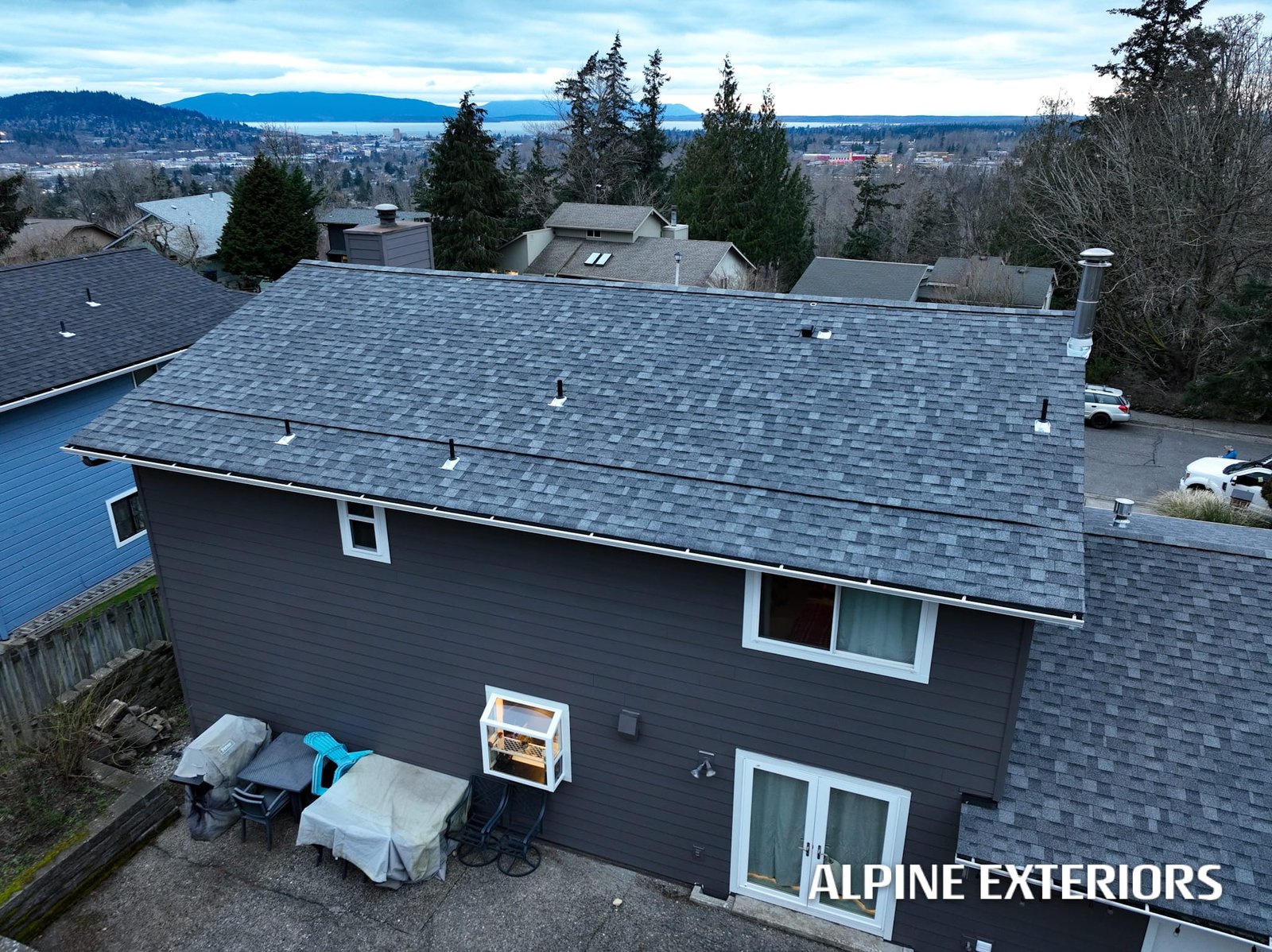
Marysville sits low in the Puget Sound lowlands, between saltwater sloughs and the Snohomish River valley, and that geography shapes how these problems show up. Our wet season runs roughly October through April, with long stretches of steady, low-intensity rain rather than short intense storms — which means roofs, skylights, and attic vents are under near-continuous moisture load for months at a time rather than dealing with occasional downpours. A marginal flashing detail that would hold up in a drier climate has months to find its way to failure here.
Shaded, north-facing roof slopes and roofs under fir or cedar canopy grow moss quickly in this climate, and moss holds water against the roof surface and can work its way under shingle tabs and around vent boots and skylight curbs, which turns a minor flashing gap into an active leak faster than it would on a bare, sun-exposed roof. Wind is a factor too — Marysville catches wind funneling up through the Skagit flats and off Port Susan and the Sound, and sustained wind-driven rain will find gaps in flashing or ridge vents that a still, misty day never would.
Cold is a smaller but real factor. Marysville doesn't see the sustained hard freezes of the Cascade foothills, but Arctic outflow events can bring a few days of hard frost, occasional snow, and genuinely cold nights most winters. An attic that's too warm because of poor insulation and air sealing, combined with even a light snow load, can produce a small amount of ice damming at the eaves — nowhere near what homes in the mountains see, but enough to back water up under shingles at the roof edge if gutters are also clogged with fall leaf litter, which is common on the maple- and alder-lined streets in and around town.
All new construction and most re-roofing or remodel work touching insulation and ventilation in Washington falls under the Washington State Energy Code, which sets minimum requirements for attic insulation levels and ventilation in this climate zone. It doesn't specify brand or product, but it does mean that a proper fix — not just a patch — usually needs to account for both insulation R-value and net free ventilation area, not one or the other.
Start with observation before you start buying materials. A few practical steps:
Be honest with yourself about scope. Adding a couple of soffit vents or sealing a few can-light gaps is reasonable DIY territory for a handy homeowner. Reworking ridge and soffit ventilation to hit a proper balanced ratio, re-flashing a skylight, or dealing with sheathing that's already showing rot are roofing-level jobs that involve working safely at height, understanding how flashing layers actually shed water, and knowing local code requirements — and getting any of those wrong can trap moisture worse than doing nothing at all. Ventilation and skylight work also isn't cheap to redo twice; expect attic ventilation corrections to run from a few hundred dollars for soffit and vent additions up into the low thousands if baffles, insulation, and fan re-routing are all needed, and skylight re-flashing or replacement to run from roughly a thousand dollars for a straightforward re-seal up to several thousand for a full replacement with a larger or better-insulated unit, depending on roof access and the skylight's condition. Get a written scope before work starts either way.
Alpine Exteriors has walked enough Marysville and greater Snohomish County attics to know that the fix is rarely just "add more vents" or "caulk the skylight" — it's usually a combination, and the combination is different in every house depending on age, insulation history, and roof design.
Timing and location are the best clues. Condensation-related moisture tends to show up broadly across the underside of the sheathing or around skylight shafts during cold snaps or right after a period of high indoor humidity, and it often improves on its own in warmer weather. A true roof leak usually tracks to a specific spot tied to a flashing point, penetration, or damaged shingle, and it gets worse with rain regardless of temperature. If you're not sure, it's worth having someone check both the attic and the roof surface at the same visit, since ventilation problems and small leaks often coexist and get blamed on each other.
Skylights work fine here as long as the shaft is properly insulated and air-sealed and the flashing is installed correctly for the roofing material around it — plenty of Marysville homes have skylights that have never given their owners a moment's trouble. The risk isn't the skylight itself, it's cutting corners on the shaft insulation or using flashing details that weren't designed for a sustained wet season. If you're adding a new skylight, that's the detail worth spending the extra time and money on, not the glass itself.
The Washington State Energy Code sets minimum insulation R-values for attics by climate zone and, through the building code provisions it references, ties into ventilation requirements meant to prevent moisture accumulation in the attic assembly. In practice that means a code-compliant attic needs both adequate insulation and adequate, balanced intake and exhaust ventilation — insulating well without addressing ventilation, or vice versa, can leave you compliant on paper in one category while still having a moisture problem in the field.
A fair amount is maintenance: keeping soffit vents clear, keeping gutters clean so water doesn't back up under the eaves, removing moss before it takes hold, and checking the attic once or twice a year for early signs of moisture. But diagnosing whether ventilation is actually balanced, correcting duct terminations, re-flashing a skylight, or replacing damaged sheathing are jobs that call for a licensed contractor who can safely access the roof and attic and knows how the components need to work together.
If your Marysville home has a musty attic, a skylight that sweats or drips, or moss creeping across a shaded roof slope, it's worth having it looked at before another wet season adds to the damage. Alpine Exteriors, WA contractor license ALPINI751OW, serves Skagit, Island and Whatcom counties along with nearby Snohomish County communities including Marysville, and can walk your attic, evaluate your ventilation balance, and give you a straightforward, written assessment of what actually needs to be done — not a sales pitch for a full re-roof when a few vents and some sealing would solve it. Reach out to schedule a look at your roof, attic and skylights before the fall rains set in.