

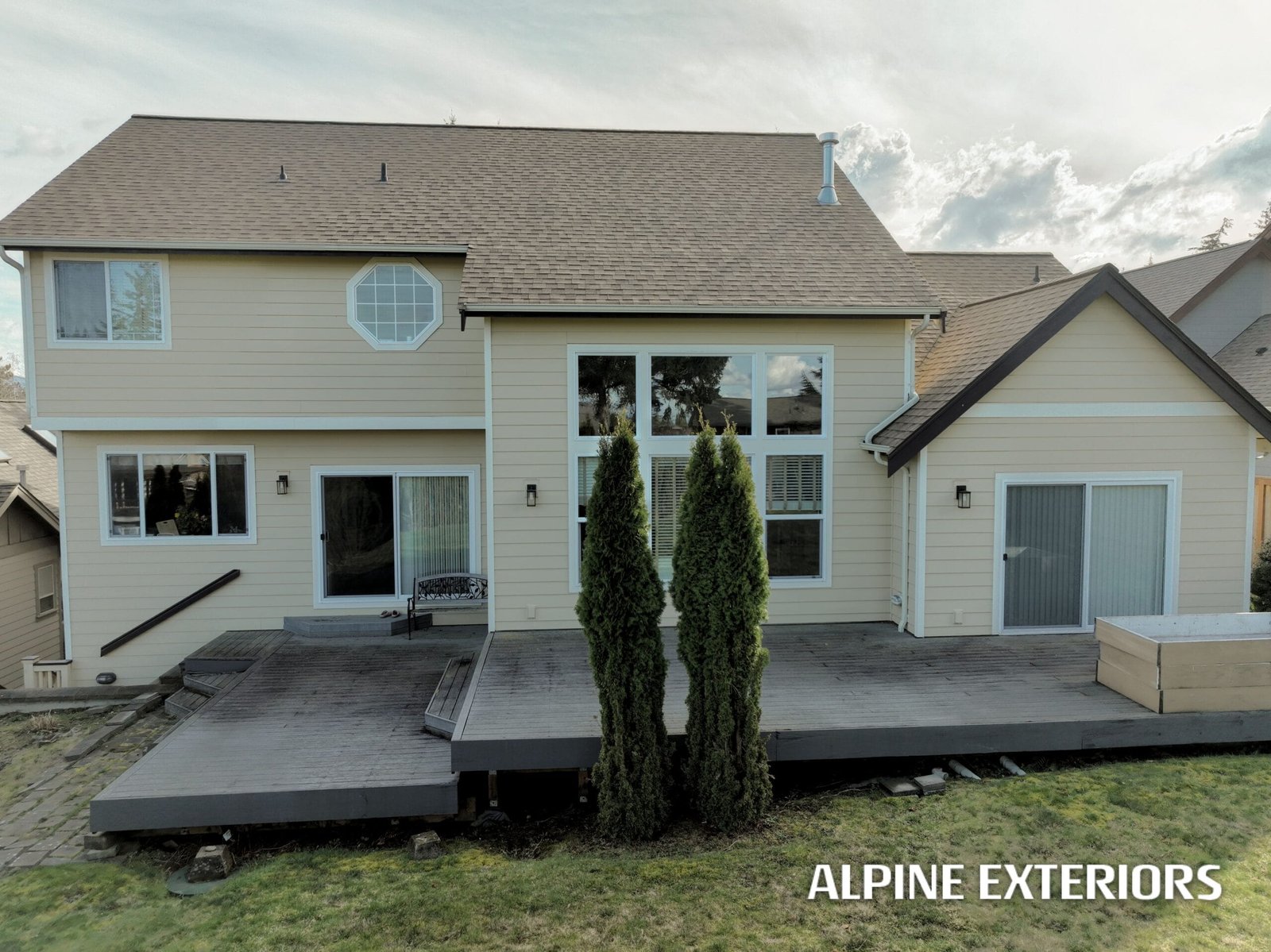
Check for immediate safety hazards first, then get a written record of the damage before you touch anything or call your insurer. In that order — safety, documentation, notification — you protect the people in the house and you protect the claim, because an adjuster who shows up days later can only pay for what you can prove was there.
Homeowners in Concrete and the rest of Skagit County usually deal with one of three storm scenarios: wind that lifts shingles or shears off ridge caps, wind-driven rain that finds its way through a compromised roof plane or window flashing, or a fallen limb — sometimes a whole tree — that punches through a roof deck, gutter run or deck rail. Each one has a slightly different first move, but the sequence above holds for all three.
A storm damage response really only has five phases, and skipping the order they belong in is the single biggest reason claims get delayed or shorted. Work through them in this sequence.
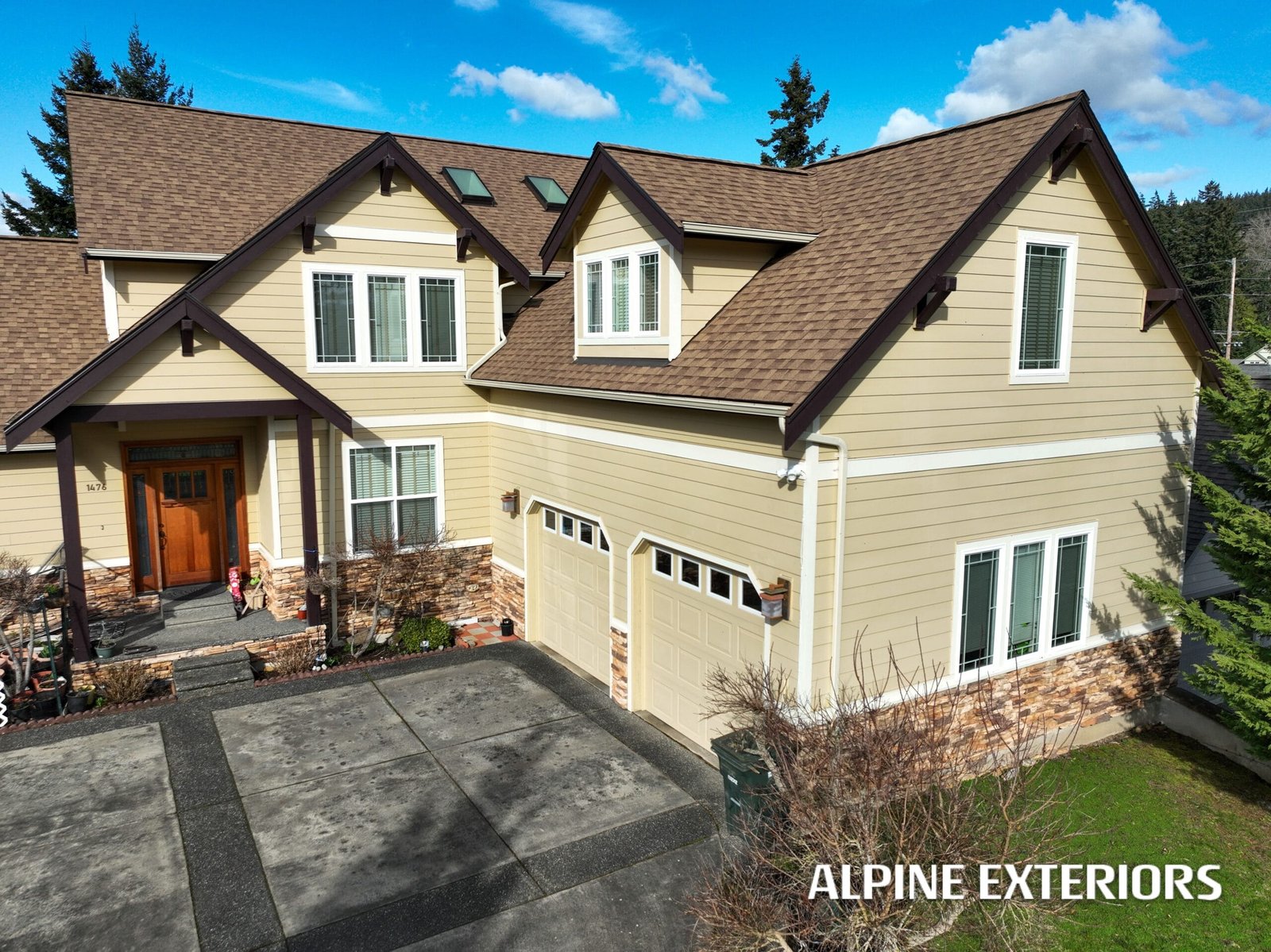
Ask any roofer who has walked a claim through to completion and they'll tell you the same thing: the claims that go smoothly are the ones with the most boring, thorough paper trail, not the ones with the most damage. Insurance adjusters are working from what's in front of them on the day they inspect — often a week or more after the storm, by which point rain has washed debris away, a tarp has covered the worst of it, or a curious neighbor has already thrown away a piece of siding that blew off. If you didn't photograph it, in the adjuster's file it functionally didn't happen.
This is where the common myth causes real financial harm: the belief that "the adjuster will see the damage themselves, so my own photos don't matter." Adjusters see hundreds of roofs in the weeks after a regional storm event. Their visit is often 20 to 40 minutes. They are not going to notice the granule loss on the north slope that you can only see from a ladder, or the bent flashing behind the chimney, unless you point them to it — and pointing them to it works far better when you already have it in a photo with a date stamp.
Not everything you photograph carries equal weight with an insurer. The strongest documentation combines several types, each covering a gap the others leave open.
| Evidence type | What to capture | Why it matters |
|---|---|---|
| Photos, wide and close | Full roof slopes, full gutter runs, and tight shots of each specific break, puncture, or dent | Wide shots give context; close shots prove the specific damage exists |
| Video walkthrough | A slow, narrated pass around the exterior and through any affected interior rooms | Captures soft spots, drafts, and sounds that a photo can't, and timestamps the whole property at once |
| Written notes / claim diary | Date and time of the storm, what you noticed and when, every phone call with the insurer and what was said | Insurers and adjusters change; your notes are the one record that stays consistent |
| Home inventory | A list (ideally made before storm season) of major exterior systems — roof age, window brand, deck material, gutter type | Lets you show what the pre-storm condition actually was, not just what the adjuster assumes it was |
| Receipts | Tarps, plywood, emergency tree removal, hotel stay if the home is uninhabitable | Reasonable mitigation costs are usually reimbursable, but only with a receipt attached |
| Contractor inspection notes | A written assessment from a licensed contractor describing scope and likely repair costs | Gives you an independent second opinion to compare against the insurer's estimate |
Keep every piece of this — photos, notes, receipts, the contractor's write-up — for at least as long as your state's contract statute of limitations, which in Washington runs several years. Insurers can and sometimes do reopen or audit a claim, and a supplemental claim for damage that surfaces later (a slow roof leak that shows up as interior staining months after the storm, for example) will lean entirely on documentation from the original event.
Once you file, the insurer assigns a claim number and, usually, an adjuster. The adjuster's job is to determine the cause of loss (was it caused by the storm, and is that peril covered by your policy), and to scope the repair cost. That visit typically happens within one to two weeks after a widespread regional storm event, longer if the storm was large enough that adjusters are stretched across the whole county.
After the inspection, insurers typically give you a written estimate and a coverage decision within a matter of days to a few weeks — but "decision within days" is the exception, not the rule, especially after a storm that hit a wide area and put every adjuster in the region behind. Delays happen for mundane reasons more often than sinister ones: high claim volume, a need for a second specialist inspection (roofers, structural engineers), or the insurer waiting on your contractor's detailed estimate before finalizing numbers.
If you disagree with the scope or the payout, you have the right to push back. Get your own contractor's estimate, point to specific line items the adjuster's report missed (a section of damaged decking, a run of gutter that wasn't itemized), and put the disagreement in writing. Washington homeowners can also contact the state Office of the Insurance Commissioner if a claim is being handled unfairly or in violation of the insurer's own policy terms — that's a real, useful resource and a step worth knowing about even if you never need it.
This single line in your policy determines how much money actually lands in your account, and it's the part most homeowners never read until it's too late to matter.
| Actual cash value (ACV) | Replacement cost value (RCV) | |
|---|---|---|
| What it pays | Replacement cost minus depreciation for the item's age and condition | The full cost to repair or replace with similar new materials, no depreciation subtracted |
| Roof example | A 15-year-old roof on a 25-year rated shingle gets paid out at a fraction of new-roof cost | Same roof gets paid at close to full new-roof cost, often in two payments |
| How you actually get paid | One payment, discounted for depreciation, no second check | Insurer typically pays the depreciated amount first, then releases the "recoverable depreciation" once repairs are completed and proof submitted |
| What to check now | Ask your agent directly which one your policy uses — it's not always obvious from the declarations page | Keep every repair receipt; recoverable depreciation is often forfeited if you never submit for it |
Homeowners are frequently surprised to learn their policy pays ACV on the roof specifically, even when the rest of the dwelling coverage is replacement cost — some insurers write roof coverage as a separate schedule once a roof passes a certain age, precisely because of the frequency of wind and moss-related roof claims in the Pacific Northwest. Read that section of your policy before you need it, not after.
National storm-damage advice is written with hurricanes and hail belts in mind, and a lot of it simply doesn't map onto what actually damages a roof, deck, or set of windows around Concrete, Mount Vernon, Anacortes, or Bellingham. A few local realities are worth knowing before you're standing in the yard looking at a downed limb.
None of this is hurricane country, and it's worth saying plainly: don't over-prepare for the wrong threat. What matters here is edge and valley flashing, ridge cap fastening, gutter hanger spacing, and moss-aware roof maintenance — not shutters or wind-rated garage doors.
Beyond the checklist above, a few practical decisions make the difference between a claim that resolves cleanly and one that drags for months.
A few patterns show up again and again in claims that end up underpaid or delayed, and almost all of them are avoidable.
Most homeowner policies require prompt notice, which in practice means filing within days to a few weeks of the storm, not months — but the exact language varies by insurer and policy, so check your declarations page or call your agent directly rather than assuming. Filing quickly also matters practically: it's much easier to prove the damage was caused by a specific storm event while the timeline is fresh and before winter rain has a chance to compound the problem.
In most standard homeowner policies, damage from a windstorm-driven falling limb is a covered peril, whether the tree was on your property or a neighbor's — coverage generally follows where the damage landed, not where the tree grew. That said, policies differ on removal costs for the tree itself versus repair costs for the structure, so it's worth confirming both pieces with your insurer rather than assuming the whole event is one line item.
Either order works, but getting a contractor's inspection before or shortly after filing gives you an independent, written scope of damage to compare against the adjuster's estimate, which is useful leverage if the two don't match. Alpine Exteriors provides storm damage inspections across Skagit, Island and Whatcom counties and can walk a homeowner through what's likely covered before the adjuster's visit, which tends to make that meeting go faster.
A repair addresses the specific damaged section — a few courses of shingles, one length of gutter, a broken window pane — while a replacement swaps out an entire system, usually because the damage is extensive, the existing material is near the end of its service life, or matching materials are no longer available. The choice affects both the insurance payout and whether current Washington State Energy Code requirements apply to the new work, so it's worth discussing with your contractor before assuming a small repair is the cheaper or simpler path.
Wind, rain and fallen limbs don't wait for a convenient time, and neither should a professional look at the damage. Alpine Exteriors, WA contractor license ALPINI751OW, inspects roofs, windows, decks and gutters after storm events across Mount Vernon, Anacortes, Burlington, Sedro-Woolley, La Conner, Stanwood, Camano Island, Concrete and Bellingham, and provides the kind of documented, written scope that makes an insurance claim move faster. If a recent storm left damage you're not sure how to handle, contact Alpine Exteriors for an inspection before you sign anything with your insurer.



