
Most homes in Lyman need larger gutters and more downspouts than a standard suburban house, because the combination of heavy Skagit Valley rainfall and the fir canopy overhead overwhelms undersized systems fast. If your gutters are the builder-grade 5-inch style with a downspout every 35-40 feet, they are very likely undersized for this stretch of the valley and are probably already contributing to the damp crawlspace or soggy foundation bed you've noticed.
The fix is rarely just "clean the gutters more often." It's usually a combination of correct sizing, enough downspouts placed where the water actually concentrates, and a plan for getting that water away from the foundation instead of just off the roof edge. Alpine Exteriors sees this pattern often in the small river-valley communities up Highway 20, and Lyman's mix of tree cover, older housing stock, and low-lying lots makes it one of the more drainage-sensitive spots we work in.
Gutter sizing is a function of roof area, roof pitch, and expected rainfall intensity, not just gutter length. A 5-inch K-style gutter can move a meaningful amount of water, but on a roof with 1,800-2,500 square feet of catchment area and a steep pitch that sheds water quickly, a 5-inch system paired with too few downspouts will overflow during a hard November or December rain event even if it's perfectly clean. Moving up to a 6-inch gutter, or adding an additional downspout run, increases capacity substantially without changing the look of the house much.
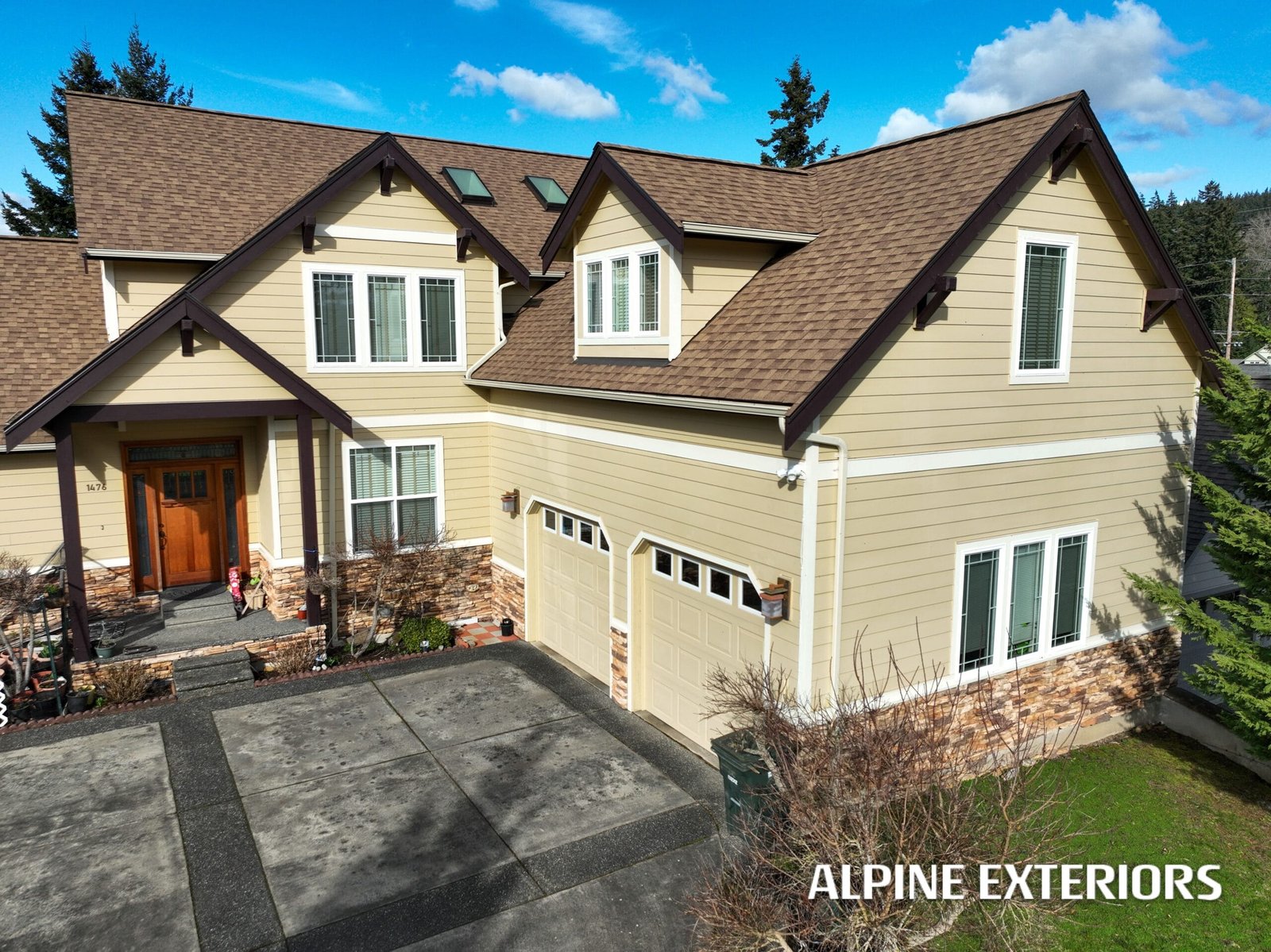
Downspout sizing matters just as much as gutter width. A 2x3-inch downspout is standard on most older Skagit County homes, but a 3x4-inch downspout moves noticeably more water per minute and clears debris more easily before it jams. On a home with a complex roofline — multiple valleys, dormers, or a wrap-around porch roof, which are common on the older farmhouses and cabins scattered around Lyman — water concentrates at valley intersections, and those points usually need their own dedicated downspout rather than relying on a single spout at the end of a long run.
The other half of the equation is what happens after the water leaves the downspout. A 4-foot plastic extension dumping onto bare soil next to the foundation does almost nothing once the ground is saturated, which it is for most of the winter here. Solid-pipe extensions that carry water 8-10 feet away from the house, tied into a gravel-filled dry well or daylighted to a lower point on the lot, make a measurable difference in how much water ends up under the house.
Lyman sits up the Skagit River valley in the foothill transition zone between the flat farmland around Mount Vernon and Burlington and the steeper terrain heading toward Concrete and the North Cascades. That location changes the drainage math in a few specific ways.
None of this is unique to Lyman by itself, but the combination — heavy sustained rain, constant conifer debris, and a high water table under older homes — is a more demanding drainage environment than most of the flatter, more open parts of Skagit County.
Start with an honest look at what's currently installed rather than assuming the gutters are "fine" because they were replaced at some point. A few practical steps make the most difference:
It's worth being realistic about the limits here too. No gutter and downspout system will fully dry out a crawlspace on a lot with a genuinely high water table during the wettest months — the goal is to reduce the volume of surface water reaching the foundation, not eliminate groundwater. And gutter guards reduce maintenance, but on a heavily treed lot they don't turn a once-a-year cleaning into a never-clean system. Setting that expectation up front avoids disappointment later.
On a lot with heavy fir or cedar cover, plan on at least once a year even with guards installed, and twice a year — typically late fall after most needle drop and again in late winter — if the gutters are open or the guards are an older style that doesn't handle conifer needles well. Homes on more open lots with less canopy can often go longer between cleanings.
Not always — a smaller roof with a simple layout and adequate downspouts can perform fine with 5-inch gutters. But on steeper roofs, larger roofs, or homes with multiple valleys that concentrate water, 6-inch gutters paired with larger downspouts provide a meaningful safety margin during the valley's heaviest rain events and reduce the chance of overflow when needles or moss partially block the flow.
Gutters and downspout extensions can significantly reduce the amount of surface water reaching your foundation, which is often a major contributor to crawlspace moisture, but they're rarely the whole fix on their own. If the crawlspace already lacks a proper vapor barrier or adequate ventilation, or if the lot has a naturally high water table, those issues need to be addressed directly alongside the drainage work.
Guards can help, but not all guard styles are equal against fir and cedar needles — some fine-mesh or reverse-curve designs handle needles reasonably well, while others clog with them almost as fast as an open gutter. Guards are best thought of as reducing how often you need to clean, not eliminating the need altogether on a heavily treed lot like most in Lyman.
If your gutters overflow during heavy rain, you're finding fir needle mats every time you check, or you've got a musty smell coming up from the crawlspace, it's worth having someone look at the whole system rather than guessing at one fix. Alpine Exteriors is a licensed Washington contractor (ALPINI751OW) serving Lyman and the rest of Skagit County, and we'll give you a straightforward read on whether your current gutters, downspouts and drainage are actually sized for your roof and your lot — no pressure, no invented urgency, just what we'd do if it were our own house.