
Most gutter problems in La Conner and the surrounding Skagit Valley are not caused by bad weather — they're caused by gutters and downspouts that were sized for a smaller, drier house than the one they're bolted to now. A 5-inch K-style gutter with 2x3 downspouts is the common default, but on many La Conner rooflines it's undersized once you account for local rainfall intensity, roof pitch, and how far water has to travel before it reaches a downspout. Get the sizing and the drainage path right and you eliminate most of the overflow, siding staining and crawlspace dampness that shows up every wet season.
Gutter capacity is a function of trough size, downspout size, and how much roof area drains into each downspout — not just the total square footage of the roof. A standard 5-inch gutter paired with a single 2x3 downspout can handle a meaningful roof section in a light or moderate rain, but Skagit County doesn't stay in that range for months at a time. Late fall through early spring, this area sees sustained rain events where an inch or more can fall over a day or two, sometimes arriving as a hard, wind-driven downpour rather than a gentle soak. When that happens on a roof plane that's fifty or sixty feet long with only one downspout at the end, the water arrives faster than a single 2x3 downspout can carry it away, and it goes over the front edge of the gutter instead of down through it.
The fix usually isn't complicated, but it does take a real calculation rather than a guess: measuring the square footage of each roof plane, checking the pitch (steeper roofs shed water faster and need more downspout capacity per square foot), and mapping where the water is actually supposed to go once it leaves the downspout. On a lot of older La Conner homes — especially the smaller houses and cottages near town and along the Swinomish Channel — the original gutter system was installed decades ago for a smaller footprint or a different roof configuration, and additions or reroofs since then have never been matched back to the drainage capacity. That mismatch is where most of the recurring problems come from: an undersized downspout on an oversized roof section, or a downspout that dumps water two feet from the foundation instead of carrying it well away from the house.
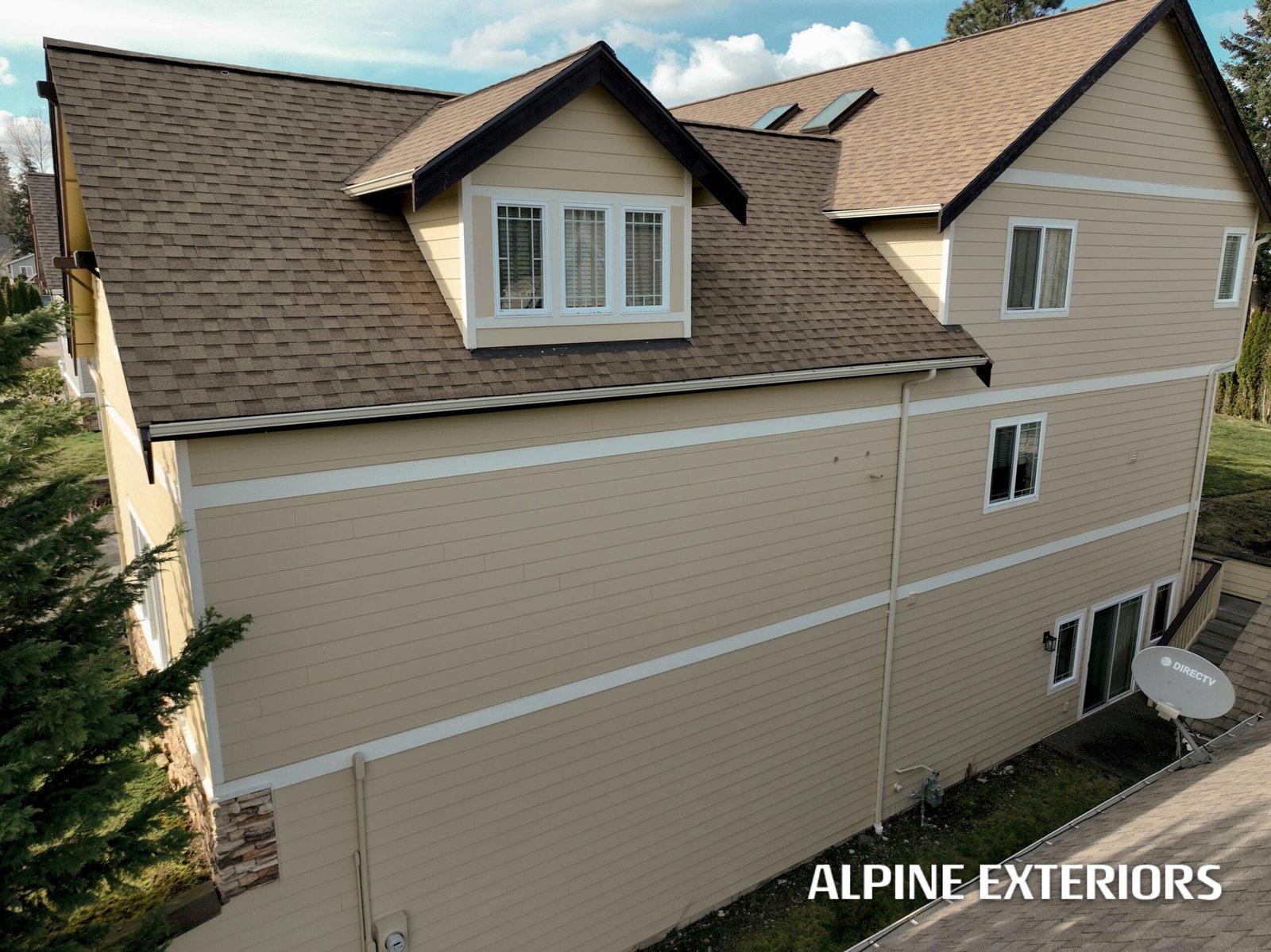
Skagit County's gutter and drainage problems aren't generic — they come from a specific mix of conditions that don't show up the same way everywhere in Western Washington, let alone in drier parts of the country.
Start with sizing, not just cleaning. If a roof section is long, steep, or feeds into a single downspout, it's worth having someone calculate whether a 6-inch gutter or an added downspout is warranted rather than assuming the original 5-inch system is adequate just because it's what's already there. On roofs with big, unbroken planes — common on some of the newer builds around Burlington and Stanwood — splitting drainage across two downspouts instead of one is often a cheaper and more effective fix than upsizing the whole run.
Second, deal with the needle problem directly rather than hoping twice-a-year cleaning will keep up. Gutter guards help, but not all guard styles handle fine fir and cedar needles well — some mesh and screen products are designed more for leaves and let needles through or trap them on top of the screen where they still block flow. A guard style suited to fine debris, combined with a fall and a late-winter check, keeps most systems clear through the wet season. Downspouts should be checked separately from the trough — a gutter that looks clean can still have a clogged downspout below the roofline.
Third, follow the water past the downspout. Extensions or buried drain lines that carry discharge at least several feet from the foundation — further on lots with heavier clay or standing water — make a bigger difference to crawlspace dryness than almost anything done to the gutter itself. On lots where the ground is naturally flat or low, as is common on the Skagit flats around La Conner and Fir Island, a simple extension may not be enough, and tying downspouts into a piped drain that daylights well away from the house, or into a dry well where soil conditions allow, is worth the extra step.
Fourth, check the crawlspace itself, not just the gutters feeding it. A functioning vapor barrier and adequate foundation venting matter as much as roof drainage does for keeping a crawlspace dry, and the Washington State Energy Code sets requirements for crawlspace insulation and vapor barriers on new construction and many renovation projects — worth confirming during any gutter or drainage work, since the two systems affect each other. If a crawlspace already shows signs of standing water or persistent dampness, gutter and grading fixes should be paired with a look at the vapor barrier and any existing sump or drainage provisions, not treated as separate problems.
Finally, inspect fasteners and hangers on exposed or waterfront properties more often than the manual suggests. Wind load and salt air both shorten the working life of standard hardware, and a downspout that's pulled away from the wall or a hanger that's corroded through does more damage in one bad storm than years of normal wear would.
Alpine Exteriors works on gutter and drainage systems throughout Skagit, Island and Whatcom counties, and the calls that come in after a wet winter are rarely about the gutters people can see — they're about the water that made it past them. A proper sizing check, debris-appropriate guards, and a downspout discharge plan that actually clears the foundation solve most of what gets called a "gutter problem" but is really a drainage problem.
Not always — a lot of smaller roof sections with short runs and a nearby downspout do fine with a properly maintained 5-inch system. The cases where 6-inch gutters or added downspouts make a real difference are long, unbroken roof planes, steep pitches that shed water fast, and homes where a single downspout is currently handling more roof area than it was designed for. The honest answer is that it depends on the specific roof, which is why a measured assessment is more useful than a blanket recommendation either way.
On lots with heavy fir or cedar cover, twice a year — once in late fall after most needles have dropped and again in late winter before the heaviest rain has passed — is a reasonable baseline, though some heavily wooded lots need a mid-season check too. The bigger issue is usually the downspouts rather than the trough itself, since needle mats tend to plug the downspout opening even when the visible gutter run still looks reasonably clear.
They're connected more often than people expect, especially on the flatter ground common around La Conner and Fir Island. When gutters overflow or downspouts discharge right next to the foundation, that water has nowhere to go but into the soil immediately around the house, and on lots with a naturally high water table it can end up under the house rather than draining away. Fixing the gutter sizing and downspout discharge point is frequently the first and most cost-effective step before assuming the crawlspace itself needs a bigger intervention.
It varies with the scope — replacing a section of gutter with a larger size, adding a downspout, or running a buried drain line to daylight further from the house are all different jobs with different costs, and rough figures for gutter replacement alone often land somewhere in the $8 to $16 per linear foot range depending on material and access, with downspout extensions or simple buried drain runs typically costing less per job than a full gutter replacement. Getting a specific quote after an on-site look is the only way to get a number that reflects the actual roof and lot.
If your gutters overflow during heavy rain, your downspouts empty right next to the foundation, or you've noticed dampness under the house, it's worth having someone look at the whole system rather than just clearing debris and hoping it holds. Alpine Exteriors serves La Conner, Mount Vernon, Anacortes, Burlington, Sedro-Woolley, Stanwood, Camano Island and Bellingham, and can walk a roof and foundation together to figure out where the water is actually going wrong. Contact Alpine Exteriors (WA contractor license ALPINI751OW) to schedule a gutter and drainage assessment before the next wet season sets in.