

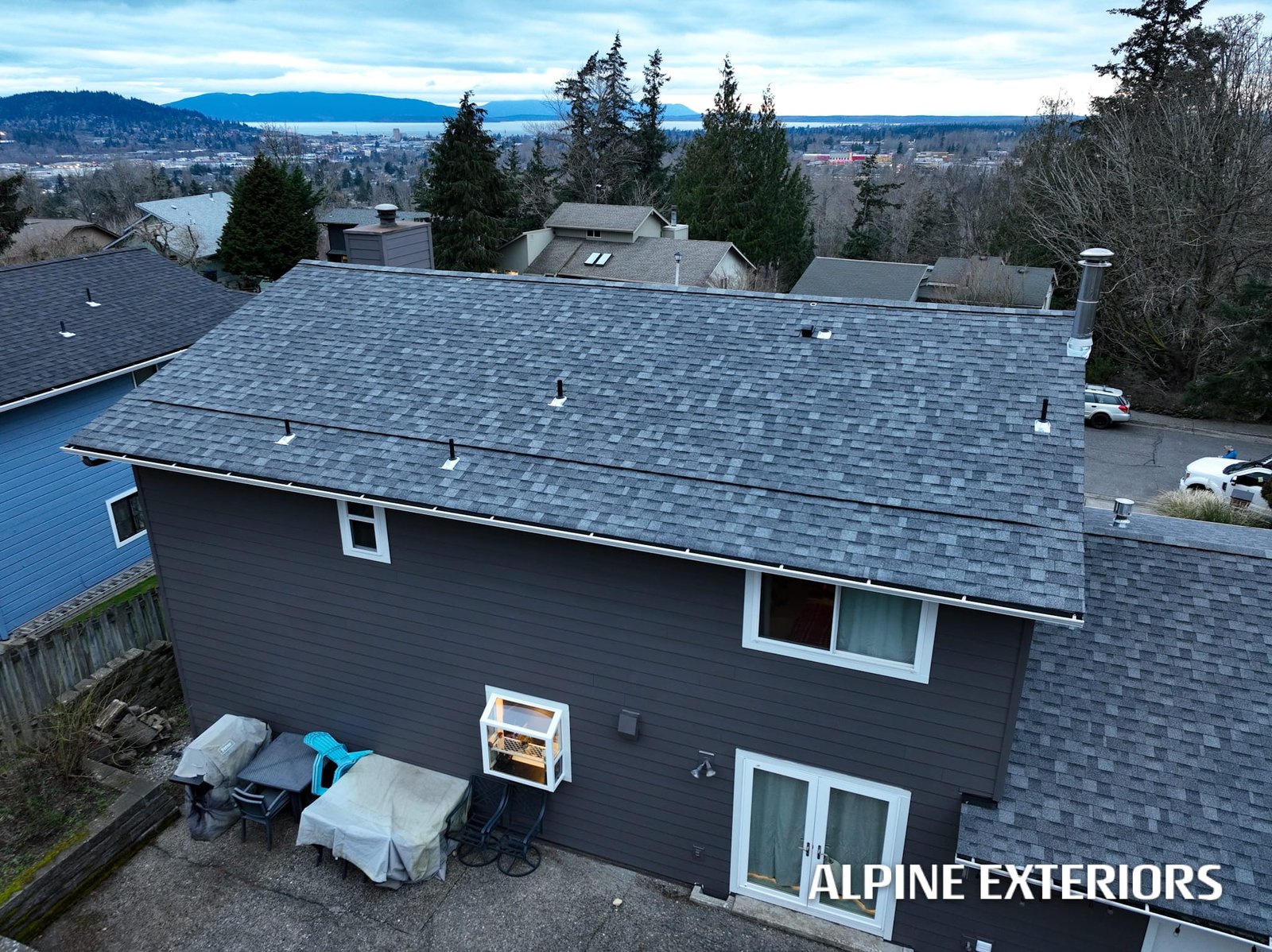
For most homes in Skagit, Island and Whatcom counties with a standard gable or gable-and-hip roof, a properly installed ridge vent paired with enough soffit intake is worth it. It moves damp attic air out efficiently, and in a climate as wet as ours that translates into a longer-lasting roof deck and fewer moisture problems overall. That said, a ridge vent is not automatically the right call for every roof shape, and one installed without matching intake, or fought against by an old power fan, can end up doing less than nothing.
A ridge vent is a continuous exhaust opening cut along the peak of the roof, covered by a low-profile cap that lets warm, moist attic air escape while keeping rain and pests out. On its own it does not do much. Attic ventilation only works as a system: cooler outside air has to enter low, usually through soffit vents under the eaves, travel up along the underside of the roof deck, and push warm air out at the ridge. That intake-to-exhaust balance matters more than the ridge vent itself. A roof with a well-built ridge vent and blocked or insufficient soffit vents will pull air from wherever it can find it — sometimes back through bathroom fan ducts, can lights, or gaps around the attic hatch — instead of from outside, which can actually pull conditioned, humid house air into the attic rather than exhaust it.
Done correctly, the payoff is real. A vented attic stays closer to outdoor temperature, which reduces the daily swelling and shrinking that ages shingles and roof sheathing. It also helps keep moisture from accumulating on the underside of the roof deck during our long, wet winters, which is one of the biggest drivers of sheathing rot and mold we see when we open up an older attic. Where a ridge vent tends to underperform is on roofs with very short ridge lines, hip roofs with little to no straight ridge to vent, low-slope sections, or additions that were bumped out over the years and now have disconnected attic spaces a single ridge run cannot reach. In those cases, a mix of ridge vent, box vents and additional soffit intake — or in some cases a different ventilation strategy entirely — usually performs better than forcing a ridge vent where the roof geometry does not support one.
A few local conditions change how we think about ridge vents here compared to drier or more sheltered parts of the country.
Heavy winter rain. Skagit, Island and Whatcom counties get sustained, weeks-long stretches of rain rather than short, isolated storms. That makes the quality of the ridge vent's internal baffle and external weather filter more important than the brand name on the box. A thin, budget ridge vent can let wind-driven rain wick through the vent slot during a prolonged soaking rain, even though it might pass a quick inspection on a dry day. Alpine Exteriors specifies ridge vents rated for external wind and rain resistance rather than the most basic option available.
Moss on shaded roofs. Between the Douglas fir cover around Sedro-Woolley, Burlington and the wooded lots outside Mount Vernon, plenty of roofs here sit in shade for a good part of the day. Shaded, damp roof surfaces grow moss, and moss holds moisture against the shingle longer than an open, sun-exposed roof would. Better attic ventilation helps the roof deck dry out from underneath, but it does not stop moss growth on the shingle surface itself — that is a separate maintenance issue tied to tree cover, gutter debris and periodic cleaning, not something a ridge vent fixes on its own.
Wind off the Skagit flats and the Strait. Open farmland around La Conner and the flats east of Anacortes funnels wind across roofs with very little to slow it down, and homes closer to Rosario Strait and the water get similar exposure from marine wind. That wind interacts directly with ridge vents, since exhaust flow at the ridge relies partly on wind-driven suction to work efficiently. It is generally a benefit — wind assists the airflow and helps the vent do its job — but it is also exactly why the external baffle and fastening detail matter so much in this area. A poorly fastened ridge vent cap in a wind-exposed location is more likely to work loose over time than the same product on a sheltered, tree-lined lot.
Salt air on the islands. Homes on Camano Island, and coastal-facing properties around Anacortes, sit close enough to saltwater that airborne salt accelerates corrosion on unprotected metal. Ridge vent systems use metal fasteners and sometimes a metal external baffle, and on these properties we specify corrosion-resistant fasteners and hardware rather than the standard-grade components that hold up fine further inland. It is a small detail, but it is the difference between hardware that is still sound in fifteen years and hardware that starts staining and weakening well before that.
Occasional ice and snow in the foothills. Properties up toward the foothills and higher elevations around Whatcom County get occasional snow accumulation that the lowland cities around Mount Vernon and Burlington rarely see. A ridge vent needs to stay clear enough to keep working under a light snow load, and in these locations we also pay closer attention to insulation and air sealing at the attic floor, since heat escaping into the attic from below is what melts snow unevenly and can contribute to ice damming at the eaves. A ridge vent alone does not solve that; it works together with attic insulation levels.
The Washington State Energy Code. Attic ventilation is not primarily an energy code item, but it does not exist in isolation from one. The Washington State Energy Code sets the insulation and air-sealing standards for the attic floor, and those requirements directly affect how much heat reaches the underside of the roof deck. An attic that is well insulated and properly air-sealed at the ceiling plane needs less ventilation to manage moisture than a leaky one, because less warm, humid house air is finding its way up there in the first place. When we look at a ridge vent request, we are also looking at what is happening below the attic floor — insulation depth, bath fan ducting, and whether the ceiling plane is actually sealed — because fixing that side of the equation often matters as much as the vent itself.
Before deciding on a ridge vent, it is worth having someone actually get into the attic rather than judge it from the ground. When Alpine Exteriors evaluates a roof for ridge venting, we start there, not with a sales sheet. A few things determine whether a ridge vent makes sense for your specific roof:
Cost is genuinely roof-dependent. Adding a ridge vent during a re-roof, when the shingles are already off and the ridge is exposed, is a comparatively modest add-on, often in the low hundreds of dollars in additional material and labor on a straightforward gable roof. Retrofitting a ridge vent into an existing roof without a full re-roof is more involved, since it means cutting the ridge open, and it costs more accordingly; on a complex roof with multiple ridge lines, dormers or steep pitches, the price climbs further. Get a number for your actual roof rather than assuming a flat rate applies, since roof complexity moves the price more than almost anything else.
The table below is a simple way to compare the common attic ventilation approaches homeowners in this area run into.
| Ventilation type | Works well when | Watch out for |
|---|---|---|
| Ridge vent + soffit intake | Long, continuous gable ridge lines; roof is being re-shingled anyway | Needs balanced intake and a wind/rain-rated baffle in exposed spots |
| Box vents / static vents | Hip roofs, short ridges, or attics with limited ridge length | Less total exhaust capacity than a full ridge run; placement matters |
| Gable end vents | Simple attics with usable gable wall space | Can short-circuit airflow if combined with a ridge vent on the same attic |
| Powered attic fan | Attics that cannot get enough passive airflow any other way | Can depressurize the attic and pull conditioned air up if intake is inadequate |
Alpine Exteriors walks Skagit, Island and Whatcom County homeowners through this attic by attic rather than defaulting to one product for every roof. Sometimes the honest recommendation is a ridge vent; sometimes it is better soffit intake, more attic insulation, or a mixed ventilation approach, and we will say so either way.
A properly installed ridge vent with a good external baffle and correct flashing should not leak, even through our long winter rain stretches. Leaks around ridge vents usually trace back to a low-quality product without adequate wind and rain resistance, poor fastening, or an installation error rather than the concept of a ridge vent itself. It is worth asking what wind and rain rating the specific product carries before it goes on the roof, especially on wind-exposed lots near the Skagit flats or the water.
In many cases, yes. A ridge vent can be retrofitted into an existing roof by cutting open the ridge and installing the vent and cap without tearing off the whole roof. It is more labor-intensive than adding one during a re-roof, since the ridge shingles have to be removed and the sheathing cut, so it costs more than doing it while the roof is already open. Whether it is worth doing on its own depends on how much ventilation your attic is currently missing.
Not as well as it does on a long, simple gable roof. Hip roofs often have short ridge lines, and multiple dormers can break the attic into sections that a single ridge run does not reach evenly. On those roofs, a combination of shorter ridge sections, box vents and adequate soffit intake usually gets better, more even results than trying to force one continuous ridge vent to handle the whole attic.
Not directly. A ridge vent manages moisture and temperature inside the attic, which helps protect the roof deck and shingles from underneath, but moss grows on the outer surface of the shingle because of shade, debris and surface moisture, factors a ridge vent has no effect on. Moss control on shaded roofs around Sedro-Woolley, Burlington and other tree-covered lots comes down to sunlight exposure, gutter and debris cleaning, and in some cases zinc or copper strips, not attic ventilation.
If you are weighing a ridge vent, a re-roof, or you are just not sure why your attic feels damp or your shingles are aging faster than they should, Alpine Exteriors can take a look at the actual roof and attic before recommending anything. We work on roofing, windows, decks and gutters across Mount Vernon, Anacortes, Burlington, Sedro-Woolley, La Conner, Stanwood, Camano Island and Bellingham, and we are licensed in Washington under contractor license ALPINI751OW. Reach out for an honest assessment of what your roof actually needs.