

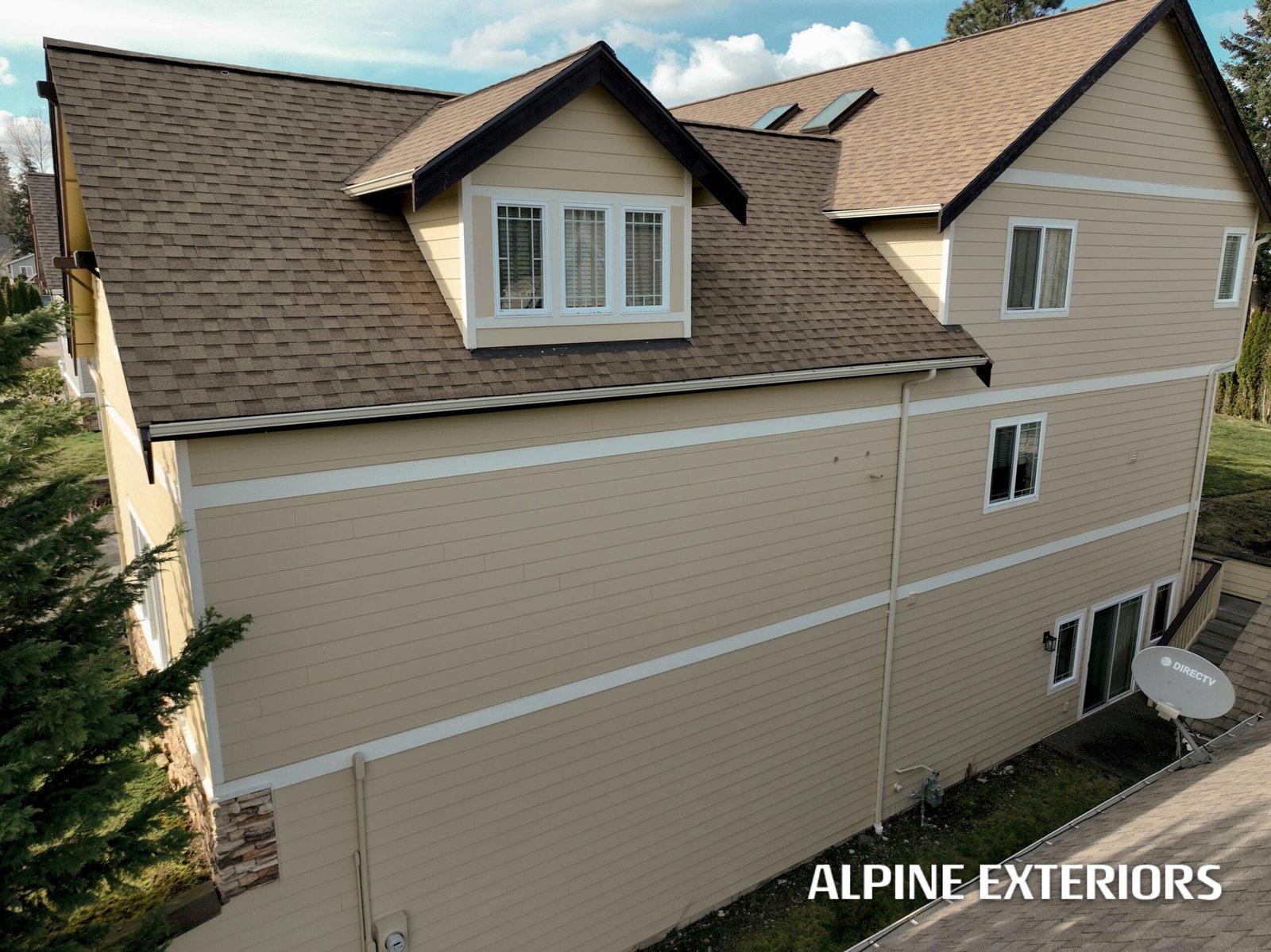
In Skagit, Island, and Whatcom counties, wood fascia boards typically hold up for 15 to 20 years and aluminum or vinyl soffit systems for 20 to 30-plus years before real replacement is needed. But the number that actually matters isn't age on a calendar — it's whether paint is failing, wood has gone soft, or moisture has started working in behind the material, and around here that clock usually starts running faster than it would in a drier climate.
Soffit is the material under your roof's overhang — often vented to let attic air move — and fascia is the vertical trim board that caps the rafter ends and gives your gutters something to mount to. Neither one is structural in the load-bearing sense, but both are your first line of defense at the exact spot where roof, wall, and weather all meet. That's a hard-working joint, and it's usually the first place a home shows its age.
Original wood fascia, common on older homes throughout Mount Vernon, Burlington, and Sedro-Woolley, fails from the outside in: paint chalks and cracks, bare wood starts absorbing water, and eventually the board softens enough that a screwdriver tip will sink into it near the gutter line. Vinyl and aluminum soffit and fascia wrap don't rot, but they aren't invincible — aluminum can dent and oxidize over decades, especially near salt air, and vinyl can go brittle and crack after enough freeze-thaw cycling, then let water through at the seams. Fiber cement fascia boards, which we install on a lot of the newer builds and remodels we work on, split the difference: they resist moisture far better than raw wood but still need paint maintained on schedule.
The real driver of failure almost everywhere in this region is water that gets behind the material rather than water that hits the face of it. A gutter that's clogged with fir needles and maple leaves overflows at the seam, and that water runs straight down the back of the fascia board for months before anyone notices a soft spot. That's why two houses built the same year, a mile apart, can have completely different soffit and fascia condition — one had gutters cleaned every fall, the other didn't.
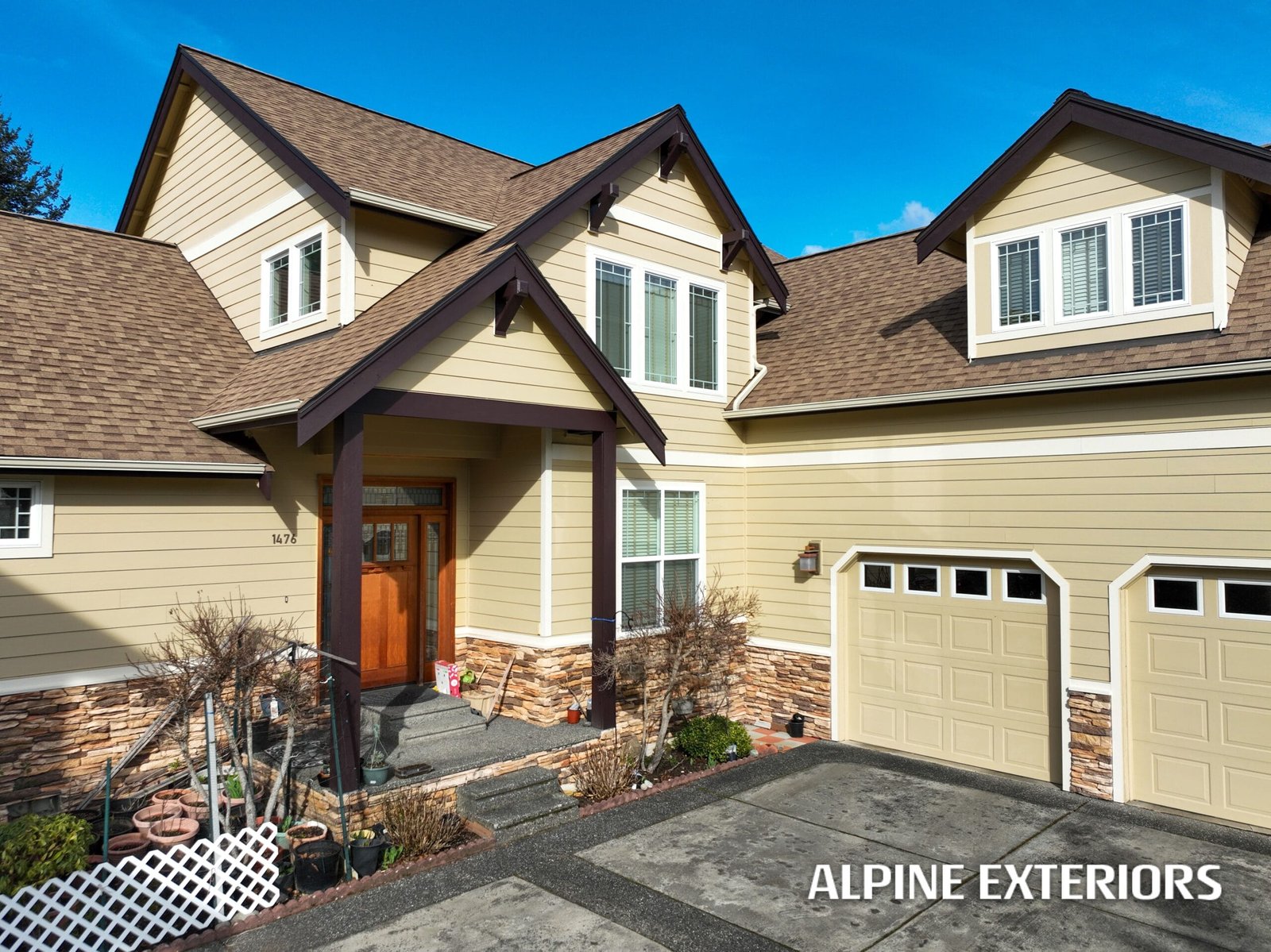
A few conditions specific to Skagit, Island, and Whatcom counties shorten or lengthen this timeline in ways that generic national advice doesn't account for:
None of this means the region is uniquely harsh — it isn't hurricane country and it isn't desert country either. It just means the specific combination of sustained rain, shade-driven moss, open-field wind, and a little coastal salt adds up differently than it would somewhere drier or more sheltered, and a lifespan estimate that ignores all of that isn't much use to a homeowner trying to plan ahead.
Most soffit and fascia problems in this region get caught early or not at all — there's rarely a dramatic failure, just a slow one that's easy to miss from the ground. A few habits make a real difference:
It's also worth knowing that soffit venting isn't just a moisture question — it's tied to the Washington State Energy Code's requirements for attic and roof assembly ventilation, which affect how much net free vent area a soffit system needs to provide. When we replace soffit on an older home, we check that the new vented panels actually meet that ventilation requirement rather than just matching the old look, since undersized venting can trap moisture in the attic and shorten the life of the roof deck above the very soffit that's supposed to be venting it.
Alpine Exteriors inspects soffit and fascia condition as part of every roof and gutter estimate we run in Mount Vernon, Anacortes, Burlington, Sedro-Woolley, La Conner, Stanwood, Camano Island, and Bellingham, because the three systems fail together often enough that looking at only one gives an incomplete picture. A five-minute look from a ladder usually tells us whether a homeowner is looking at a repaint, a partial board replacement, or a full soffit and fascia redo alongside gutter work.
Press firmly on the wood near the gutter line and at inside corners, since those are the spots that hold moisture longest. If the wood flexes, feels spongy, or a screwdriver tip sinks in without much resistance, paint won't fix it and the board section needs to come out. If the wood is still solid but the paint is cracked, chalky, or peeling, a proper scrape-and-repaint (or a fiber cement or aluminum wrap for the future) is usually enough to buy several more years.
It does real damage, not just cosmetic staining. Moss holds water against the surface it's growing on far longer than an open, sun-exposed surface would stay wet, and where it creeps from the roof field down onto the fascia board, that constant dampness is exactly the condition that softens wood and lifts paint. It's worth removing moss carefully rather than leaving it, but pressure-washing straight up under a soffit can force water into vents and seams, so a gentler approach or a soft wash is usually the better call.
Both hold up reasonably well near salt air, but each has a different weak point. Aluminum resists moisture completely but can oxidize or pit very slowly over decades and shows dents more than vinyl does. Vinyl won't corrode at all, but it can become more brittle with age and UV exposure, and a hard, wind-driven impact on an older vinyl panel is more likely to crack it than dent it. Neither is a bad choice on the islands; it mostly comes down to the look a homeowner wants and how the rest of the home's trim is finished.
Yes, and in most cases it should be. The fascia board is usually exposed once old roofing and gutters come off, and it's far cheaper to replace or wrap a marginal board during that window than to pull gutters back off later for a standalone fascia job. We flag soffit and fascia condition during every roof estimate specifically so a homeowner can decide upfront whether to bundle that work in rather than getting surprised by it mid-project.
If you're not sure whether what you're looking at from the ground is a repaint, a repair, or a full replacement, that's a quick, honest thing for us to check in person. Alpine Exteriors is a licensed Washington contractor (ALPINI751OW) serving Skagit, Island, and Whatcom counties — including Mount Vernon, Anacortes, Burlington, Sedro-Woolley, La Conner, Stanwood, Camano Island, and Bellingham — for roofing, siding, windows, decks, and gutters. Reach out for an inspection, and we'll tell you plainly what condition your soffit and fascia are actually in, not just what would be convenient to sell you.



