
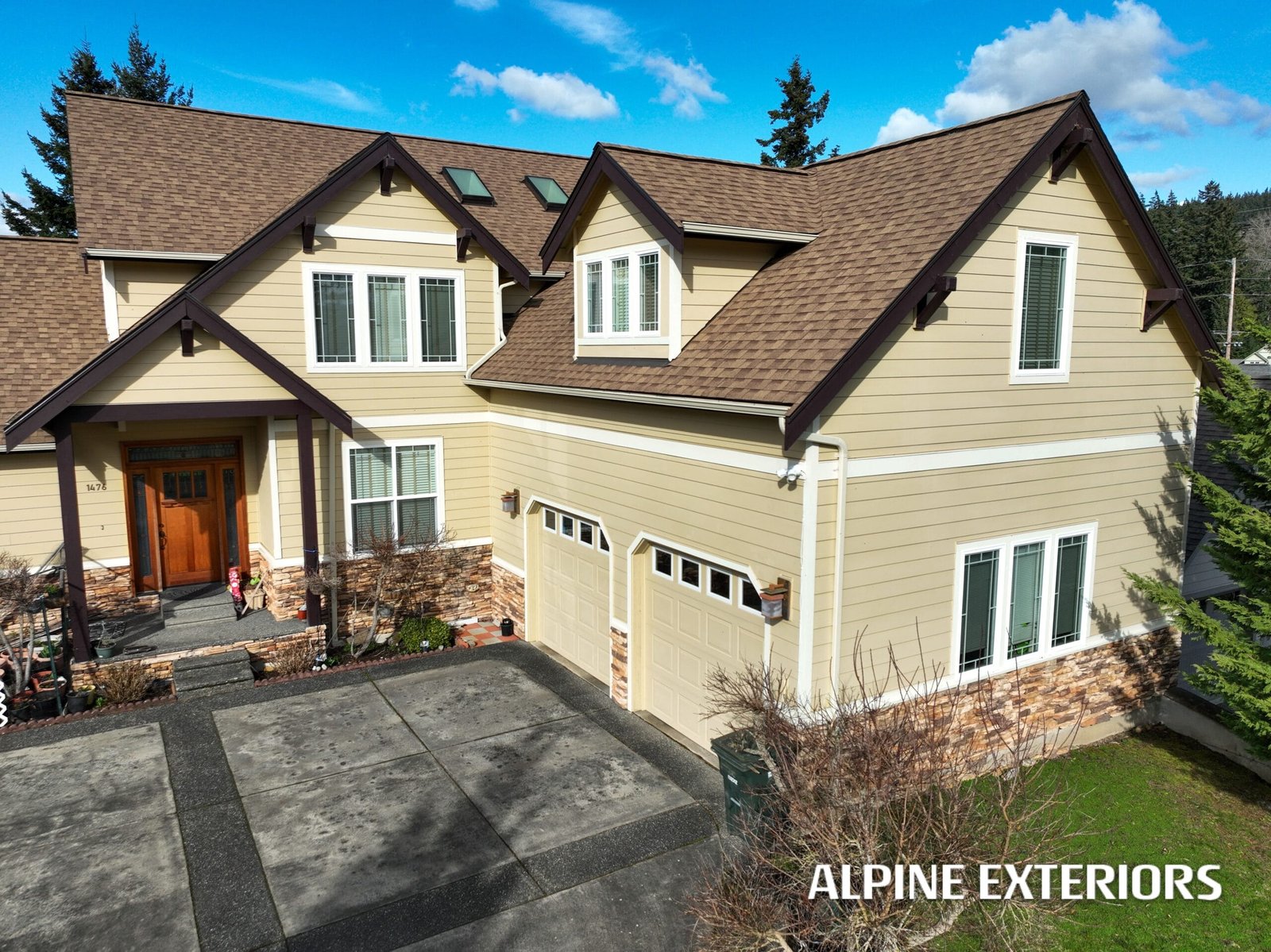
A properly installed ridge vent on a Skagit County home typically lasts 20 to 30 years, roughly matching the service life of the roofing it's installed under. The vent itself rarely "wears out" in that time — what actually shortens its life here is moss growth working under the shingles at the ridge, wind-driven rain finding its way past a worn external baffle, and windstorms off the Skagit flats lifting cap shingles that were nailed a little short.
A ridge vent is a low-profile strip of rigid plastic or metal, set into a slot cut along the peak of the roof and covered with matching cap shingles. Hot, moist attic air rises and exits through it, while soffit vents at the eaves pull cooler outside air in to replace it. There's very little to break: no moving parts, no motor, no seals that dry out the way a rubber pipe boot's do. The plastic baffles used on most residential ridge vents (Owens Corning VentSure, GAF Cobra, and similar products) are UV-stabilized and rated for the life of the roof, and the cap shingles over them are the same architectural or three-tab product as the rest of the roof field.
What actually ends a ridge vent's useful life is almost always something happening around it, not to it. The cap shingles nailed over the vent take the brunt of sun, rain and wind, and if they were installed with nails set too high or too shallow — a shortcut we still see on some older re-roofs in this area — they loosen well before the 20-year mark. Once a cap shingle lifts, wind-driven rain gets under it and into the ridge slot, and from there it can track into the attic insulation. The vent baffle itself is usually fine when we pull a failed ridge apart; it's the fasteners and the cap shingles that gave out first.
The other quiet failure mode is moss. Skagit County's tree cover and persistent damp mean moss doesn't stay confined to the north slopes of a roof — on a heavily shaded lot in Sedro-Woolley or along the wooded edges of Burlington, we routinely find moss creeping right up to and over the ridge line. Moss holds moisture against the cap shingles far longer than open sun and wind would, and it can physically wedge shingle tabs up just enough to break the seal, which lets water in exactly where the ridge vent needs to stay dry to work.
Ridge vent performance and lifespan aren't the same everywhere, and Skagit, Island and Whatcom counties have a specific combination of conditions that shapes how these systems age.
Most ridge vents don't need attention on any set schedule — but a little regular observation catches problems while they're still cheap to fix.
Alpine Exteriors inspects ridge vents as a standard part of roof evaluations across Mount Vernon, Anacortes, Burlington, Sedro-Woolley, La Conner, Stanwood, Camano Island and Bellingham, and we're straightforward when a vent still has years of life left in it — a repair to a few cap shingles is a very different job from a full ridge vent replacement, and most of what we find falls into the smaller category. Replacement costs vary widely depending on roof size and pitch, but a straightforward ridge vent repair is generally in the low hundreds of dollars, while a full ridge vent replacement tied to a re-roof runs alongside the cost of the roofing project itself.
Not necessarily. If the ridge vent baffle itself is intact and the ridge slot beneath it is clean and dry, it can sometimes be reused with new cap shingles installed over it during a re-roof. That said, most roofing manufacturers' warranties expect a full ridge vent replacement as part of a re-roof, and reusing an older vent can complicate that warranty, so it's worth discussing with whoever is doing the work before deciding either way.
A ridge vent that's manufactured and installed correctly, with the right nailing pattern and cap shingles properly sealed over it, is not a common source of leaks on its own. Leaks at the ridge are much more often traced to loosened cap shingles, moss holding water against the ridge line, or a nailing shortcut from a prior install — not a defect in the vent product itself.
Yes. A ridge vent is the exhaust half of a two-part system; it depends on soffit vents at the eaves to pull replacement air in. Without enough soffit intake, a ridge vent can actually pull air from the wrong places, including through gaps in the ceiling below, which undermines both the ventilation and the insulation's performance. This balance is part of what the Washington State Energy Code's ventilation provisions are meant to ensure.
Often, yes, especially on older homes in this region relying on gable vents or turbine vents alone. A well-balanced ridge and soffit system tends to ventilate more evenly across the whole attic, which helps with moisture control during our long wet season and can reduce ice damming risk on homes closer to the foothills. It's a conversation worth having during any re-roof rather than a stand-alone project in most cases, since the roof has to be opened up regardless.
If you're not sure whether what you're seeing at your ridge line is normal wear or the start of a real problem, Alpine Exteriors offers roof inspections across Skagit, Island and Whatcom counties — including Mount Vernon, Anacortes, Burlington, Sedro-Woolley, La Conner, Stanwood, Camano Island and Bellingham. We'll tell you honestly whether your ridge vent has years left in it or whether it's time for a repair, and walk you through the cost range either way before any work starts. Alpine Exteriors is licensed in Washington under contractor license ALPINI751OW — reach out for a straightforward, no-pressure look at your roof.