
A standard composition (asphalt) shingle roof in Mount Vernon typically lasts 20 to 30 years, with most homes landing closer to 20-22 in practice once you account for our wet climate. The exact number depends heavily on the shingle grade installed, the roof's slope and shade exposure, and how consistently it's been inspected and maintained over the years.
Composition shingles are rated by manufacturers in three general tiers: 3-tab shingles (often rated around 20-25 years), standard architectural/laminate shingles (rated around 30 years), and heavier-profile or impact-rated architectural shingles (rated 40-50 years or "lifetime," which usually means as long as the original owner keeps the house). Those numbers come from lab testing in controlled conditions, not from a roof that sits under Douglas firs in Skagit County and gets rained on for half the year. In the real world, a well-installed 30-year architectural shingle in this area commonly performs for 22-28 years before granule loss, curling, and cracking add up to the point where a roofer recommends replacement rather than another round of repairs.
Several factors move that number up or down. Attic ventilation is a big one — a roof deck that can't breathe traps summer heat and winter moisture, and both accelerate shingle aging from underneath. Installation quality matters just as much as the shingle itself: nailing pattern, starter strip placement, and flashing details around chimneys, skylights, and valleys are where most premature leaks actually originate, not from the shingle field itself. And orientation matters — a south- or west-facing slope that gets full sun will often out-age a shaded north-facing slope of the exact same shingle, because the shaded side stays damp longer and grows moss faster, while the sunny side takes more direct UV breakdown. Both are ways to lose years off the same warranty period, just from opposite mechanisms.
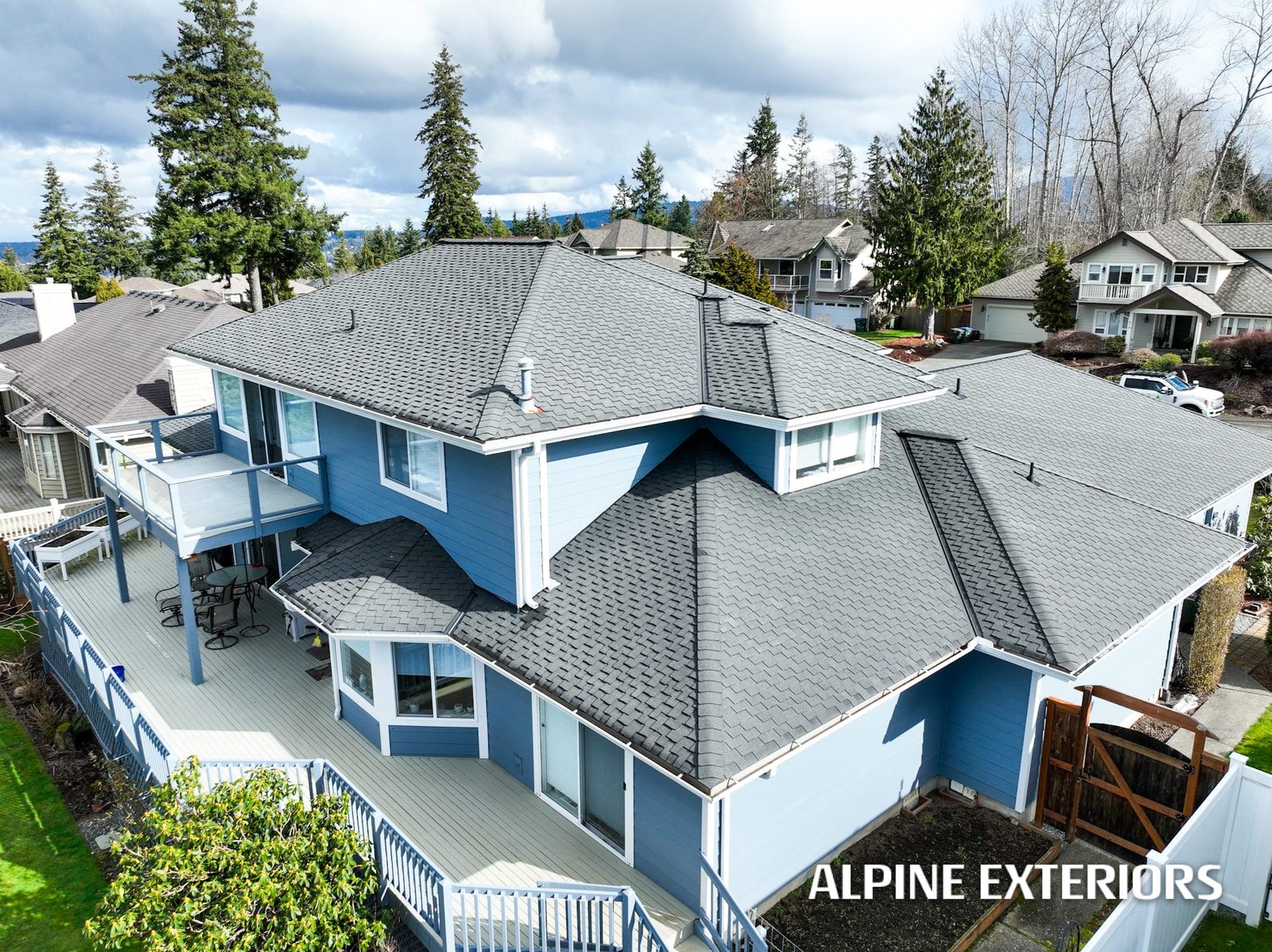
Mount Vernon and the rest of Skagit, Island, and Whatcom counties don't put a roof through hurricane-force wind events or heavy hail, but the year-round dampness is its own kind of stress test. Here's what actually shortens a composition roof's life in this specific area:
None of these are the wind-and-hail scenario a roof in the Midwest or a hurricane-zone roof in the Southeast is built around — that's a different set of stresses entirely, and it's not what's relevant here. What matters locally is moisture management: keeping water moving off the roof and out of the attic, and keeping organic growth from taking hold on the shaded slopes.
Roofing in this region also has to meet the ventilation and insulation provisions of the Washington State Energy Code, which affects how new roof systems are built even when the work is a re-roof rather than new construction. Proper attic ventilation isn't just an energy-code checkbox — it's one of the more direct ways to add real years to a shingle roof's service life in a climate this wet.
If your composition roof is under 15 years old, a homeowner's job is mostly prevention: keep gutters clear so water isn't backing up under the eaves, keep tree limbs trimmed back so shaded areas get some airflow and sun, and have someone knock back visible moss growth before it spreads across a whole slope — a soft wash rather than aggressive pressure washing, since high-pressure water can strip granules and do more harm than the moss itself.
Once a roof passes the 15-year mark, it's worth having it looked at from the attic side as well as the surface. Daylight coming through the decking, damp insulation, or dark staining on the rafters are all signs of a leak that hasn't shown up as a ceiling stain yet. From the outside, watch for granules collecting in the gutters (a sign the shingle surface is wearing down), curling or cupped shingle edges, and cracked or missing tabs after a windy stretch — these are the practical signs that matter more than the calendar age of the roof.
It's also worth being honest about what a repair can and can't fix. Patching a few damaged shingles after a wind event is reasonable and often the right call. But if granule loss is widespread, if flashing is failing in multiple places, or if the roof is already past 20-22 years and showing several of these signs at once, repeated patch jobs usually cost more over a few years than planning a full replacement while you can still choose the timing. Alpine Exteriors typically walks homeowners through that distinction during an inspection — what's a legitimate repair versus what's a sign the roof is at the end of its practical service life — rather than defaulting to either extreme.
One honest drawback worth naming: composition shingles, even good ones, are not the lowest-maintenance option available. If a homeowner wants to essentially forget about moss treatment and gutter clearing for a decade at a time, a metal roof or a heavier-tier impact-rated shingle is a fair thing to price out and compare, even though the upfront cost is higher. There's no single right answer — it depends on how long you plan to stay in the house and how much roof maintenance you're willing to keep up with.
It's more than cosmetic. Moss holds moisture directly against the shingle surface and can work its way under tabs as it grows, which accelerates granule loss and can lift shingles enough to let wind-driven rain underneath. Left alone for years on a shaded slope, it can measurably shorten how long that section of roof performs compared to a slope that's kept clear.
Not special shingles in the sense of hurricane-rated products — that's not the wind profile we deal with here. But on more exposed lots along the flats or waterfront, it's worth asking for a higher wind-rated architectural shingle and confirming that ridge caps, starter strips, and edge nailing are done correctly, since those details are where wind exposure shows up first.
Usually not quite. The 30-year rating comes from manufacturer testing under standardized conditions, and our persistent rain and shaded, moss-prone slopes tend to shorten that in practice. Most homeowners here get somewhere in the low-to-mid 20s out of a 30-year shingle unless the roof has excellent ventilation, good sun exposure, and consistent maintenance.
Look at how many separate problems are showing up at once — widespread granule loss, multiple flashing leaks, curling across several slopes, or a roof already past 20-22 years old. One isolated issue is usually a repair. Several of these together, especially on an older roof, is typically a sign that continued patching is a short-term fix on a roof that's near the end of its service life.
Roof age numbers on a spec sheet only tell part of the story — what matters is how your specific roof, on your specific lot, has actually held up to Skagit Valley rain, shade, and wind. Alpine Exteriors, licensed in Washington as ALPINI751OW, inspects roofs across Mount Vernon, Anacortes, Burlington, Sedro-Woolley, La Conner, Stanwood, Camano Island, and Bellingham and gives homeowners a clear read on what's left in the roof and what it would take to extend it. If you're not sure whether your composition roof needs moss treatment, a flashing repair, or a full replacement, Alpine Exteriors can walk the roof with you and lay out the honest options.