
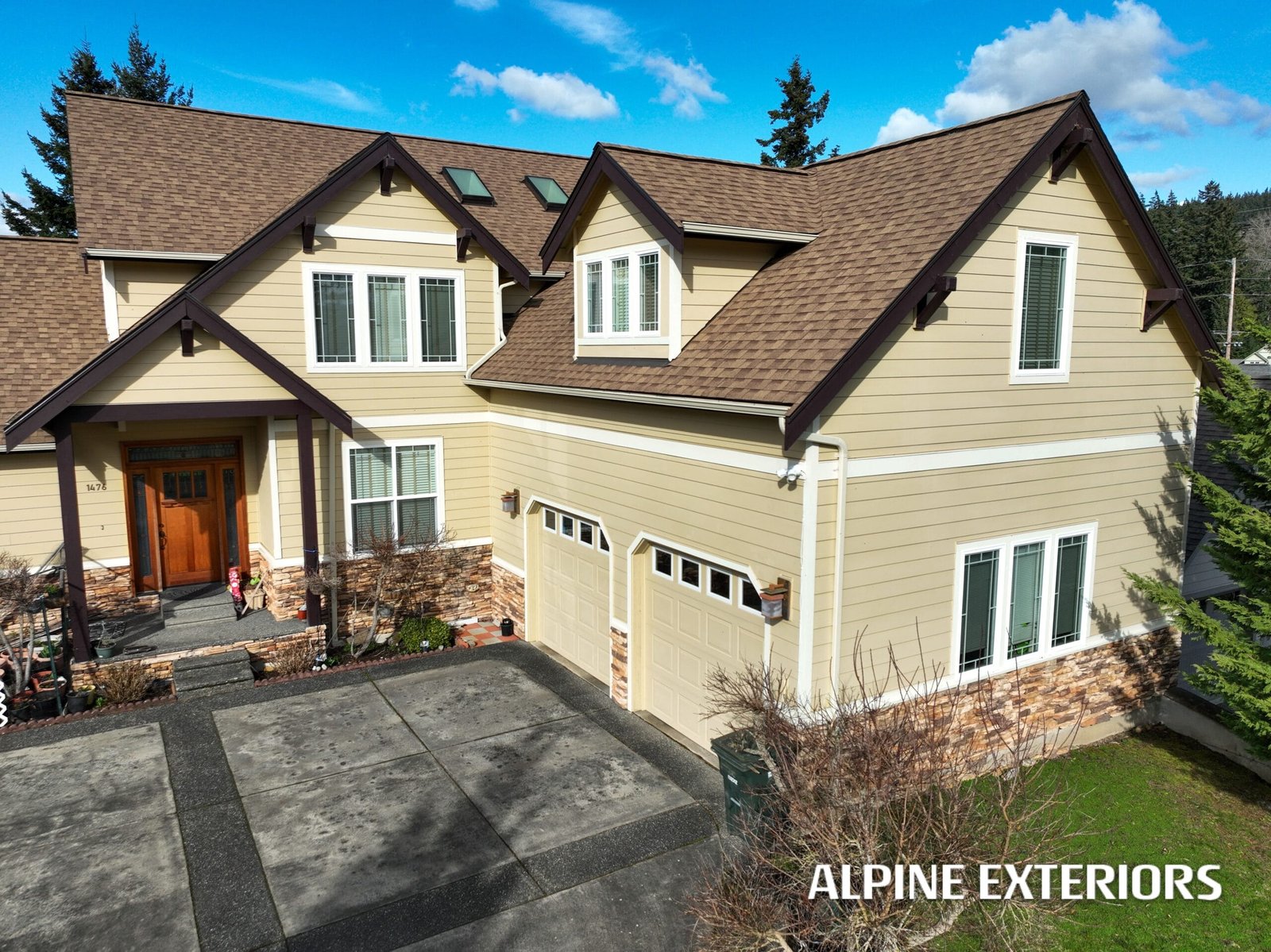
In Hamilton, the roofs that fail early almost never fail because of one big storm — they fail because moss and standing moisture were left alone for years. Between the shade from surrounding fir and cedar cover, the long wet season that runs from fall through spring, and the town's position tucked against the Cascade foothills along the Skagit River, roofs here hold moisture longer than roofs in more open, breezier parts of the county, and that extra moisture is what shortens their life.
Moss itself doesn't tear a hole in a roof. What it does is worse in a slow way: it grows in mats along the shaded, north-facing slopes and in the valleys where two roof planes meet, and those mats hold water against the shingle or shake surface long after the rest of the roof has dried out. Composition shingles are granule-coated asphalt, and the granules are what protect the asphalt mat underneath from UV and from physical wear. Moss roots work into the granule layer, loosen it, and hold water directly against it, which accelerates granule loss in exactly the spots that were already the wettest part of the roof. On cedar shake — still common on older homes around Hamilton and up toward Concrete — moss and the mold that follows it hold moisture inside the wood fibers themselves, which is the direct cause of shake cupping, splitting, and eventual rot.
Rain volume compounds the problem in a different way. Skagit County's upper valley gets more annual rainfall than the lowland cities closer to the water, and Hamilton sits close enough to the foothills that it catches orographic lift — moist air pushed up and over rising terrain, which wrings more rain out of passing storms than falls just a few miles downstream in Sedro-Woolley or Burlington. That means gutters and downspouts here are asked to move more water, more often, for a longer stretch of the year. A gutter that's half-clogged with fir needles and moss debris in October can overflow behind the fascia by January, and that overflow is what actually gets into the wall assembly and the eaves — not the rain falling on the roof field itself.
None of this is dramatic on its own. It's cumulative. A roof with moss and clogged gutters loses a few years of service life quietly, without ever showing an obvious leak, until the day a homeowner finds a soft spot in the decking or a stain on the ceiling and realizes the damage was years in the making.
Hamilton isn't the same roofing environment as Anacortes or Camano Island, and it's worth being specific about why, because the right maintenance plan depends on it.
The practical takeaway is that a maintenance plan built for a sunny, breezy lot near the water is the wrong plan for a shaded lot along the Skagit River, and the reverse is also true.
A short, honest list beats a long vague one. Here's what actually moves the needle on a Hamilton roof:
It's also fair to say what maintenance can't fix. If shake has already cupped and split from years of trapped moisture, or if decking underneath has gone soft, no amount of cleaning or zinc strip installation reverses that — at that point it's a repair or replacement conversation, not a maintenance one. Alpine Exteriors will say so plainly during an inspection rather than selling a cleaning service on a roof that actually needs structural work.
Most heavily shaded roofs in and around Hamilton benefit from a moss treatment or zinc/copper strip refresh every one to two years, since the combination of tree cover and long wet seasons keeps conditions favorable for regrowth almost year-round. A roof with more direct sun exposure, even elsewhere in the same neighborhood, may go longer between treatments.
Not usually, and it's worth being upfront about this. High-pressure washing can strip the protective granule layer off asphalt shingles and drive water up under shake tabs and flashing laps, which trades a cosmetic problem for a leak risk. Low-pressure rinsing after chemical or manual moss removal, followed by a zinc or copper strip installation, is generally the safer long-term approach.
Hamilton sees snow and hard freezes more often than the lowland towns closer to Puget Sound, and even a modest snowfall combined with poor attic ventilation can form an ice dam at the eaves. It doesn't happen every winter, but when a cold snap does come through the foothills, homes with under-insulated or poorly vented attics are the ones that end up with ice damming and the water intrusion that follows it.
There's no invented number that's honest here, because it depends heavily on the specific roof's shade exposure, slope, material, and how consistently it's been maintained. What's fair to say is that a well-maintained roof with regular moss treatment and clear gutters will noticeably outlast a similar roof on the same street that's been left alone, and shaded roofs in general tend to show wear sooner than roofs with more sun and airflow, regardless of the underlying material.
If moss has taken hold on a north-facing slope, gutters are backing up every winter, or it's just been a while since anyone looked at the roof from above, it's worth getting an honest inspection rather than guessing. Alpine Exteriors serves homeowners throughout the Skagit, Island, and Whatcom County area, including Hamilton, Sedro-Woolley, Mount Vernon, and the surrounding foothill communities, and can walk a Hamilton roof in person to point out what's cosmetic, what's a maintenance item, and what actually needs repair. Alpine Exteriors is a Washington-licensed contractor (license ALPINI751OW) offering roofing, gutter, window, and deck services — reach out for a straightforward, no-pressure look at what a rainy, shaded Hamilton roof actually needs this season.