
If you're seeing dripping skylights, damp insulation, or dark streaks on the underside of your roof deck in Hamilton, the cause is almost always warm, moist indoor air reaching a cold roof surface with nowhere to escape. Fixing it means balancing intake and exhaust airflow through the attic and sealing the air leaks that let household humidity up there in the first place — not just adding more insulation or blaming the skylight itself.
Condensation in an attic is a temperature and moisture problem, not a leak problem, even though the two look identical from inside a bedroom ceiling. Every home generates water vapor from showers, cooking, laundry, and simply breathing. In a well-sealed, well-ventilated attic, that vapor stays in the living space and exits through bath fans and range hoods. In a home with gaps around can lights, attic hatches, plumbing stacks, or a skylight shaft that was framed without a continuous air barrier, warm humid air rises into the attic all winter. Once it hits the cold underside of the roof sheathing — which in the Skagit Valley's damp winters can sit well below the dew point for days at a time — it condenses into liquid water or frost.
Skylights make this worse in two specific ways. First, the shaft between the ceiling and the roof deck is a direct chimney for warm air if it isn't insulated and air-sealed on all four sides, which is a common shortcut on older installations. Second, the skylight's own glazing and frame are colder than the surrounding ceiling, so they're often the first place moisture shows up even when the real problem is attic-wide. A fogged or dripping skylight is frequently the messenger, not the source.
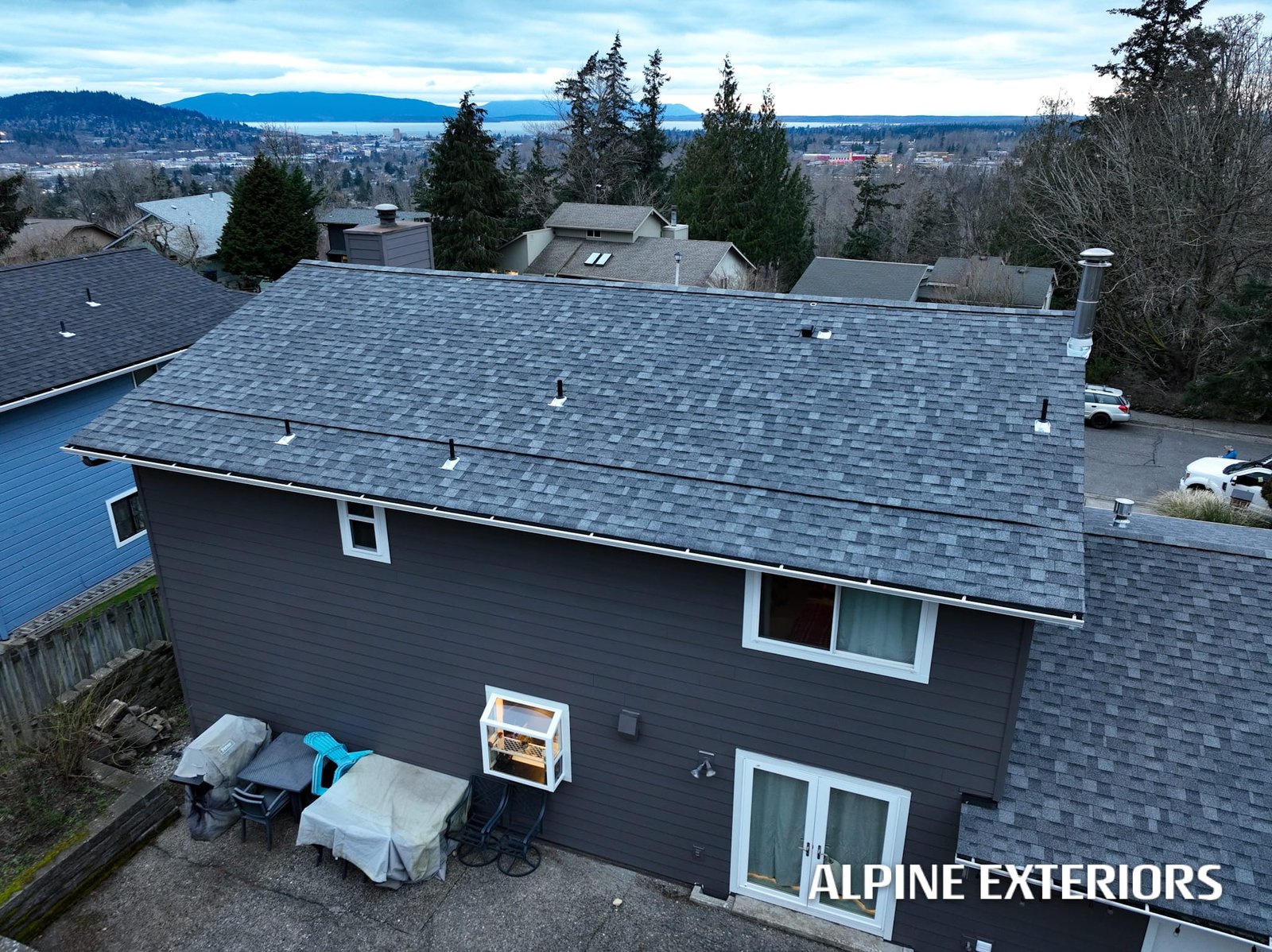
Proper attic ventilation works by keeping the underside of the roof deck close to outdoor temperature and by continuously flushing out any moisture that does make it up there. That requires a balanced system: intake at the eaves (soffit vents or edge vents) and exhaust at or near the ridge, with baffles that keep insulation from blocking the airflow path in between. When only one half of that pair exists — ridge vents with no soffit intake is the most common version we find in this area — the attic doesn't actually exchange air, it just recirculates whatever is already up there.
Hamilton sits up the Skagit River valley in the foothills, tucked closer to the Cascades than the open farmland around Mount Vernon or Burlington. That location changes the ventilation and condensation picture in a few real ways:
None of this involves hurricane-force wind or the kind of storm surge concerns coastal Gulf or Atlantic markets deal with — Skagit County's exposure is rain volume, moss, shade, and cold, not tropical weather.
Start with the attic, not the skylight, even if the skylight is where you see the water. A useful sequence:
The honest drawback: ventilation and air-sealing work is often more diagnostic labor than material cost, and it can take a full heating season to confirm a fix actually solved an intermittent condensation issue, since it only shows up under the right combination of cold and humidity. Adding vents or a bigger fan without addressing the air leaks underneath sometimes helps a little and sometimes does nothing, so it's worth resisting the urge to buy a single product as a cure-all. Alpine Exteriors has run into both outcomes on older Skagit County homes and prefers to diagnose the airflow path fully before recommending work, rather than guessing from the symptom alone.
No. In our experience across Skagit County, a dripping or fogged skylight is condensation from attic moisture more often than a failed seal or flashing, especially if the dripping happens on cold, clear nights or during long rainy stretches rather than during active rain. A flashing leak usually tracks with rainfall and wind direction, while condensation tracks with temperature swings and indoor humidity; the two are worth telling apart before replacing anything.
You need both working together. Exhaust vents at the ridge only pull air out effectively if there's a matching source of fresh air coming in at the soffits; without that intake, the attic doesn't ventilate, it just shuffles the same humid air around. This is one of the most common gaps we find in homes around Hamilton and the surrounding foothill communities.
Not necessarily — moss is mostly a function of shade, moisture retention, and how long a roof section stays wet, which is common on north-facing and tree-covered lots throughout the Skagit Valley regardless of attic condition. That said, heavy moss can hide early shingle or decking damage, so it's worth having it checked at the same time as any attic ventilation work, particularly if you're also seeing interior moisture signs.
Usually not by itself. Insulation slows heat transfer but doesn't stop air leakage, and it's air leakage — warm, moist household air escaping into the attic through gaps and penetrations — that causes most condensation. Sealing those air paths first, then confirming the ventilation is balanced, generally solves the problem more reliably than insulation alone, and it also keeps you from burying an active leak point under more material.
If you're dealing with a damp attic, a dripping skylight, or moss creeping across a shaded roof section in Hamilton or anywhere else in the Skagit River valley, it's worth having someone look at the whole system — intake, exhaust, air sealing, and the skylight shaft — rather than treating the symptom you can see. Alpine Exteriors is a Washington-licensed contractor (license ALPINI751OW) serving Skagit, Island and Whatcom counties, including the outlying communities around Sedro-Woolley and up the Skagit Valley toward Hamilton. Contact Alpine Exteriors for an on-site attic and roof assessment before your next wet season sets in.