
Most Granite Falls homes need 6-inch K-style gutters with 3x4-inch downspouts spaced roughly every 25 to 30 feet, not the 5-inch, 2x3 setup that's standard on new construction elsewhere in the county. The extra capacity matters because Granite Falls sits at the edge of the Cascade foothills, where rain totals and roof runoff run noticeably heavier than in the lowland valleys closer to Puget Sound.
Get the gutter size right, keep the downspouts clear of fir and cedar debris, and route the water at least 6 to 10 feet from the foundation, and you'll avoid the two failures that show up most often out here: gutters that overflow during a hard December storm, and crawlspace moisture that traces back to water being dumped right next to the footing.
Gutter sizing isn't guesswork — it's a function of roof area, roof pitch, and the rainfall intensity the system has to handle in a worst-case storm. A 5-inch gutter, which is what most big-box installers default to because it's cheaper and lighter, is rated to handle a modest roof area per downspout under moderate rainfall. Push a steep-pitched roof with 1,800 or more square feet of catchment through a 5-inch system during a real Puget Sound frontal system, and the water simply outruns the gutter's carrying capacity before it ever reaches the downspout. You see it as sheeting water off the front edge of the gutter during the heaviest part of a storm, not because the gutter is clogged, but because it's undersized for the job.
A 6-inch K-style gutter holds close to twice the water volume of a 5-inch gutter for the same length, and a 3x4-inch downspout moves roughly 50% more water than the common 2x3-inch size. On a typical single-story Granite Falls home with a moderately steep roof, that difference is usually enough to keep the system working through the heaviest atmospheric-river events without overtopping. On larger roofs, multi-story homes, or roofs with long unbroken runs and few valleys to break up flow, we also look at adding a downspout rather than just relying on gutter size alone — spacing downspouts every 25 to 30 feet, rather than stretching one downspout across 40 or 50 feet of gutter run, keeps water moving instead of backing up at the low point.
None of this is exotic. It's the same math any gutter contractor should be running — roof area times expected rainfall intensity, divided by the flow capacity of the trough and downspout size — but it gets skipped constantly because a 5-inch gutter looks the same on a quote as a 6-inch one, and most homeowners have no way to tell the difference until the first serious storm.
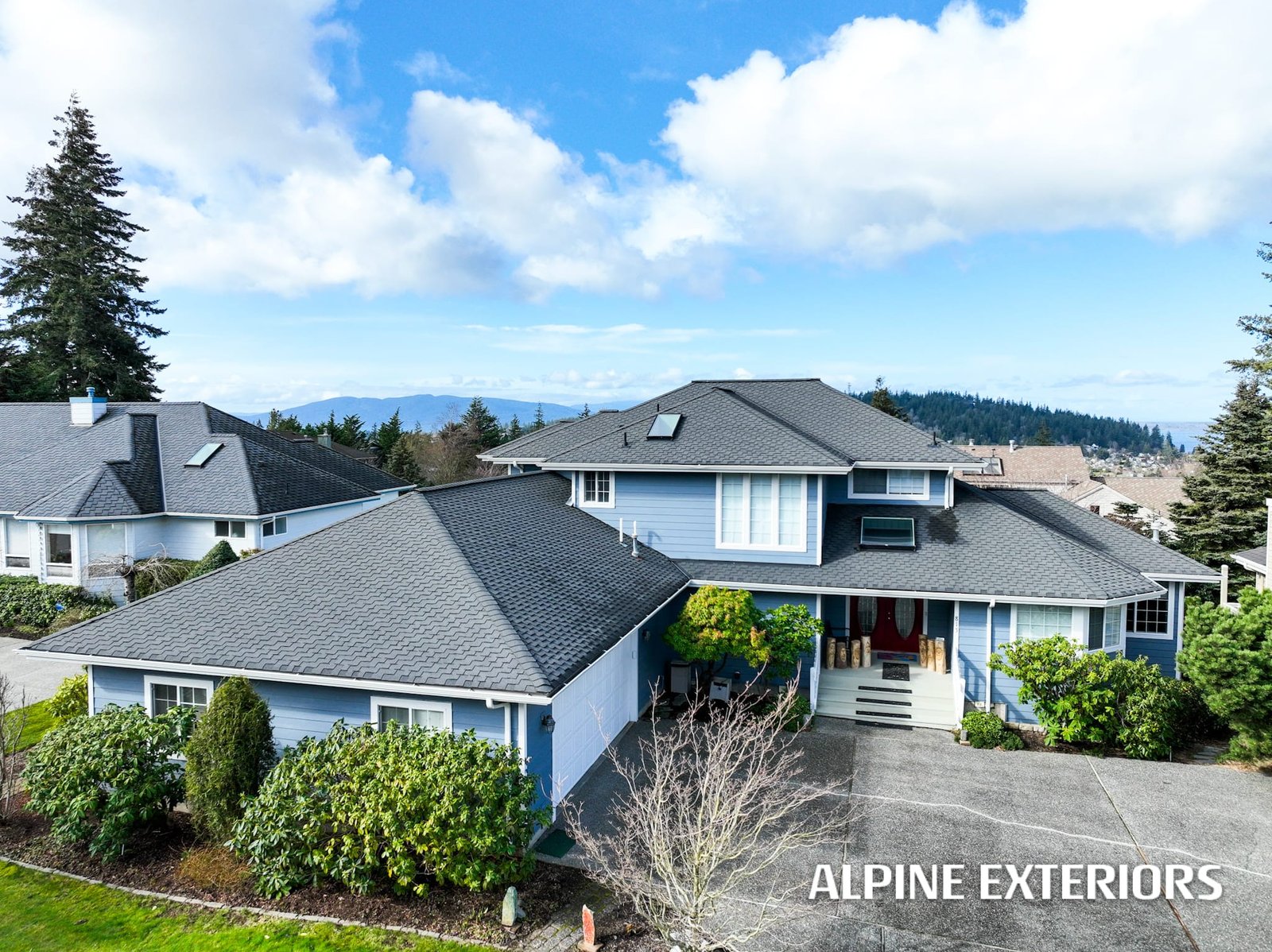
Granite Falls sits up against the western slope of the Cascades, higher and further inland than the rest of Alpine Exteriors' Skagit and Whatcom County service area. That elevation and proximity to the foothills changes the water problem in three specific ways.
Rainfall runs heavier. As Pacific storm systems push inland and start climbing the foothills, they wring out more moisture than they do over the flatter lowlands closer to the water. Roofs here take on more total rainfall per storm, and they take it in shorter, harder bursts during the wettest months of the year — which is exactly the scenario that exposes an undersized gutter.
Conifer canopy is constant, not seasonal. In a lot of Puget Sound towns, gutter debris is a fall problem tied to deciduous leaf drop. Around Granite Falls, where fir, hemlock and cedar dominate the tree cover, needles, cones and small twigs come down year-round, with the heaviest drop after wind events and dry spells rather than on a predictable autumn schedule. Needles are also worse than leaves in one specific way: they're small enough to pack into a tight mat inside a gutter or downspout without fully blocking a screen or guard, so a system can look clear from the ground while it's actually choked solid a few inches down.
Older homes still run on crawlspaces. A meaningful share of the housing stock in and around Granite Falls was built on a crawlspace foundation rather than a slab, often decades before current moisture-control expectations were standard practice. Combine that with heavier regional rainfall and grading that wasn't always designed with modern drainage in mind, and you get a direct line from a poorly performing gutter system to a damp, musty crawlspace — something we see repeatedly on inspections in this area. At elevation, this part of Snohomish County also sees occasional snow and ice in winter that lowland Skagit County rarely gets, which adds freeze-thaw stress to gutters that are already holding standing water from a clogged downspout.
Start with the gutters themselves, then follow the water all the way to where it actually ends up.
Alpine Exteriors walks Granite Falls-area homes through this as a system, not a single line item — gutter size and downspout count first, then where the water actually goes once it leaves the downspout, then a look at the crawlspace vents and vapor barrier if the home has one. Fixing the gutters without addressing where the discharge lands, or vice versa, tends to just move the moisture problem instead of solving it.
Plan on two to three cleanings a year rather than the single fall cleaning that works in neighborhoods with mostly deciduous trees. Fir and cedar needles come down throughout the year, and they're small enough to build up gradually inside a gutter without an obvious clog forming, so a late-fall, late-winter, and mid-summer check is a more realistic schedule on a heavily treed lot.
It depends on the roof, not the house size. A single-story home with a low-pitched roof and modest square footage can often perform fine with a well-installed 5-inch system. Once you're dealing with a steeper pitch, a larger roof area, or a long gutter run with only one downspout, a 6-inch gutter with a 3x4-inch downspout gives real headroom during a hard winter storm instead of running right at its limit.
No, and be skeptical of anyone who claims otherwise. Mesh and micro-mesh guards reduce how often you need to clean gutters and make the job faster when you do, but fir and cedar needles are small and persistent enough to accumulate on top of even a good guard system over time. Treat guards as an interval-extender, not a maintenance-eliminator.
It's one of the most common causes, but not the only one. If downspouts are discharging close to the foundation, or a gutter is overflowing along one section of roofline, that water often ends up against the footing and finds its way into the crawlspace. It's also worth checking the vapor barrier and foundation vents while you're looking at the gutters, since a drainage fix alone won't solve a torn or missing vapor barrier, and vice versa.
If your gutters overflow during heavy storms, your downspouts are packed with fir needles by the time you notice, or you've got a crawlspace that stays damp longer than it should, it's worth having someone look at the whole system rather than just patching the symptom. Alpine Exteriors is a licensed Washington contractor (license ALPINI751OW) serving Granite Falls and the surrounding Skagit, Island and Whatcom county communities, and we size gutters and drainage for the roof and property in front of us, not off a one-size-fits-all chart. Reach out to schedule a gutter and drainage assessment before the next round of winter storms moves through.