

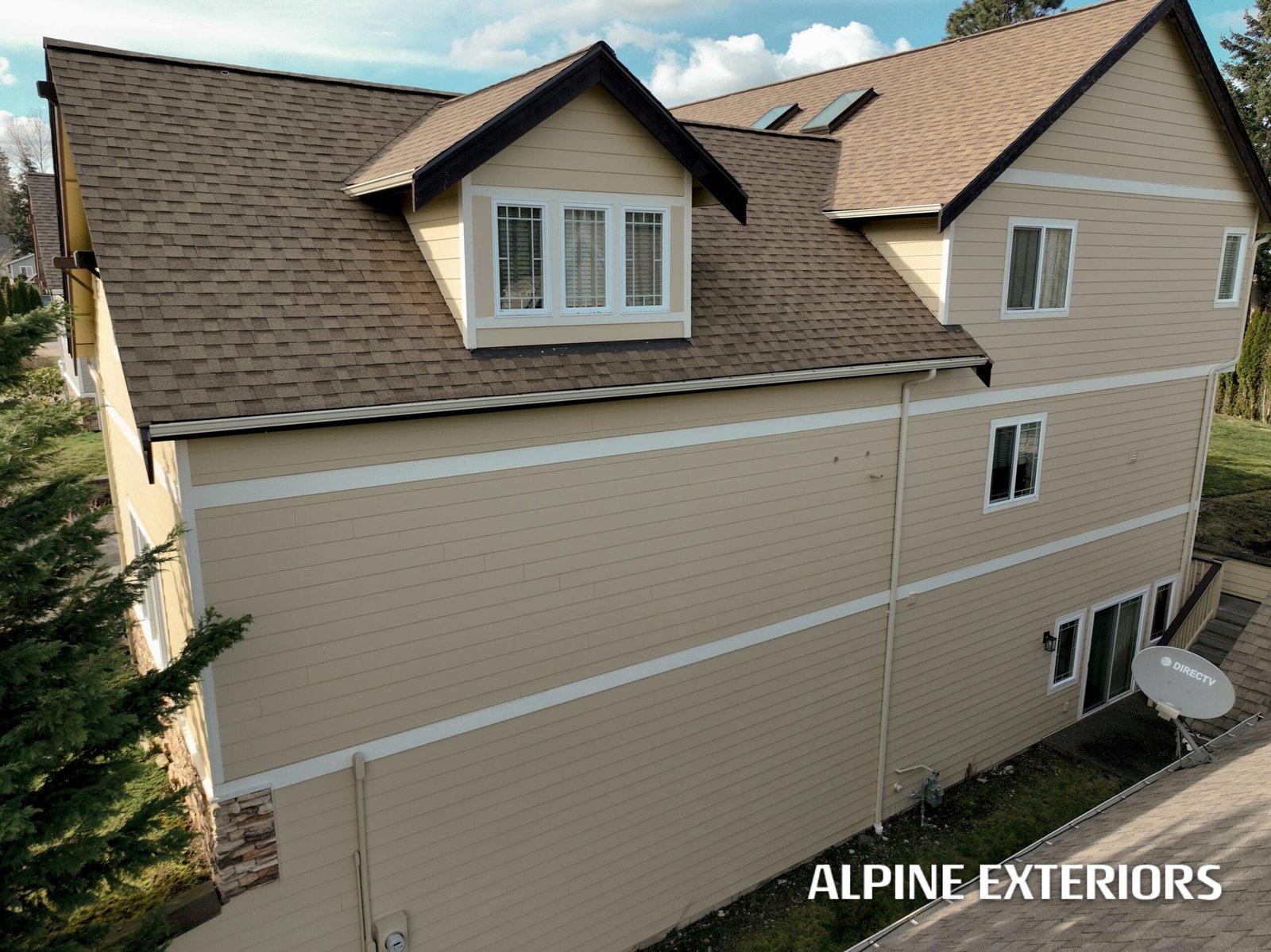
Replacing a deck on Camano Island comes with a few regional wrinkles that homeowners on the mainland do not always deal with. The island sits out in Puget Sound between the Skagit and Whatcom county mainland and Snohomish County, so most lots get some combination of salt-laden air, exposed wind off the water, and heavy winter rain that keeps wood structures damp for months at a time. Alpine Exteriors builds and replaces decks throughout Skagit, Island, and Whatcom counties, and Camano Island projects consistently land in a wider price range than similar-sized decks a few miles inland, mostly because of site access, shoreline setbacks, and the extra corrosion protection that salt exposure demands. This guide walks through realistic cost ranges, the variables that push a project toward the low or high end, what a written quote should include, and how to compare bids from different contractors without getting burned by an incomplete estimate.
There is no single "average" deck price that means much on its own, because a small ground-level cedar deck and a tall multi-level composite deck with cable railings and a stair down to a bluff trail are not the same project. Across Skagit, Island, and Whatcom county deck replacements, a modest ground-level deck in pressure-treated lumber typically lands toward the lower end of what most contractors quote, while a large, tall, or multi-level deck in composite or PVC decking with upgraded railings can run several times that amount. Treat any number here as a planning range, not a quote for a specific address — the only way to know the real cost of a specific project is a site visit and a written estimate.
On Camano Island specifically, three things tend to widen the range compared with a similar deck in Mount Vernon or Burlington. First, many lots sit on bluffs or near the shoreline, which can trigger Island County shoreline setback review and occasionally a geotechnical opinion before footings go in. Second, waterfront and view-lot decks are often built taller, which means deeper footings, taller posts, and more structural bracing to handle wind. Third, salt air accelerates corrosion on fasteners, joist hangers, and any exposed metal, so a deck built to last here usually calls for stainless or heavily coated hardware rather than the standard galvanized fasteners common further inland — an upgrade that adds cost but avoids early hardware failure.
| Cost Factor | Typical Low End | Typical High End |
|---|---|---|
| Deck size and footprint | Small, ground-level deck under roughly 200 square feet | Large or multi-level deck exceeding roughly 400 square feet |
| Decking material | Pressure-treated lumber | Composite or PVC boards, or premium cedar |
| Height above grade | Deck sits close to grade, minimal posts | Tall bluff or view-lot deck needing deep footings and long posts |
| Substructure condition | Existing footings and framing are sound and reusable | Full tear-out and rebuild of footings, framing, and ledger |
| Railing style | Standard wood picket railing | Cable, glass-panel, or custom metal railing |
| Site access | Easy truck and trailer access | Hand-carried materials or excavator staging on steep or waterfront lots |
| Permits and review | Standard county building permit only | Shoreline setback review or geotechnical opinion required |
| Fasteners and hardware | Standard coated fasteners | Full stainless-steel hardware for salt-air exposure |
Several variables swing a Camano Island deck replacement toward the lower or higher end of any range a contractor quotes. Size is the obvious one — cost scales with square footage, but not perfectly linearly, since a very small deck still carries fixed costs for permits, mobilization, and demolition that get spread across fewer square feet. Height matters almost as much as footprint on this island's terrain: a deck sitting close to grade needs far less structural work than one perched ten or fifteen feet up a bluff-side lot, where taller posts, additional bracing, and sometimes a permanent stair to grade all add labor and material.
Decking material is the next big lever. Pressure-treated lumber remains the least expensive option and holds up reasonably well if it is stained or sealed on a maintenance schedule, but it shows its age faster under this region's long wet season than it would in a drier climate. Cedar looks good longer with regular care but is a softer wood that needs consistent upkeep to resist moss and moisture staining, especially on the shaded side of a house under fir or cedar trees. Composite and PVC decking cost more upfront but need little more than periodic washing, which matters where moss and algae on shaded, damp surfaces is a routine fact of life rather than an occasional nuisance.
Site access and old-deck removal also swing pricing. A deck reachable by truck and trailer is cheaper to build than one on a steep waterfront lot where materials have to be hand-carried or staged with a mini excavator. If the existing deck has rotted framing, undersized or corroded ledger flashing, or footings that no longer meet current code, more of the substructure has to be rebuilt rather than reused — common on older Camano Island homes built before current ledger-flashing and fastener standards were widely enforced. Permit and possible shoreline review timelines in Island County can also add administrative cost and calendar time that a comparable inland Skagit County job may not encounter.
A complete, comparable quote for a deck replacement should spell out demolition and haul-away of the existing structure, not just the cost of building the new one. It should list the exact decking material by brand and product line, not just "composite" or "wood," since price and durability vary widely within each category. Framing lumber grade and fastener type should be specified, and on Camano Island in particular, a quote worth trusting will call out stainless steel or heavily coated hardware for ledger connections and joist hangers given the salt-air exposure, rather than leaving hardware unspecified.
The quote should also cover footing size and depth appropriate to the soil on that specific lot, and the ledger board attachment and flashing detail — one of the most common failure points on older decks in a region with this much annual rainfall, since a poorly flashed ledger lets water track into the house's rim joist for years before anyone notices. Railing style and height, stair construction, permit fees, and whether engineering review is included if the project falls under Island County shoreline jurisdiction should all appear as line items. Finally, a clear timeline and a warranty statement covering workmanship, separate from any manufacturer material warranty, should be part of the written proposal. Alpine Exteriors provides an itemized written quote along these lines for every deck project so homeowners can see exactly what they are paying for before signing anything.
The only fair way to compare bids from different contractors is to make sure they are pricing the same project. Two quotes that differ by a large margin often turn out to specify different decking materials, different fastener quality, or a different scope for old-deck removal, not simply different labor rates. Before comparing dollar figures, line up each quote's square footage, material brand and line, railing type, and whether demolition and disposal of the old deck is included.
It is also worth confirming that whoever is bidding the job is actually licensed to do it. Washington's Department of Labor and Industries maintains a public contractor lookup where a license number can be verified along with bond and insurance status — that takes a few minutes and avoids a lot of regret later. Alpine Exteriors holds Washington contractor license ALPINI751OW, and any homeowner is welcome to verify it before signing a contract. Beyond licensing, ask each contractor how they handle the ledger flashing detail and what fastener hardware they plan to use given the salt exposure on Camano Island; a contractor with a specific, confident answer has probably built decks in this environment before.
Payment schedule is another point of comparison. Washington law limits how much a contractor can require as an upfront deposit before work begins, so a bid asking for full or near-full payment up front is worth questioning directly. A reasonable schedule ties payments to project milestones — permit issuance, framing completion, and final walkthrough — rather than front-loading the money before any work has happened on site.
Most homeowners pay for a deck replacement through some mix of savings, a home equity line of credit, or a financing plan offered by the contractor or the decking manufacturer itself. Several major composite decking brands offer promotional financing through third-party lenders, which can make higher-end material more affordable on a monthly basis even though the total project cost is higher than pressure-treated lumber. It is worth asking a contractor directly what financing options they offer rather than assuming none exists.
On the insurance side, homeowners policies generally do not cover a deck replacement driven by ordinary wear, rot, or age — that is treated as routine maintenance, not a covered loss. Where insurance sometimes does apply is sudden damage: a windstorm off the Strait or the Skagit flats that snaps a railing or cracks a support post, or a fallen tree limb that damages decking, may be covered under a standard homeowners policy's wind or falling-object provisions. If a deck failure follows a specific storm event, it is worth documenting the damage with photos and contacting the insurer before assuming the repair is entirely out of pocket, since a partial replacement tied to storm damage is a different conversation than a routine end-of-life replacement.
Most straightforward deck replacements move from permit approval to substantial completion within a few weeks once the crew is on site, though the exact timeline depends on deck size, whether shoreline or geotechnical review is required, and how many weather delays the wet season adds to the schedule. Projects on bluff or waterfront lots with limited equipment access typically take longer than a similar-sized deck on a flat, easily reached lot.
In most cases yes — Island County generally requires a building permit for deck construction or replacement above a certain height or footprint, and lots near the shoreline may also trigger additional review under county shoreline regulations. A contractor familiar with local permitting can confirm what applies to a specific address before work starts, and pulling the correct permit protects a homeowner if the property is ever sold or inspected later.
For many homeowners here, yes, mainly because composite and PVC decking resist the moisture staining and moss growth that shows up on shaded, damp wood surfaces during the long wet season, and they need far less ongoing maintenance than wood. The tradeoff is a higher initial material cost, so the right answer depends on how long the homeowner plans to stay in the house and how much upkeep they are willing to put into wood decking over the years.
Sometimes, if the existing framing, ledger flashing, footings, and fasteners are all still sound and up to current code — but on many older Camano Island decks the substructure has deteriorated or was never properly flashed at the ledger, which makes a boards-only swap a short-term fix rather than a lasting one. A contractor should inspect the framing before quoting a boards-only replacement so the homeowner knows whether that approach will actually hold up.
A deck replacement is a large enough investment that it deserves a detailed, apples-to-apples comparison rather than a decision based on the lowest number on a page. Alpine Exteriors serves homeowners throughout Skagit, Island, and Whatcom counties, including Camano Island, Stanwood, and the surrounding communities, and provides written quotes that spell out material, hardware, permit handling, and timeline before any work begins. Reach out to discuss a specific property, lot conditions, and the deck style that makes sense for the site.



