
If you're seeing damp insulation, dark streaks on roof sheathing, or fogged-up skylights in an Alger home, the root cause is almost always poor attic airflow combined with warm, moist indoor air finding its way up and out through the ceiling. In our climate, an attic that can't breathe properly traps humidity all winter, and that trapped moisture condenses on the coldest surfaces it can find — usually the underside of the roof deck and the glass or frame of a skylight.
Fixing it is rarely about one product. It's about balancing intake and exhaust ventilation, sealing the air leaks that push household moisture into the attic in the first place, and choosing skylight flashing and glazing that were actually designed for a wet marine climate. Alpine Exteriors sees this pattern often enough on homes between Alger and the rest of Skagit County that we treat it as a system problem, not a single repair.
Every home generates moisture — cooking, showers, laundry, breathing while you sleep — and in a well-built house that moisture is supposed to leave through bath fans, kitchen exhaust and general ventilation, not through the ceiling. But ceilings are full of small penetrations: can lights, plumbing vents, wiring holes, the attic hatch itself, sometimes a poorly sealed skylight shaft. Warm indoor air is more buoyant and holds more water vapor than cold air, so it rises and pushes through those gaps into the attic, a process sometimes called the stack effect.
Once that moist air is in the attic, what happens next depends on ventilation. A properly vented attic has intake at the eaves (soffit vents) and exhaust higher up (ridge vent, gable vents, or roof-mounted vents), so the moist air keeps moving and exits before it can condense. When soffit vents are painted shut, blocked by insulation, or simply weren't installed generously enough to begin with — which is common on additions and older re-roofs — the attic becomes a stagnant, humid space. On a cold Skagit County night, that humid air hits the cold underside of the roof sheathing and condenses into liquid water or frost. Over a winter, that cycle soaks insulation, stains sheathing, and in bad cases rots roof framing from the inside, all without a single drop of rain getting through the shingles.
Skylights add a second failure point because they interrupt the attic's insulation and air barrier at exactly the place where warm moist air wants to escape. A skylight shaft that isn't sealed and insulated correctly acts like a chimney for household humidity, and the glass itself, being the coldest surface in the room on a winter morning, condenses that moisture directly where you can see it running down the frame onto drywall and trim.
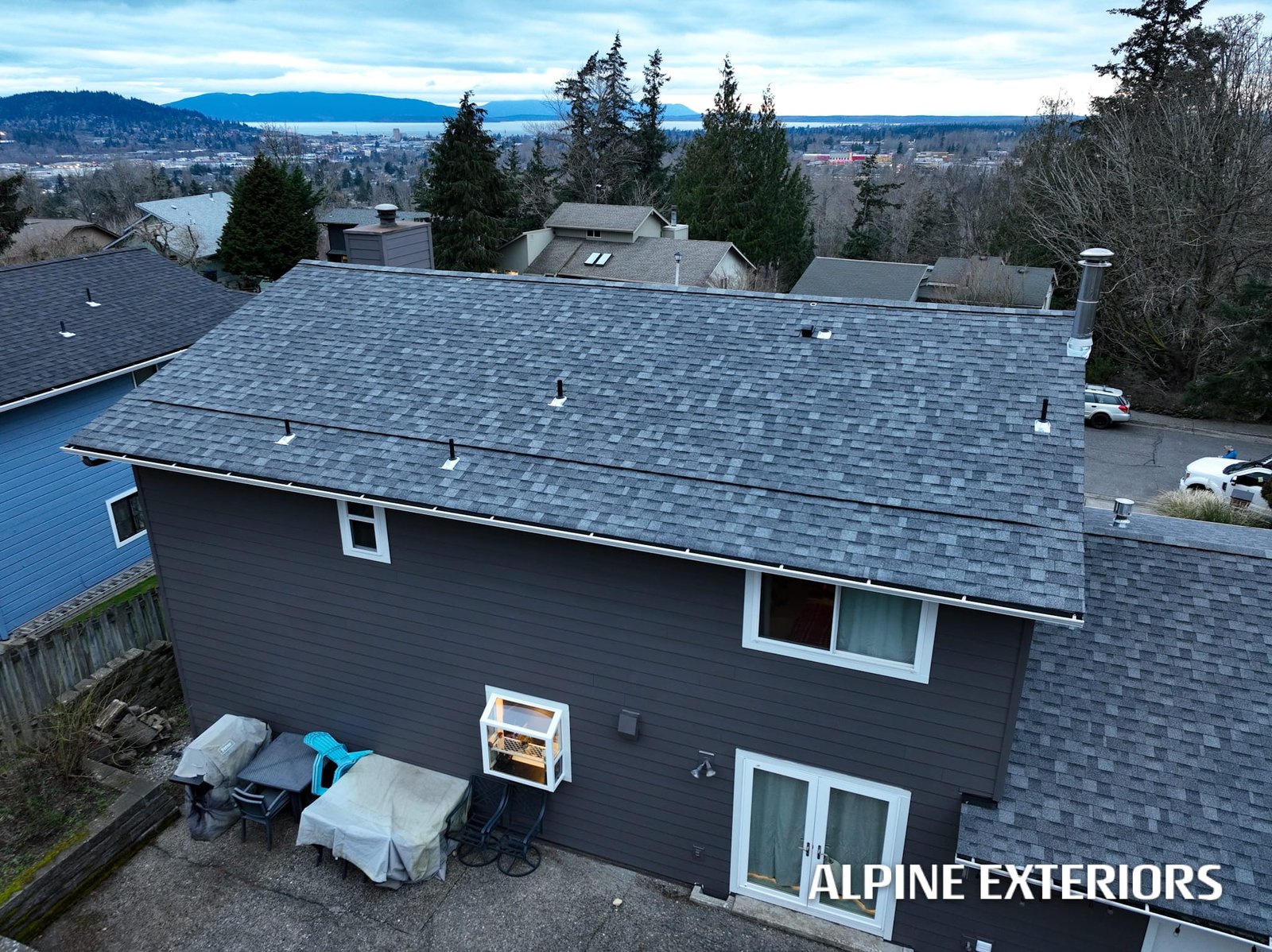
Alger sits in a stretch of Skagit County that gets a long, wet winter with steady rain rather than dramatic storms, plus wind that comes off the Skagit flats and funnels up through the valley toward the foothills. That combination matters for three reasons. First, the sheer number of wet, overcast days means attics have far less opportunity to dry out between condensation events than they would in a drier climate — moisture that would evaporate away in a sunny region here just sits and accumulates. Second, many lots around Alger are wooded or sit in the shade of the foothills, and shaded, damp roofs grow moss aggressively; moss holds water against the shingles and can back it up under the shingle edge near soffit vents, choking off the very intake ventilation the attic needs. Third, wind off the flats and out toward the Strait puts real pressure on skylight flashing and ridge vents, so hardware that's marginal to begin with tends to fail here faster than it would in a calmer inland location.
The foothills toward Lake Cavanaugh and the higher parts of the county also see occasional snow and refreeze cycles that flatland Skagit County mostly avoids. That matters for skylights and eave ventilation together: a poorly insulated attic melts snow unevenly, and meltwater refreezing at the cold eave can back up under shingles right where soffit intake lives, which is a second way moss and ice combine to choke off airflow. None of this is hurricane-country weather — there's no need to engineer for wind uplift the way you would on the Gulf Coast — but the Pacific Northwest's own combination of persistent damp, shaded roofs and valley wind is a real, specific set of stresses on attic systems that a generic ventilation fix doesn't always account for.
Start by looking, not guessing. On a cold morning, a quick look in the attic (or a photo taken through the hatch) tells you a lot: frost or dark water stains on the underside of the roof sheathing, sagging or discolored insulation, or a musty smell are all signs that moisture is accumulating faster than it's leaving. Outside, check whether soffit vents are actually open — painted-over, insulation-blocked or screened-shut soffits are one of the most common and cheapest problems to fix, and they're often the real reason a ridge vent isn't doing its job.
Skylights deserve their own line item. If a skylight is original to a roof that's now 15-20 years old, the flashing kit underneath it has likely outlived its expected service life even if the visible seal looks fine, and replacing an aging skylight at the same time as a roof replacement is almost always more cost-effective than doing them as two separate projects later. Double-check that any new or replaced unit is rated for condensation resistance, not just water resistance — the two are tested differently, and a skylight that never leaks rain can still sweat constantly on the inside if it wasn't built with a thermally broken frame. Alpine Exteriors, WA contractor license ALPINI751OW, walks Skagit County attics through this exact sequence — airflow, air sealing, then skylight condition — before recommending any specific repair, because treating the symptom (a wet ceiling stain) without finding which of those three is failing usually means paying for the same fix twice.
Be honest about the limits here too. Adding a ridge vent or extra soffit vents will not fix a condensation problem that's actually coming from an unsealed bath fan duct or an uninsulated attic hatch — ventilation moves air, it doesn't stop moisture from getting into the attic in the first place. And no amount of attic work will fix a skylight that's leaking rain from failed roof flashing; that's a water intrusion problem, not a condensation problem, and the two can look similar on a stained ceiling but need different repairs.
That's almost always interior condensation, not a roof leak. Warm, humid household air is reaching the cold glass or frame of the skylight — often because the shaft isn't sealed and insulated the way the surrounding ceiling is — and condensing there overnight. Improving the air seal around the shaft and making sure bath and kitchen exhaust vent outside rather than into the attic usually solves it; if it persists, the skylight glazing itself may not be built for condensation resistance.
It can be both. Moss on its own is mostly cosmetic on a well-ventilated, well-drying roof, but on shaded lots common around Alger it holds water against the shingles and can grow thick enough to back water up under the shingle edge near the eave, which blocks soffit intake vents right where the attic needs them most. If moss is concentrated on the shaded, north-facing side of the roof and you're also seeing attic moisture, it's worth having both looked at together rather than just having the moss treated.
It depends on the roof's shape and how much soffit intake is actually available, not on which product is trendiest. A continuous ridge vent paired with continuous soffit intake is generally the most balanced system on a straightforward gable or hip roof, but homes with limited ridge length, dormers, or complicated rooflines sometimes do better with a mix of gable and roof-mounted vents. The wrong combination — exhaust with too little matching intake — can actually pull conditioned air out of the living space rather than just venting the attic, so it's worth having the balance checked rather than guessing.
The energy code sets minimum insulation and air-sealing standards for the ceiling plane, which directly affects how much moisture-laden air can reach the attic in the first place. When Alpine Exteriors or any licensed contractor is doing significant attic, insulation or skylight work in Skagit County, that work needs to meet current Washington State Energy Code requirements for the ceiling assembly, which is one more reason ventilation, air sealing and skylight condition are best addressed as one project rather than three separate ones.
If you're dealing with a musty attic smell, stained ceiling drywall, a moss-covered roof section, or a skylight that sweats every winter morning, it's worth having someone look at the whole system rather than patching the symptom you can see. Alpine Exteriors serves Alger and the rest of Skagit, Island and Whatcom counties, from Mount Vernon and Burlington out to Anacortes, La Conner, Camano Island and Bellingham, and can walk your attic, soffits and skylights together to identify what's actually driving the moisture before recommending a fix.