
If you've started asking around Mount Vernon, Anacortes, Burlington, Sedro-Woolley or La Conner about soffit and fascia work, you've probably noticed the quotes don't agree with each other. That's normal for this trade — soffit and fascia pricing swings more than roofing or siding pricing because so much depends on what's hiding behind the old boards once they come off. This page walks through realistic ranges for our part of Skagit, Island and Whatcom counties, what actually moves the number up or down, and how to read a quote so you're comparing apples to apples. Alpine Exteriors (WA contractor license ALPINI751OW) put this together from the patterns we see on homes in this region — not as a substitute for an on-site look at your specific eaves.
Soffit and fascia are almost always priced together because they're installed together and because damage to one is often a symptom of damage to the other — water that rots fascia boards tends to have already found its way into the soffit venting behind it. For a typical single-story home in the Mount Vernon or Burlington area with straightforward roof lines, homeowners are generally looking at a modest per-linear-foot range for aluminum-wrapped or vinyl soffit and fascia replacement, climbing from there based on the factors below. Two-story homes, homes with lots of dormers or gable returns, and waterfront homes on Camano Island or near Anacortes where wind and salt air accelerate wear tend to land toward the higher end of any given range.
| Cost Factor | Low End | High End |
|---|---|---|
| Material choice (vinyl vs. aluminum-wrapped vs. wood/fiber cement) | Basic vented vinyl soffit | Painted aluminum or engineered wood fascia system |
| Extent of hidden rot behind old boards | Sound sheathing, straightforward wrap | Rotted rafter tails or sheathing needing carpentry repair |
| Roof height and pitch | Single-story, low-slope, easy ladder access | Two-story, steep pitch, staging or lift required |
| Linear footage and roof complexity | Simple rectangular footprint | Multiple gables, dormers, and cut-in valleys |
| Ventilation upgrades | Reuse existing vent spacing | Added continuous soffit venting to meet current airflow needs |
| Paint/color matching and trim detail | Standard factory color | Custom color match or specialty trim profiles |
Because of that spread, a small single-story home with sound framing underneath can land well under what a two-story home with rot repair and custom color matching will run. Any contractor who quotes a firm number over the phone without seeing your eaves in person is guessing — and in this region, where roofs shed a lot of water over many months of the year, that guess is more likely to be wrong than right.
The single biggest swing factor we see across Skagit, Island and Whatcom counties is hidden rot. Skagit County gets sustained winter rain for months at a time, and soffit assemblies sit right where roof runoff, gutter overflow and condensation from attic moisture all converge. On shaded, north-facing roof sections — common on lots backed by trees in Sedro-Woolley or along wooded stretches near Stanwood — moss and organic debris hold water against the fascia board longer than a sunnier elevation would, which is why rot often shows up first on that side of a house. Once we pull the old fascia off, we sometimes find the rafter tails or roof sheathing behind it has softened, and that's carpentry work that goes beyond a straight trim swap.
Wind is the second factor. Homes out on the Skagit flats, in La Conner, or facing open water on Camano Island and around Anacortes take more sustained wind loading than homes tucked into town lots, and that means fasteners and trim need to be installed to hold under that load rather than just look finished. On the islands and anywhere close to Bellingham Bay or the Strait, salt-laden air also speeds up corrosion on uncoated or lower-grade aluminum trim, which is a reason we typically steer waterfront customers toward heavier-gauge, properly coated material even when it costs more up front.
A few other things that move the price:
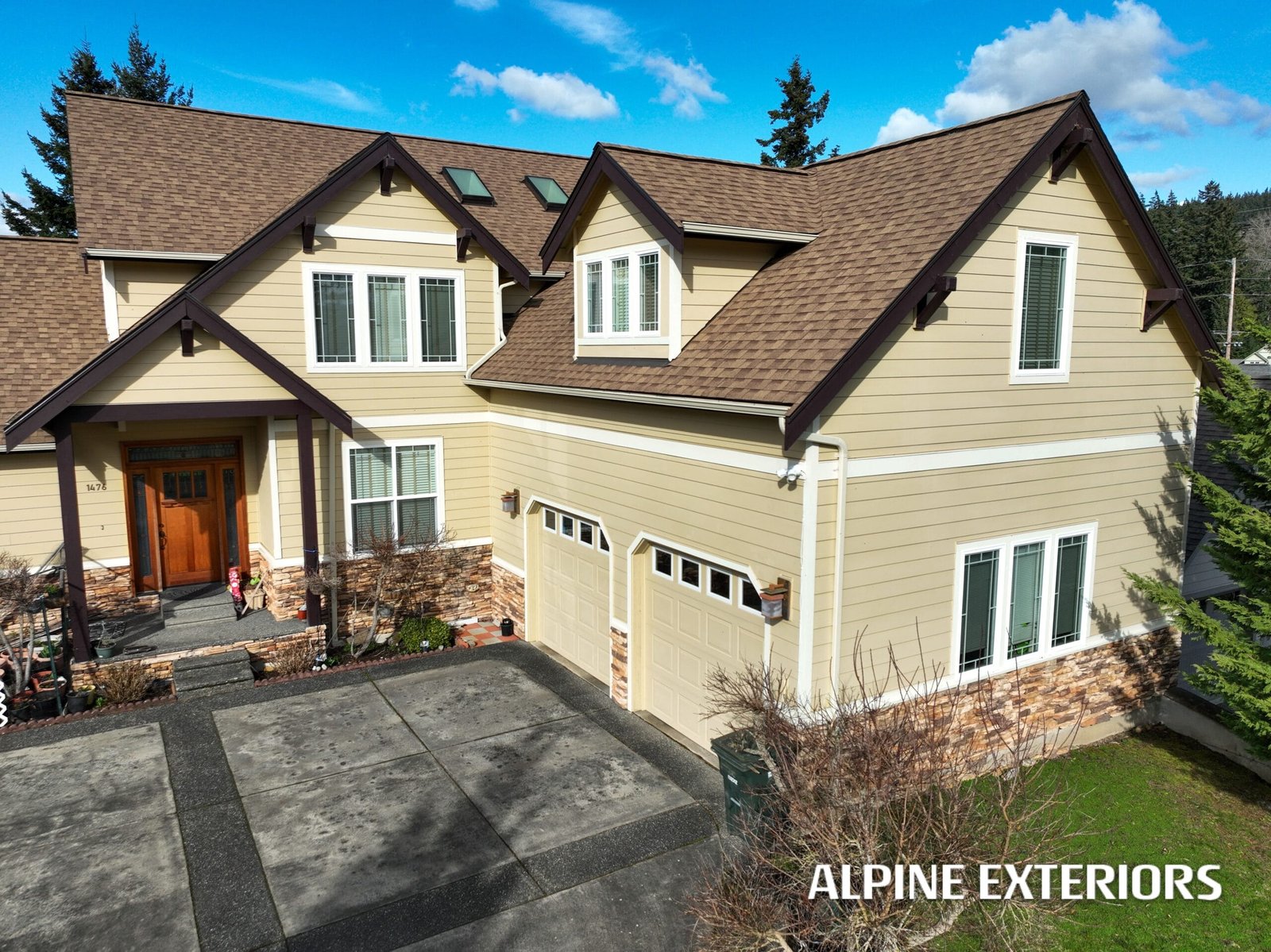
A usable quote spells out more than a total dollar figure. At minimum it should specify the material and gauge or thickness being installed, the linear footage being replaced (not just "the whole house"), whether any rot repair is included or billed separately once boards are opened up, what happens with existing soffit vents, how the fascia and any gutters or downspouts tie together, paint or finish color, and cleanup and disposal of the old material. If a quote doesn't mention what happens when hidden rot is found — because on older homes in this region, it usually is found somewhere — ask directly. A contractor who has an honest answer about how rot repair gets priced (per-board rate, time-and-materials, or a not-to-exceed allowance) is easier to work with than one who avoids the question until the boards are already off the house.
Alpine Exteriors writes soffit and fascia quotes with that rot-repair language spelled out up front, because it's the part of this job most likely to surprise a homeowner otherwise. We'd rather set the expectation before the ladder goes up than explain a change order mid-project.
Line up quotes side by side on scope, not just price. A lower number that doesn't include ventilation upgrades, doesn't specify material gauge, or is vague about rot repair isn't necessarily cheaper — it may just be missing items the higher quote included. Ask each contractor to confirm they're licensed to work in Washington and to show their contractor registration number; Alpine Exteriors' is ALPINI751OW, and any legitimate contractor should provide theirs without hesitation. Ask how they handle discovered rot, whether the quote is a fixed price or an estimate with contingencies, and what warranty applies to labor versus material. And if you're getting quotes for a waterfront or island property, ask specifically whether the proposed material and fastener grade account for salt exposure — that's a detail some quotes leave out entirely.
It's also worth asking how long the crew has worked in Skagit, Island or Whatcom counties specifically. A contractor familiar with the moss patterns on shaded local roofs, the wind exposure on the flats, and the venting expectations under the Washington State Energy Code is going to scope the job more accurately than one working from a generic template.
Soffit and fascia replacement is routine exterior maintenance, and by itself it's not typically the kind of damage homeowners insurance treats as a covered claim — insurers generally expect trim and eaves to wear out over time rather than fail suddenly. That changes if the damage traces back to a specific covered event, such as a windstorm that tore trim loose or a fallen limb that damaged the eave line; in those cases it's worth documenting the damage with photos and checking your policy before starting repairs, since the insurer may want to inspect before work begins. For projects that aren't insurance-related, many homeowners in this area pair soffit and fascia work with financing options or roll it into a broader exterior project — roofing, siding or gutters — to spread cost and reduce the number of times a crew needs to be on the roof. Ask your contractor what financing partners they work with and get the terms in writing before signing anything.
In most cases yes — soffit and fascia sit at the eave line below the roofing material, and a competent crew can replace them without disturbing shingles or metal roofing above. The exception is when rot has traveled up into the roof sheathing or the first course of roofing needs to be lifted to tie in new drip edge or flashing properly, which is something a contractor should flag during inspection rather than after the fact.
Weathered fascia usually shows peeling paint, graying wood, or surface cracking but is still solid when pressed on. Rotted fascia typically feels soft or spongy under light pressure, may show dark staining that traces up from the bottom edge, and can have visible gaps where it's pulling away from the roof edge. Given how much sustained rain this region gets, it's worth having a contractor probe a few spots rather than judging from the ground, since rot often starts on the backside of the board where you can't see it.
Yes — proper soffit venting lets outside air move up through the attic and out at the ridge, which helps control moisture buildup during Skagit County's long wet season and reduces the risk of condensation forming on the underside of the roof sheathing. The Washington State Energy Code sets ventilation expectations for roof assemblies for this reason, and homes with blocked, painted-over, or undersized soffit vents are more prone to attic moisture issues over time, even if the roofing itself is in good shape.
Both can work, but the details matter more than the material name. Near the islands or open water where salt air is a factor, aluminum trim needs a quality factory finish and stainless or coated fasteners to resist corrosion, while vinyl needs to be a grade rated to hold color and resist becoming brittle under UV and wind exposure. A contractor familiar with waterfront properties in Island and Skagit counties should be able to explain which grade they're proposing and why, rather than defaulting to whatever's standard for an inland job.
Soffit and fascia pricing depends too much on what's behind your existing trim to responsibly quote sight unseen. Alpine Exteriors serves Mount Vernon, Anacortes, Burlington, Sedro-Woolley, La Conner, Stanwood, Camano Island and Bellingham, and we're happy to come take a direct look at your eaves, check for hidden rot, and put together a written quote that spells out material, scope and any rot-repair contingency clearly before any work starts. Reach out to schedule an on-site inspection and get a number you can actually compare against other bids.