
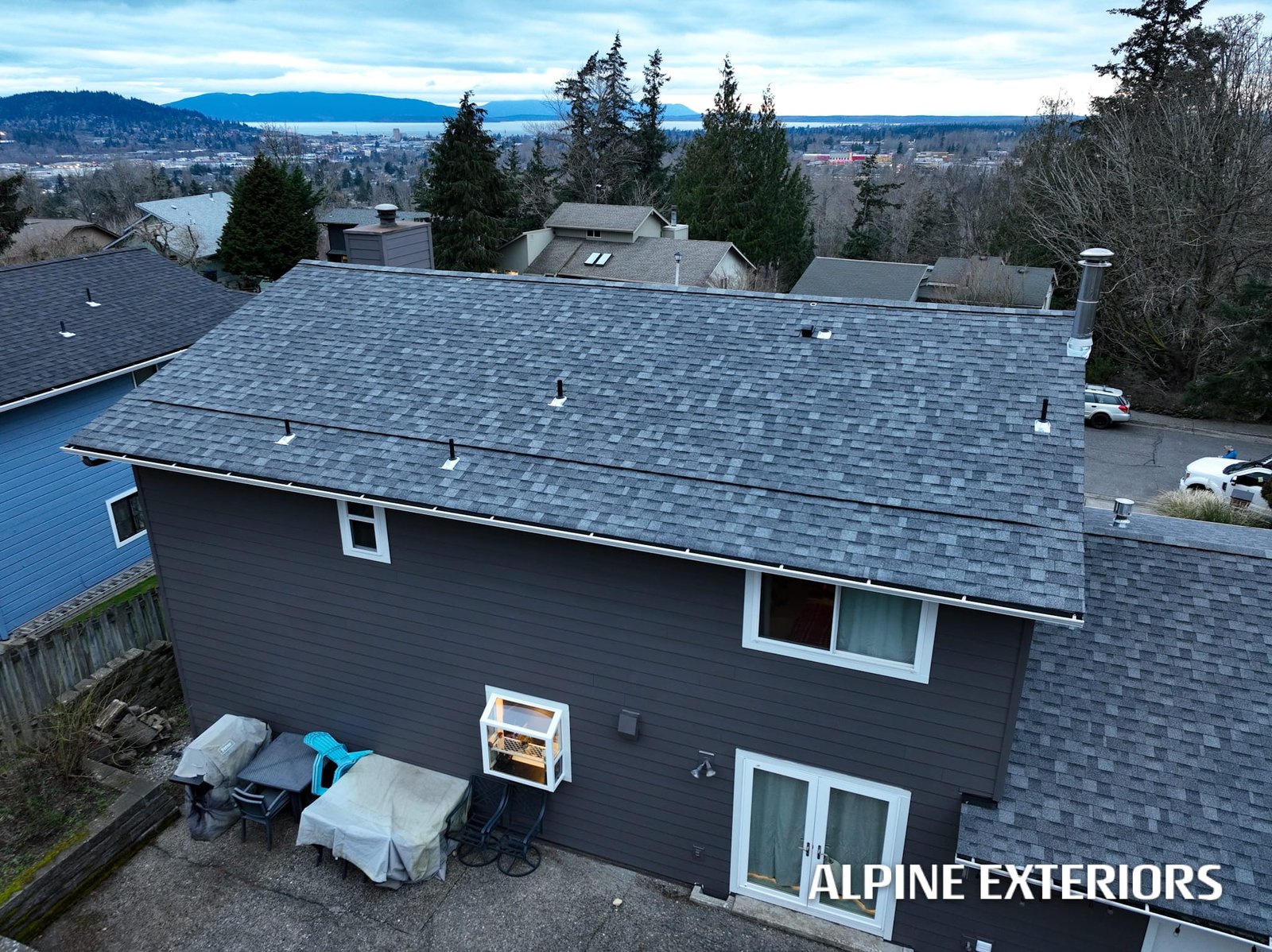
La Conner sits where the Skagit Valley farmland meets the Swinomish Channel, and that location shapes roofing decisions in ways homeowners in drier parts of the state never have to think about. Roofs here spend months under low gray skies, pick up moss under the fir and cedar canopy on shaded lots, and take wind off the flats and the nearby Strait during fall and winter storms. If you're pricing a roof replacement, the honest answer is that there is no single number that applies to every house — but there is a realistic range, and understanding what pushes a project toward the low end or the high end will make you a much better shopper when quotes start coming in. Alpine Exteriors has priced and built roofs across Skagit, Island and Whatcom counties, and this guide walks through what actually drives the cost of a roof replacement in the La Conner area.
Most single-family roof replacements in the La Conner area land somewhere in a broad low-to-high range, and where a given project falls inside that range depends almost entirely on size, material, and how much of the existing roof structure needs work once the old covering comes off. A straightforward composition shingle re-roof on a modest, simply-shaped one-story home with sound decking sits toward the lower end. A large roof with steep pitches, multiple valleys, dormers, or a metal or cedar-look synthetic covering sits toward the higher end. The table below breaks out the main factors that move a quote up or down; treat these as directional ranges, not quotes, since every roof is different once a crew is actually standing on it.
| Cost Factor | Pushes Toward Low End | Pushes Toward High End |
|---|---|---|
| Roofing material | Standard composition/asphalt shingle | Standing-seam metal, cedar-look synthetic shake, or heavier architectural shingle |
| Roof size and pitch | Smaller footprint, low-to-moderate pitch, easy walking surface | Large square footage, steep pitch requiring extra fall protection and labor time |
| Roof complexity | Simple gable or hip shape, few penetrations | Multiple valleys, dormers, skylights, chimneys, and roof-to-wall transitions |
| Tear-off scope | Single layer of existing roofing to remove | Multiple old layers, or roofing over old wood shakes that must come off |
| Decking condition | Plywood or planking is sound once exposed | Rot or delamination found under moss-covered or long-shaded sections, requiring replacement sheets |
| Ventilation and code work | Existing ventilation already meets current code | Attic ventilation, baffles, or insulation upgrades needed to meet Washington State Energy Code |
| Access and site conditions | Easy driveway and yard access for dumpsters and delivery | Tight lots, long farmland driveways, tide-flat proximity, or landscaping that limits staging |
| Permits and disposal | Standard single-family permit and one dumpster load | Additional disposal loads or engineering review on older or unusual structures |
The single biggest swing factor on most La Conner roofs is what's found once the old material comes off. This area's wet season runs long, and roofs that sit under mature trees — common on the wooded edges of town and along the sloughs — tend to develop moss and hold moisture longer than roofs in full sun out on the flats. Moss itself isn't automatically a reason to replace a roof, but years of moss growth can trap water against the shingles and, eventually, against the decking underneath. When a crew pulls old shingles off a shaded roof and finds soft or delaminated plywood, that decking has to be replaced before new roofing goes down, and that's real material and labor cost that can't be known for certain until the roof is opened up.
Wind is the other regional factor worth planning around. La Conner doesn't see hurricane-force weather, but the flats and the channel funnel wind in a way that stresses ridge caps, flashing, and loosely fastened shingles over time, especially on homes with long unbroken roof planes facing open farmland or water. A quote that accounts for proper ridge and hip fastening, sealed flashing at every penetration, and wind-rated shingle installation may cost a bit more up front than a bare-minimum install, but it's the difference between a roof that holds up through a normal Skagit Valley winter and one that needs flashing repairs within a few years. Homes on Camano Island, near the Strait, or otherwise close to open water also deal with salt-laden air, which can accelerate corrosion on unprotected metal fasteners and flashing — something worth asking about if your property sits close to the water.
Roof pitch and complexity matter just as much as size. A steep roof takes longer to work safely, requires more fall-protection setup, and generally costs more per square than a walkable low-slope roof of the same area. Roofs with multiple valleys, dormers, or a mix of roof planes also need more flashing, more cutting, and more skilled labor time than a simple rectangular roof, even if the total square footage is similar. Finally, ventilation and insulation requirements tied to the Washington State Energy Code can add scope that wasn't part of the original roof — older homes in particular sometimes need updated attic ventilation to meet current code when the roof covering is replaced, and that's a legitimate line item rather than an upsell.
A complete roof replacement quote should spell out scope clearly enough that you could hand it to a different contractor and get a comparable bid. At minimum, look for these items in writing:
Alpine Exteriors builds quotes around this level of detail because a roof replacement is a large, largely one-time purchase, and a homeowner shouldn't have to guess what's actually being installed. Ask any roofer bidding your job to walk through each of these points before you compare price alone.
The fastest way to get misled by roofing quotes is to compare the bottom-line number without checking that every bid covers the same scope. Two quotes that look far apart in price often turn out to specify different materials, different underlayment, or a different decking allowance — the lower bid may simply be excluding work the higher bid includes. Before comparing dollar figures, line up each quote's material brand and product line, underlayment type, ice-and-water shield coverage, decking replacement allowance, and warranty terms side by side. If one bid is silent on any of these, ask for clarification before assuming it's the better deal.
It's also worth confirming that whoever is bidding the job is actually licensed, bonded, and insured to do roofing work in Washington, and that they'll be pulling the required permit rather than asking you to skip it. A contractor that skips permitting to shave time or cost off a bid is passing risk on to you as the homeowner. Alpine Exteriors carries Washington contractor license ALPINI751OW, and any homeowner is welcome to verify that license independently through the state before signing a contract — that's a reasonable step with any roofing bid, not just ours.
Finally, ask each bidder how they'll handle unknowns — specifically, what happens if they find rotten decking once the roof is opened up. A contractor who gives you a per-sheet decking price up front, rather than an open-ended "we'll figure it out," is giving you a much more honest starting point for your budget.
Many roofing contractors, including Alpine Exteriors, offer financing options for homeowners who'd rather spread a roof replacement over monthly payments than pay the full cost at once. Financing terms, rates, and qualification vary by lender, so it's worth asking what's available and comparing terms just as carefully as you'd compare contractor bids.
On the insurance side, it's important to understand what a homeowner's policy typically does and doesn't cover. Sudden damage from a specific wind event — a storm that visibly tears off shingles or damages flashing in one incident — is the kind of thing insurers are generally willing to look at as a claim. Gradual deterioration from age, ordinary wear, or long-term moss and moisture buildup is typically treated as a maintenance issue rather than a covered loss, since it develops over years rather than in a single event. If you suspect storm damage, document the roof with photos as soon as it's safe to do so, and get a written inspection report from a contractor before filing a claim — that documentation matters when an adjuster reviews the loss. Don't assume a full replacement will be covered just because the roof is old and showing wear; read your policy's specific language on roof age and maintenance exclusions, since many policies reduce coverage on older roofs.
A straightforward single-layer tear-off and re-roof on an average home can often be completed within a few days of active work, weather permitting. Larger or more complex roofs, or projects that turn up decking repairs, take longer. Because this area gets extended stretches of rain, especially from fall through spring, scheduling always builds in some flexibility for weather delays — a roofer working here should be planning around that rather than promising a fixed timeline regardless of conditions.
Not necessarily. Light to moderate moss on an otherwise sound roof can often be treated and controlled with cleaning and preventive measures, and doesn't automatically mean the roof needs to come off. The concern is what moss does over years if it's left unaddressed on a shaded roof — it holds moisture against the shingles and can eventually contribute to decking damage underneath. A physical inspection is the only reliable way to tell whether moss has caused underlying damage or whether it's still a maintenance issue rather than a replacement issue.
Yes, roofing work continues through the wetter months in this region, but crews work in sections and monitor weather closely to avoid leaving a home exposed during a downpour. It's common for a job scheduled in the rainy season to take a bit longer than the same job in July or August, simply because work pauses during active rain. A contractor experienced in this climate will plan the tear-off in stages so the house is never left uncovered longer than necessary.
Most roof replacement projects require a building permit, whether the property is within La Conner town limits or in unincorporated Skagit County, and the specific requirements and fees are set by the local jurisdiction. A reputable contractor will pull the permit as part of the project and coordinate any required inspections rather than leaving that step to the homeowner. If a bid doesn't mention a permit at all, ask directly whether one will be pulled before work starts.
Every roof in the La Conner area carries its own combination of pitch, tree cover, material, and age, which is exactly why cost ranges only get you so far — the real number comes from someone walking the roof and looking at what's underneath. Alpine Exteriors serves La Conner along with Mount Vernon, Anacortes, Burlington, Sedro-Woolley, Stanwood, Camano Island and Bellingham, and can walk through your roof's condition, explain what's driving your specific price, and put the scope in writing before any work starts. If you're weighing a roof replacement and want a clear, itemized estimate rather than a rough guess, reach out to Alpine Exteriors to schedule a roof inspection.