

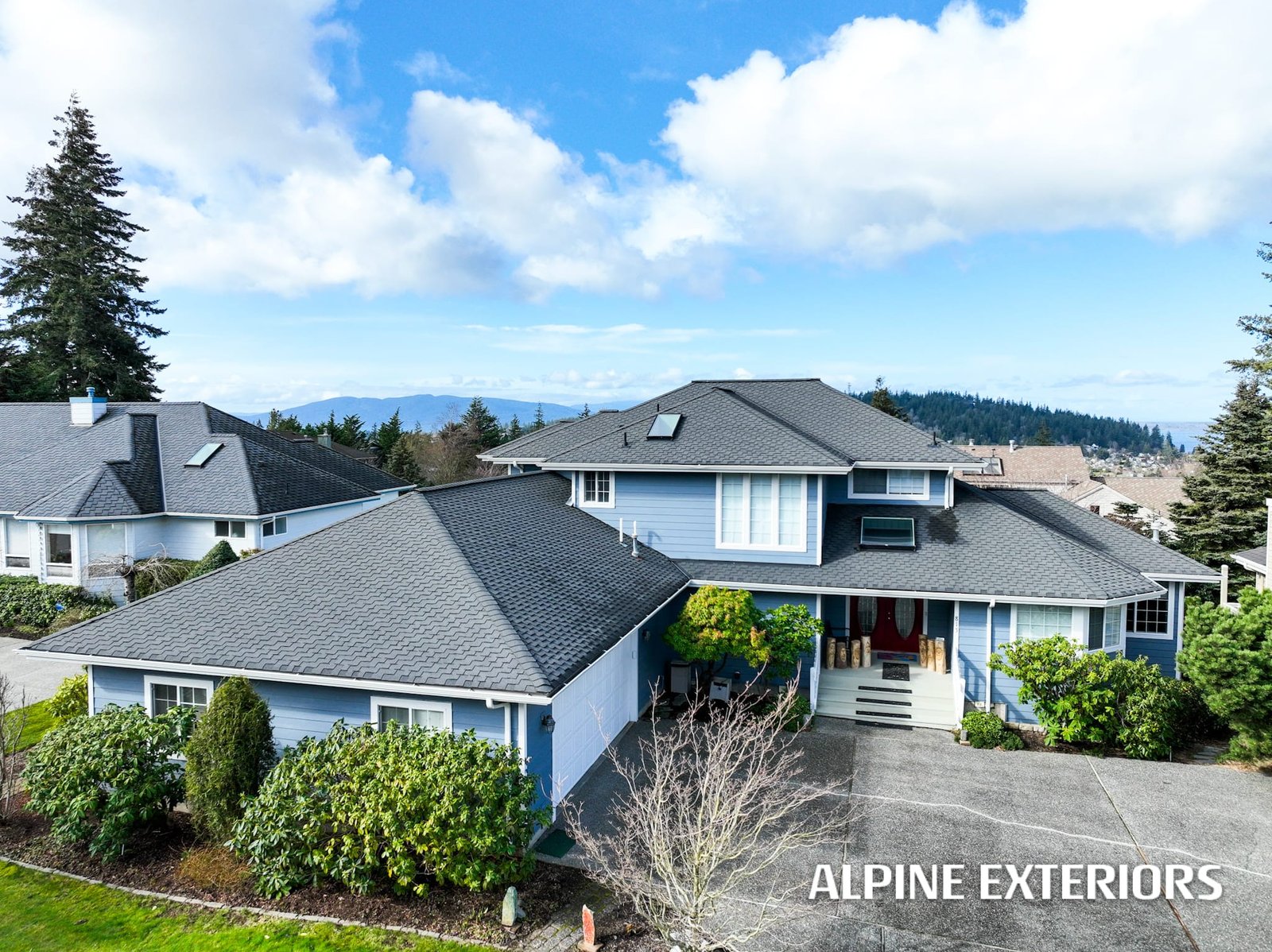
If you own a home along Big Lake Boulevard, back in the trees toward Clear Lake, or anywhere in the unincorporated stretch of Skagit County between Mount Vernon and Sedro-Woolley, the first question about a new roof is almost always the same one: what's this going to cost? It's a reasonable question, and it deserves a reasonable answer rather than a single number pulled out of the air before anyone has set foot on the roof. Roof replacement pricing in the Big Lake area depends on the size and pitch of the roof, the material chosen, what the tear-off crew finds once the old shingles come off, and a handful of conditions that are specific to living under heavy tree cover near a freshwater lake in western Washington. Alpine Exteriors has priced and installed roofs across Skagit, Island and Whatcom counties, and this guide walks through realistic ranges and what actually moves them, without promising a firm figure before an inspection has happened.
Most single-family roof replacements around Big Lake fall within a broad range that's driven far more by material choice and roof complexity than by square footage alone. A straightforward asphalt composition shingle re-roof on a home with a simple, moderately pitched roof plane sits toward the lower end of the local market. Add a steep pitch, several roof planes, dormers, skylights, a second layer of old shingles that has to come off first, or a switch to standing seam metal, and the total climbs from there. The table below breaks down the main line items that make up a typical bid, with the kind of low-to-high spread you should expect a written estimate to reflect.
| Cost Factor | Typical Low End | Typical High End |
|---|---|---|
| Tear-off and disposal | Single layer, easy access, minimal moss | Multiple layers, steep pitch, heavy moss or debris buildup |
| Asphalt composition shingle, installed | Standard three-tab or entry-level architectural shingle | Premium architectural or impact-rated shingle line |
| Standing seam metal roofing, installed | Lighter-gauge panel, standard color | Heavier-gauge panel, custom color, complex valleys and flashing |
| Decking repair or replacement | A sheet or two of spot repair | Widespread replacement once old roofing is stripped away |
| Pitch and access difficulty | Single story, walkable low-slope roof | Steep pitch, multiple stories, tree-crowded or lake-lot access |
| Flashing, vents, skylights, chimney work | Simple roof with few penetrations | Multiple skylights, chimneys, and cut-up rooflines |
| Permit and code-related upgrades | Standard re-roof permit only | Added attic ventilation or underlayment upgrades to meet current code |
Read that table as a map of where the money goes on a typical job, not as a quote for your house. Square footage, pitch, the number of existing layers, and the condition of the decking underneath all have to be measured in person — nobody can price a Big Lake roof accurately from a satellite photo or a phone call alone, and any contractor who tries to should raise a flag.
Beyond the basic material and size math, a handful of factors specific to this part of Skagit County tend to push a bid up or down more than homeowners expect.
A serious, itemized roof replacement quote should read like a project scope, not a single lump-sum number on a business card. At minimum, look for each of the following spelled out in writing:
Alpine Exteriors builds Big Lake estimates around this same level of detail, because a vague number is nearly impossible to compare against anyone else's bid, and it tends to hide the corners that get cut later.
The single biggest mistake in comparing roofing bids is treating them as three numbers on three pieces of paper. Two bids that look close on price can represent very different scopes of work. Before comparing totals, line up each proposal against the same checklist: same shingle or metal product line, same underlayment and ice-barrier spec, same decking repair rate, same number of layers assumed for tear-off, and the same warranty terms. A bid that's noticeably lower than the others is often lower because it's quietly skipping ice-and-water barrier, assuming a single layer when there are actually two, or using a lighter-weight material than the others quoted.
It's also worth asking who will actually be on the roof — an in-house crew or a subcontractor — and confirming the contractor is licensed and bonded with Washington's Department of Labor & Industries, since that status is public record and easy to verify. Ask for a couple of local references in Skagit or the surrounding counties if you haven't worked with the company before. And be cautious of any contractor who wants a large percentage of the total cost paid before work begins; a modest deposit tied to material ordering is normal, but a full or near-full upfront payment is not a standard practice in this industry.
Many roofing contractors, Alpine Exteriors included, can connect homeowners with third-party financing options that spread a roof replacement into monthly payments rather than a single cash outlay. Terms vary by lender and by the homeowner's credit, so it's worth asking early in the estimate process what's available and reading the terms before signing anything.
On the insurance side, it's important to be realistic about what a homeowner's policy typically covers. Wind or storm damage — a section of roof torn loose in a windstorm off the Skagit flats, for example — is the kind of sudden, identifiable event insurers generally consider for a covered claim, subject to an adjuster's inspection and the specifics of the policy. Gradual wear, moss damage from years without maintenance, or a roof that's simply reached the end of its expected service life is a different situation, and most policies treat that as ordinary maintenance rather than a covered loss. Be skeptical of anyone who promises upfront that insurance will cover it before an adjuster has looked at the roof — that's a decision the insurance company makes, not the contractor. Keeping photos and maintenance records over the years genuinely helps if a storm claim does come up later.
Most single-family roof replacements in this area take anywhere from a couple of days to just over a week, depending on roof size, pitch, and complexity. Because Skagit County has a long wet season, crews generally schedule around forecasted dry stretches, and a job can run a little longer than expected if weather forces a pause partway through. A contractor should give you a realistic window rather than a fixed date carved in stone.
Standing seam metal costs more to install than asphalt shingles, but it also tends to last considerably longer, sheds heavy rain and any occasional snow more effectively, and holds up well against wind. Whether the extra cost is worth it depends on how long you plan to stay in the home and your tolerance for a higher upfront number in exchange for less frequent replacement. It's a legitimate option for this climate, not just a cosmetic upgrade, but it isn't automatically the right call for every budget or every home.
Honestly, yes, to some degree — especially on shaded sections of roof under mature trees, which describes a lot of properties around Big Lake. A new roof with zinc or copper strips near the ridge, combined with periodic cleaning and keeping overhanging branches trimmed back, will slow regrowth substantially, but no roofing material in this climate is permanently moss-proof under heavy tree cover. Regular light maintenance is part of owning a roof here, not a sign that something went wrong with the installation.
In most cases, yes — a roof replacement typically requires a permit through the applicable local jurisdiction, and any related ventilation or underlayment work needs to meet current Washington State Energy Code requirements. A licensed contractor should handle pulling the permit as part of the project rather than leaving that step to the homeowner, and it's worth confirming in writing who is responsible for it before work begins.
A roof replacement is a significant expense, and the only way to turn a broad range into a real number is a walk-through of your specific roof — its pitch, its layers, its decking, and its exposure to sun, wind, and rain. Alpine Exteriors, WA contractor license ALPINI751OW, serves Big Lake along with the rest of Skagit, Island and Whatcom counties, and can provide a written, itemized estimate based on an actual inspection rather than a guess. If you're weighing a repair against a full replacement, or just trying to understand what a fair price looks like for your home, reach out to schedule a roof evaluation and get a scope-based quote in writing.



