
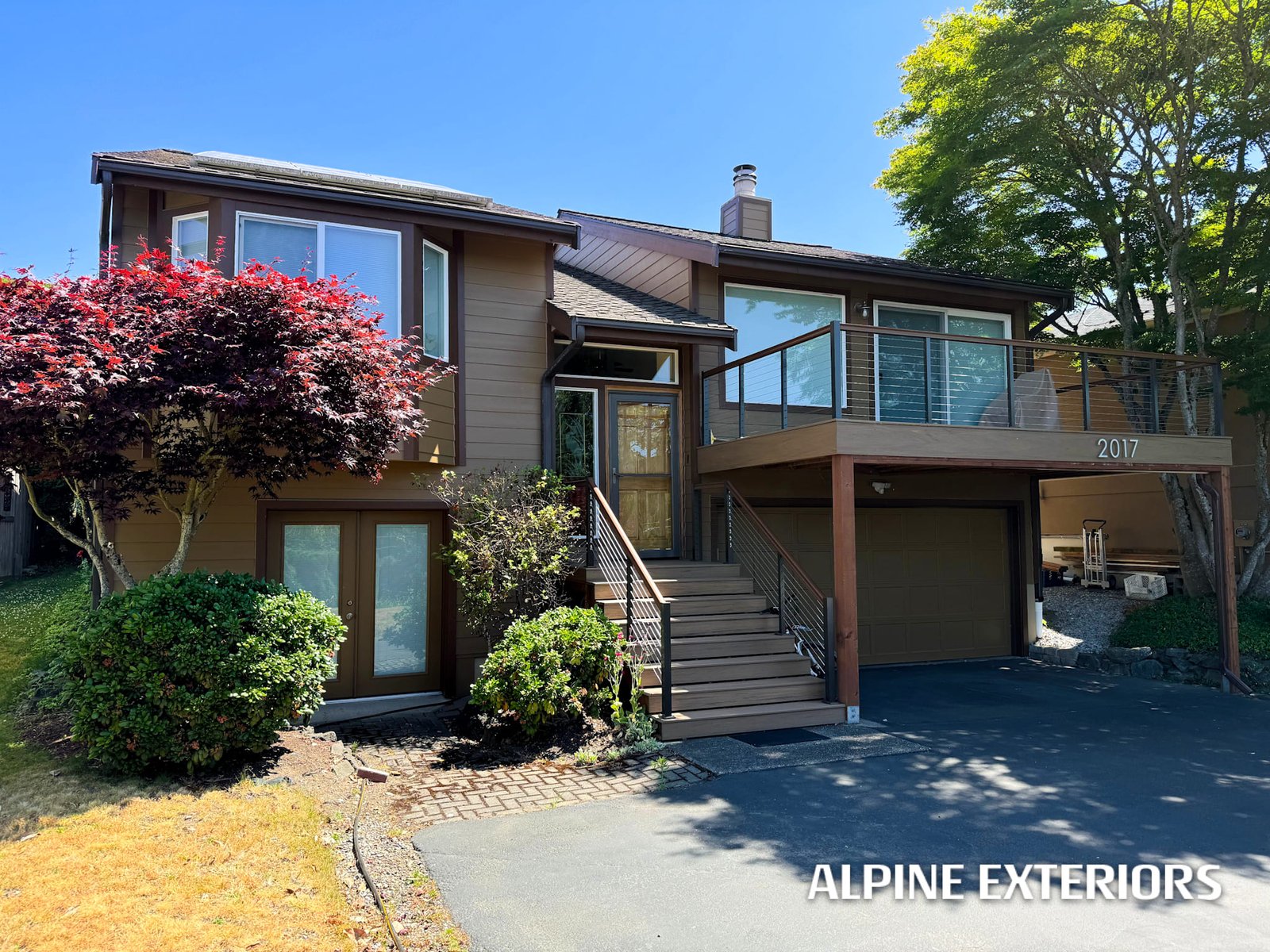
Lopez Island decks live a harder life than most people expect. Salt air off the Strait and the surrounding channels accelerates corrosion on fasteners and hardware, winter storms bring sustained wind and driving rain, and many island decks sit in partial shade under fir and madrona where moss and algae take hold on anything that stays damp. Add in the fact that every board, bag of concrete, and crew member has to come over on the ferry, and deck replacement here is a different project than the same job in Mount Vernon or Burlington. This page walks through realistic cost ranges, what actually drives the number up or down, and how to read a quote so you're comparing apples to apples. Alpine Exteriors serves Lopez Island as part of our broader San Juan and Skagit County service area, and this guide reflects what we actually see in the field — not a generic national estimate.
Deck replacement costs vary widely based on size, material, substructure condition, and height off grade. On Lopez Island specifically, expect the low end of any regional range to move higher than you'd see on the mainland, mainly because of ferry scheduling, barge freight for larger material orders, and the smaller pool of local subcontractors (electricians for lighting, county surveyors, etc.) who also have to factor in travel time. A straightforward, single-level pressure-treated deck replacement on an accessible lot tends to land at the lower end of the regional range; a multi-level composite deck with new railings, stairs, and footings on a steep or waterfront lot lands well above it. The table below breaks out the main cost factors we see quoted separately, each shown as a range rather than a fixed price, since no two decks are identical.
| Cost Factor | Low End Drivers | High End Drivers |
|---|---|---|
| Decking material | Pressure-treated lumber, standard board width | High-end composite (Trex, TimberTech) or clear cedar with hidden fasteners |
| Substructure & framing | Existing joists and posts reusable, sound footings | Full tear-out to grade, new footings, posts replaced due to rot or undersized framing |
| Railings & guards | Basic wood or metal baluster rail meeting code minimums | Cable rail, glass panel, or custom composite rail systems |
| Stairs & landings | Single short run to grade | Multiple stairs, wraparound landings, or stepped terrain |
| Site access & logistics | Level lot, driveway access, no ferry-timed deliveries | Remote lot, steep grade, material staged around ferry schedule, barge freight for bulk orders |
| Permitting & inspection | Simple in-kind replacement, minimal county review | Height, setback, or shoreline review triggered by San Juan County Critical Areas rules |
| Fasteners & hardware | Standard galvanized fasteners for a sheltered deck | Stainless steel or coated fasteners specified for full salt-air exposure |
A handful of Lopez Island–specific conditions push a deck project up or down from a generic estimate. The first is corrosion protection. Salt-laden air off the surrounding water is harder on exposed metal than an inland site, and we routinely see fastener heads, joist hangers, and post bases on older decks corroding well before the wood itself fails. Specifying stainless or heavy-coated hardware costs more up front but avoids a repeat failure in a decade, and it's a legitimate reason two quotes for the same size deck can differ.
The second is moisture and rot in the substructure. Heavy winter rain is the norm here, and any deck built low to the ground, tucked under tree cover, or missing proper flashing where it ties into the house tends to develop hidden rot in ledger boards, posts, and joists. You often can't see this until the old decking comes off, which is why a quote based only on a visual walk-through can shift once demolition starts. A contractor who prices in a contingency allowance for hidden framing repair is being realistic, not padding the bid.
The third is access and logistics. Everything for a Lopez Island project — lumber, composite decking, concrete, a mini excavator if footings need work — either comes over on the ferry or gets barged in bulk. Crews also have to work around ferry sailing times, which affects how many trips they can make in a day and how tightly a project timeline can be scheduled. This is the single biggest reason island pricing runs higher than a comparable job in Mount Vernon or Sedro-Woolley, and it's worth asking any contractor how they're handling material delivery and crew transport before you compare their number to a mainland quote.
Fourth, height and grade matter. A deck built up off a sloped lot needs taller posts, more bracing, and often a guardrail meeting current code height and baluster spacing requirements, none of which applies to a low deck a step above a patio. Fifth, county permitting can add time and modest cost if the deck is near a bluff, shoreline, or other San Juan County Critical Areas designation — in those cases a survey or additional review may be required before a permit issues, and that's worth flagging early rather than discovering mid-project.
A complete deck replacement quote should spell out, at minimum: full demolition and haul-away of the old deck (including disposal, which on an island isn't as simple as a same-day dump run); scope of substructure work, including whether existing footings, posts, and joists are being reused or replaced; the specific decking material, board width, and fastening method; railing type and code compliance for guard height and baluster spacing; stair and landing details if applicable; the fastener and hardware grade being used, especially given the corrosion factor noted above; who is pulling the county permit and covering the permit fee; and a stated timeline that accounts for ferry scheduling. If a quote is a single lump number with no material spec or scope breakdown, ask for it in writing before signing anything.
Because island logistics can swing pricing more than material choice alone, the most useful comparison isn't the bottom-line number — it's whether each contractor is quoting the same scope. Confirm that every bid includes demolition and disposal, that footing and framing work is priced the same way (reuse vs. full replacement), and that railing and stair details match. Ask each contractor directly how they're planning material delivery and whether ferry timing is built into their schedule; a bid that ignores this often turns into change orders later. It's also fair to ask how they handle hidden rot discovered after tear-out — a contractor who has a clear process for pricing that work, rather than treating it as a surprise, is generally more trustworthy than one who doesn't mention it at all. Alpine Exteriors provides itemized quotes for Lopez Island deck projects that separate material, labor, substructure, and permitting so homeowners can see exactly what they're paying for and compare it against other bids line by line.
Deck replacement is generally treated as a home improvement project rather than an emergency repair, so most financing options are the standard ones: a home equity line, a contractor-arranged payment plan where available, or a personal loan. It's rarely covered by homeowners insurance unless the original deck failed due to a covered peril, such as storm damage from a specific windstorm event — normal wear, rot, or age-related deterioration is considered maintenance and typically isn't a covered claim. If a windstorm or falling tree limb damaged an existing deck, it's worth checking with your insurer before starting replacement work, since documentation of the damage may be needed to support a claim. For budgeting purposes, it's reasonable to build in a contingency for the substructure repairs mentioned above, since those are the most common source of a project moving from the estimate to the final invoice.
The biggest factor is logistics. Materials and crews travel by ferry or barge, delivery has to be scheduled around sailing times, and the pool of local subcontractors is smaller, so travel time gets built into their pricing too. Add in the salt-air corrosion protection often specified for hardware, and island projects typically run above what the same-size deck would cost on the mainland side of Skagit County.
Sometimes, if they're sound, sized correctly for current code, and free of rot — that's determined once the old decking comes off and the substructure is visible. On Lopez Island in particular, heavy winter rain and tree cover in shaded yards mean hidden rot in ledger boards or posts is common enough that we recommend budgeting some contingency rather than assuming a full reuse.
In most cases yes, and if the deck is near a bluff, shoreline, or other environmentally sensitive area, San Juan County's Critical Areas rules may require additional review before a permit is issued. A straightforward in-kind replacement away from sensitive areas is usually a simpler process, but it's worth confirming with the county or your contractor before demolition starts.
Timeline depends on deck size and scope, but expect it to run longer than a comparable mainland project once ferry scheduling for material delivery and crew transport is factored in. A contractor familiar with island logistics should be able to give you a realistic window rather than a mainland-based estimate that doesn't account for sailing times.
Every deck on Lopez Island is a little different — exposure, grade, existing framing condition, and access all shift the price, and the only way to get an accurate number is a site visit. Alpine Exteriors is licensed in Washington (contractor license ALPINI751OW) and works throughout San Juan County as well as Skagit, Island, and Whatcom counties, so we understand both the island logistics and the coastal conditions that affect how a deck holds up over time. If you're weighing a deck replacement on Lopez Island, reach out for an on-site assessment and an itemized quote you can actually compare against other bids.