
If your deck in Freeland has gone soft underfoot, the railings wiggle, or the boards have started cupping and graying past the point of another round of stain, you're probably past the repair stage and into replacement territory. Freeland sits on Whidbey Island in Island County, and decks here take a different kind of beating than decks fifty miles inland. Salt-laden air off Holmes Harbor and Useless Bay, near-constant winter moisture, and long stretches of shade from Douglas fir and cedar canopies all shorten the working life of fasteners, framing, and decking surfaces. That means the "right" cost for a deck replacement in Freeland isn't the same number you'd get from a national cost calculator or a contractor quoting a dry-climate build. This guide walks through realistic regional price ranges, what actually drives the number up or down, what a legitimate quote should include, and how to compare bids without getting burned. Alpine Exteriors has worked on decks, roofing, and exterior projects throughout Skagit, Island, and Whatcom counties, and this page reflects what we see in the field on Whidbey Island specifically, not a generic average.
Deck replacement costs in Freeland and the surrounding Island County communities vary widely because "deck replacement" covers a lot of ground: a modest ground-level platform swap is a very different project from a raised, multi-level deck with stairs, built-in seating, and a full guardrail system facing the water. As a rough starting point, homeowners in this area typically see full deck replacement projects land somewhere between the low five figures for a small, straightforward wood deck and well into the higher five figures for a larger composite deck with elevated framing, custom railings, and difficult site access. Those are wide bookends on purpose — the table below breaks out the individual cost factors so you can see where your specific project is likely to fall within that range.
| Cost Factor | Typical Low End | Typical High End | What Changes the Number |
|---|---|---|---|
| Tear-off & disposal of old deck | Lower | Higher | Layered or rotted decking, buried fasteners, and hauling debris off an island can push disposal costs up compared to mainland jobs. |
| Substructure: footings, posts, beams, joists | Lower | Higher | Frost-depth footing requirements, soil conditions, and deck height above grade all affect how much framing work is needed. |
| Decking surface material | Lower | Higher | Pressure-treated lumber sits at the low end; cedar and composite or PVC decking sit progressively higher. |
| Railing & baluster system | Lower | Higher | Basic wood rail vs. cable, glass, or powder-coated metal systems built to resist salt-air corrosion. |
| Stairs & landings | Lower | Higher | Number of stair runs, landing size, and whether they tie into a sloped or uneven yard. |
| Permits & inspections | Lower | Higher | Island County permit and inspection fees, plus any additional review for shoreline setback or view-corridor rules near the water. |
| Labor & project management | Lower | Higher | Site access, ferry or barge logistics for materials, and crew travel time to Whidbey Island properties. |
Notice that several of these factors are regional rather than universal. Getting materials and crews onto Whidbey Island, whether by ferry or the Deception Pass route, adds logistics time that a mainland Mount Vernon or Burlington project wouldn't carry. That's a real cost driver in Freeland specifically, and any quote that ignores it is either underbidding or planning to add it back later as a surprise.
Beyond the basic size-and-material math, a handful of Freeland-specific and Island County-specific conditions tend to push project costs up or down more than homeowners expect.
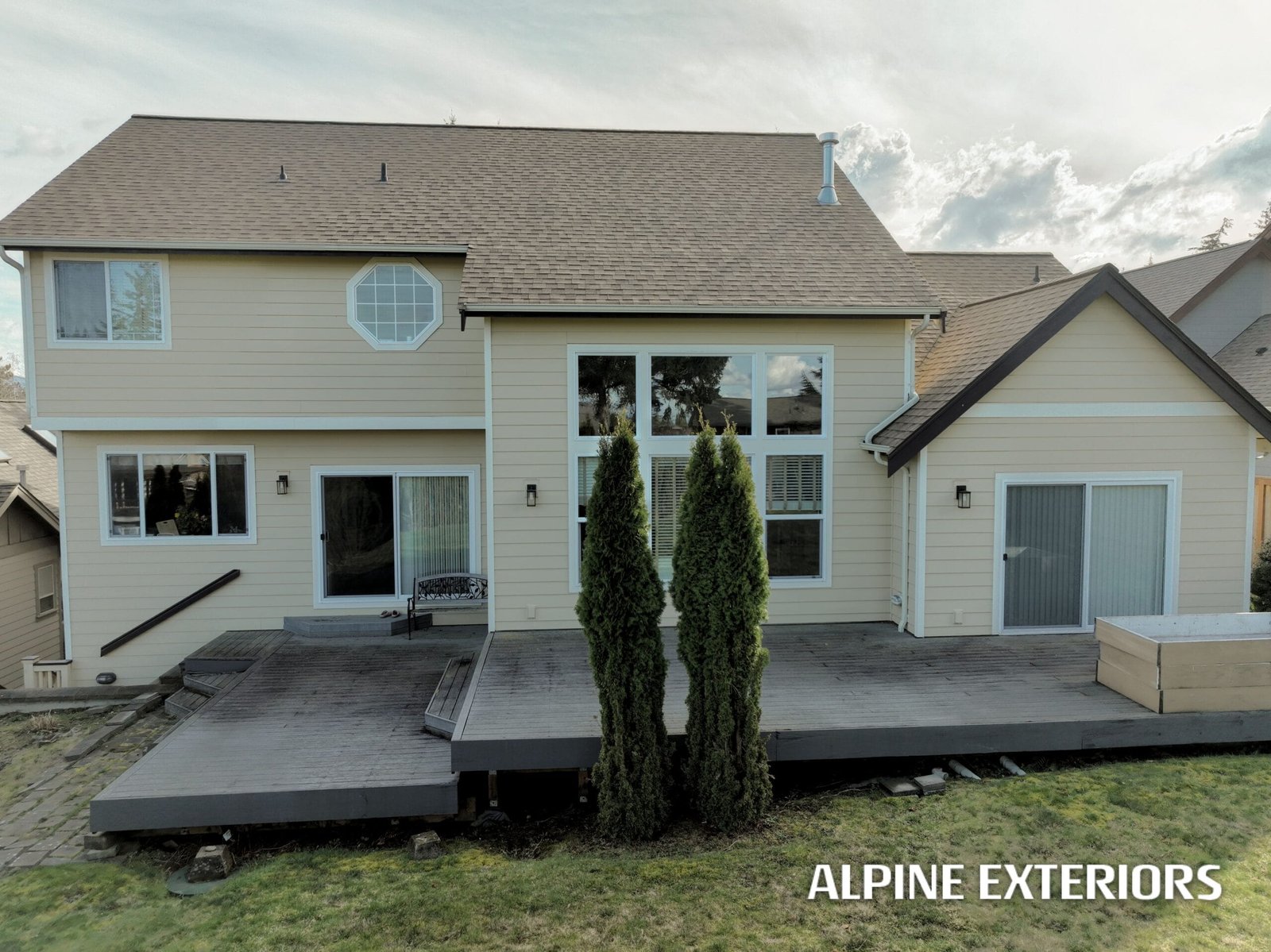
A quote that's just a single bottom-line number is hard to evaluate and even harder to hold a contractor to later. A complete deck replacement quote for a Freeland property should spell out:
When Alpine Exteriors puts together a deck quote for a Freeland or broader Island County property, we walk the site first specifically to check ledger condition, footing accessibility, and exposure to wind and salt air before pricing anything, because those site conditions genuinely change the scope.
The temptation with any home project is to line up three numbers and pick the middle one. That approach falls apart quickly on a deck project because the scope hiding behind each number can be very different. Start by confirming every quote is pricing the same square footage, the same decking material tier, and the same railing system — a quote using pressure-treated lumber and basic wood rail will always look cheaper than one specifying composite decking and metal railing, but they're not comparable projects. Ask each contractor directly whether their fastener and hardware spec accounts for salt-air exposure; a lowball quote using standard interior-grade hardware will look attractive today and cause corrosion problems in a few years. Check whether the quote includes the Island County permit and inspection process or treats it as a homeowner responsibility added later. Ask about warranty terms on both labor and materials, and get them in writing rather than as a verbal assurance. Finally, ask for a couple of references for deck work specifically on Whidbey Island or elsewhere in Island County — a contractor with strong reviews for interior remodeling doesn't necessarily have a track record building decks that hold up to this climate. A contractor who is licensed to work in Washington, like Alpine Exteriors under WA contractor license ALPINI751OW, should be able to provide that license number and project history without hesitation.
Most homeowners pay for deck replacement out of pocket, through a home equity line of credit, or through contractor-arranged financing, and it's worth asking any contractor you're considering whether they offer or partner with financing options and what the actual terms are, including interest rate and repayment length, before committing. On the insurance side, deck replacement triggered by sudden storm damage, such as a large tree limb coming down in a winter windstorm, may be covered in part by a homeowner's policy, while replacement driven by ordinary age, rot, or wear typically is not — insurers generally treat gradual deterioration as a maintenance issue rather than a covered loss. If you suspect storm damage played a role, document it with photos before any demolition begins and contact your insurer before signing a contract, since some policies require an adjuster inspection first. Either way, confirm that any contractor you hire carries current liability insurance and workers' compensation coverage, and ask to see proof rather than taking it on faith — this matters more on elevated deck work than on most home projects, given the fall risk involved.
A straightforward ground-level deck replacement often takes about one to two weeks from demolition to final walkthrough, while a larger, elevated deck with extensive stairs and railing can take several weeks longer. Timelines in this region also depend heavily on the season — projects scheduled during the wetter fall and winter months are more likely to see weather-related delays than those scheduled in the drier summer stretch.
In most cases, yes. Island County generally requires a building permit for deck construction or replacement, particularly for elevated structures or any work involving footings, framing, or guardrails, and a reputable contractor should handle that permit application and coordinate the required inspections as part of the project rather than leaving it to the homeowner to sort out after the fact.
It depends on your priorities and your specific site. Composite and PVC decking cost more upfront than pressure-treated wood but generally resist moisture, moss, and salt-air weathering better, which can matter a lot on shaded or waterfront Freeland lots where wood decks need frequent refinishing. If your deck sits in full sun with good airflow, quality wood decking maintained on a regular schedule can still be a reasonable, lower-cost choice.
Getting materials and crews onto Whidbey Island typically adds logistics time compared to a job in Mount Vernon or Burlington, and coastal properties often require upgraded, corrosion-resistant hardware that inland jobs don't need. Both of those are legitimate cost drivers rather than padding, so it's worth asking any contractor to explain how their quote accounts for site logistics and hardware spec rather than assuming a higher number means a worse deal.
Cost ranges are a useful starting point, but the only way to know what your Freeland deck replacement will actually cost is to have someone walk the site, check the framing and ledger condition, and account for your property's specific exposure to wind, moisture, and salt air. Alpine Exteriors serves Freeland and the rest of Island County alongside Skagit and Whatcom county communities including Mount Vernon, Anacortes, Burlington, Sedro-Woolley, La Conner, Stanwood, Camano Island, and Bellingham, and can put together a detailed, itemized deck replacement quote built around your specific home rather than a generic estimate. Reach out to schedule a site visit and get a straightforward, written breakdown of what your project will involve.