

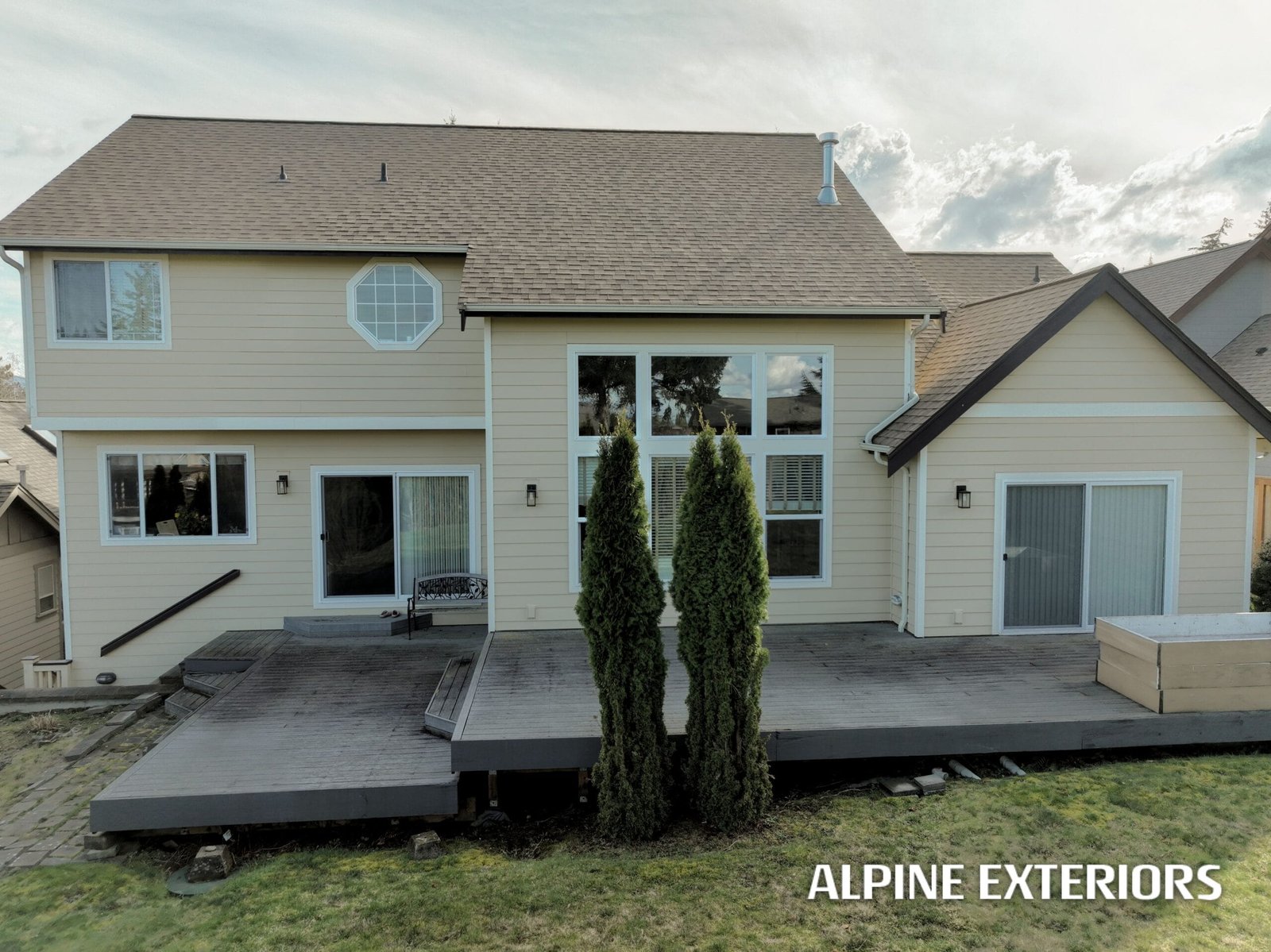
If you've started pricing out a composite deck for a home in Mount Vernon, Anacortes, Burlington, Sedro-Woolley, La Conner, Stanwood, Camano Island or Bellingham, you've probably noticed that online calculators and national "average cost" articles don't line up with the quotes actually landing in your inbox. That's because composite decking pricing in this part of Washington is shaped by local conditions — heavy winter rain, wind funneling off the Skagit flats and the Strait of Juan de Fuca, salt-tinged air on the islands, and shaded yards where moss and algae get a foothold on any horizontal surface that stays damp. This guide walks through realistic price ranges, what actually drives the number up or down, what a legitimate quote should contain, and how to compare bids without getting burned. Alpine Exteriors builds decks throughout Skagit, Island and Whatcom counties, and the ranges below reflect the kind of projects we see and price in this region — not a national average pulled from a different climate.
Composite decking projects in Skagit, Island and Whatcom counties tend to land in a wide band because "a deck" can mean a simple 10-by-12 ground-level platform or a multi-level structure with stairs, built-in railings, and lighting cantilevered over a slope. As a rough planning range, homeowners here are typically looking at somewhere in the low-to-mid tens of thousands of dollars for a modest single-level composite deck, climbing well past that for larger, multi-level, or highly detailed projects. Material tier alone can move the number substantially — entry-level capped composite boards sit well below premium, heavily-mottled or scalloped-profile lines from the same manufacturer.
The table below breaks out the main cost factors we see driving quotes up or down on projects in this region. These are relative low/high bands meant to show where the money goes, not a quote for your specific project.
| Cost Factor | Typical Low End | Typical High End |
|---|---|---|
| Composite board material (entry-level capped vs. premium/multi-tone lines) | Basic solid-color capped composite | Premium wood-grain, variegated, or cooler-touch board lines |
| Substructure/framing | Standard pressure-treated joists on an existing footprint | New footings, ledger work, or composite/aluminum substructure on a sloped or difficult site |
| Deck size and footprint complexity | Small, simple rectangular footprint | Large, multi-level, or irregular shapes with cutouts around trees or utilities |
| Railing system | Basic composite or metal-baluster railing | Glass-panel, cable, or fully matched composite rail systems |
| Old deck removal and haul-away | No demo needed (new build) | Full tear-off of a large or multi-level existing deck |
| Permits and inspections | Small, low-height deck under local permit thresholds | Elevated decks requiring engineering, guardrail review, or setback variances |
| Fasteners, flashing, and rain protection detailing | Standard hidden-fastener clips | Full ledger flashing, joist tape, and upgraded corrosion-resistant hardware for wet-climate durability |
Beyond the basic factors in the table, a handful of region-specific and project-specific details tend to swing composite decking quotes the most around here.
A thorough composite decking quote from a contractor working in this region should spell out more than a single bottom-line number. Look for these elements spelled out in writing:
Alpine Exteriors itemizes these on every composite decking quote so homeowners in Skagit, Island and Whatcom counties know exactly what they're paying for before work starts.
Once you have two or three bids in hand, resist the urge to compare only the bottom-line total. Start by confirming every quote covers the same square footage and the same board tier — a quote for entry-level composite decking will always look better than one for a premium multi-tone line, even if the second contractor is actually the better value once you account for material quality. Next, check whether demolition of the old deck, permit fees, and haul-away are included in each number or listed as add-ons; a quote that looks low simply because it excludes demo isn't actually the lower bid. Ask specifically about rain and moisture detailing — given how wet this region gets, a contractor who flashes the ledger board and tapes the joists is protecting the structural lumber underneath your composite boards, and that detail is often the difference between a deck that lasts and one with hidden rot in eight or ten years. Confirm the contractor is licensed to work in Washington — Alpine Exteriors, for example, operates under Washington contractor license ALPINI751OW, and any contractor you're seriously considering should be able to provide their license number and current insurance certificate without hesitation. Finally, ask who's actually doing the labor: some companies use their own crews, others subcontract, and that can affect both quality control and how warranty issues get resolved down the line.
Many decking contractors, including Alpine Exteriors, offer financing options that let homeowners spread the cost of a new composite deck over monthly payments rather than paying the full amount upfront; terms and qualification vary by lender, so it's worth asking early in the quoting process if that's something you'd want to use. On the insurance side, it's important to set expectations correctly: homeowners insurance generally does not cover the cost of replacing a deck simply because it's old, worn, or made of wood that's rotting from years of regional rain exposure — that's considered normal wear and maintenance, not a covered loss. Where insurance does sometimes come into play is sudden damage from a specific event, such as a windstorm off the Skagit flats snapping a railing or a falling tree limb during a winter storm. If that's your situation, get a written, itemized estimate before repairs begin, since insurers typically want documentation of both the damage and the proposed repair scope before approving a claim.
Generally, yes — composite boards usually cost more per square foot than standard pressure-treated wood decking at the outset. The tradeoff is lower long-term maintenance: composite doesn't need the annual staining or sealing that wood decking does to hold up against the amount of rain this region gets, so many homeowners view the higher upfront cost as an investment that reduces work and expense over the life of the deck.
In most cases, yes, though exact thresholds vary by jurisdiction — cities like Mount Vernon, Anacortes, and Bellingham, along with the counties themselves, generally require a building permit for decks above a certain height or size, and guardrails are required once a deck reaches a certain height above grade under the locally adopted building code. A reputable contractor will know the specific rules for your address and should handle the permit application as part of the project, but it's worth confirming that in writing before work starts.
Composite decking is designed to resist the rot, splintering, and moisture damage that wood decking is prone to after repeated exposure to this region's wet winters, and most manufacturers back their products with lengthy warranties against structural defects and fading. That said, longevity still depends on proper installation — adequate airflow underneath the boards, correct fastening, and flashing details that keep water from pooling against the substructure — plus periodic cleaning to keep moss and algae from building up on shaded or north-facing sections.
Sometimes, but it depends on the condition of the existing substructure. If the underlying joists and ledger board are structurally sound, free of rot, and properly spaced for composite board requirements, reusing the frame can reduce cost. Given how much moisture this region sees, though, it's worth having a contractor actually inspect the framing before assuming it's reusable — hidden rot at the ledger connection or joists is a common finding once old decking boards come up, and building on top of compromised framing just delays a bigger repair.
Composite decking is a significant investment, and the honest answer to "what will it cost" depends on your site, your material choices, and how your property handles this region's rain, wind, and shade. Alpine Exteriors provides itemized, written quotes for composite decking projects throughout Mount Vernon, Anacortes, Burlington, Sedro-Woolley, La Conner, Stanwood, Camano Island, Bellingham, and the surrounding areas of Skagit, Island and Whatcom counties, operating under Washington contractor license ALPINI751OW. If you'd like a real number for your specific project rather than a general range, reach out to Alpine Exteriors for a site visit and a detailed, no-pressure quote.



