


Most homes in the Stanwood area need 6-inch K-style gutters paired with 3x4-inch downspouts, not the 5-inch gutters and 2x3-inch downspouts that get installed by default on a lot of production-built houses. The volume and duration of winter rain coming off Port Susan and the Skagit flats routinely overwhelms the smaller system, and that's the root cause behind most of the overflow, staining and crawlspace moisture calls we see in this part of Snohomish County.
Beyond pipe size, three things matter almost as much: keeping fir needles out of the trough, getting water at least 6 to 10 feet away from the foundation before it's allowed to soak in, and making sure the crawlspace itself has somewhere for water to go if it does get close to the house. Get those right and a well-built gutter system will handle a Stanwood winter without drama.
Gutter sizing is a math problem before it's a shopping decision. A 5-inch gutter with a single 2x3 downspout is rated to handle a certain roof area at a certain rainfall intensity — fine for a lot of the country, but this stretch of the Puget Sound lowlands gets long stretches of steady, moderate-to-heavy rain from November through February, plus the occasional atmospheric river event that dumps well above normal totals in a 24-48 hour window. When a roof section larger than about 600-700 square feet drains into a single undersized downspout during one of those events, the gutter fills faster than it can discharge and water goes over the back edge, right where it can run down siding, behind trim, or into a crawlspace vent.
The fix on most homes we look at in Stanwood, Camano Island and the surrounding area is a combination of upsizing to 6-inch gutter and 3x4 downspouts on the runs that see the most roof area, and adding a downspout rather than relying on one oversized outlet to do all the work. On a typical single-story home this often means going from two downspouts to three, or relocating one to a corner that was previously starved for capacity. It's not a dramatic-looking change, but it's the difference between a gutter system that keeps up with a hard December rain and one that spills over every time it really lets go.
Alpine Exteriors sizes gutter runs off actual roof plane measurements rather than a one-size-fits-all rule, because a steep, complex roofline with several valleys concentrates far more water into a short run than the same square footage on a simple gable. That's the part that's easy to get wrong when a gutter job is quoted from a drive-by estimate instead of a walk of the roof.
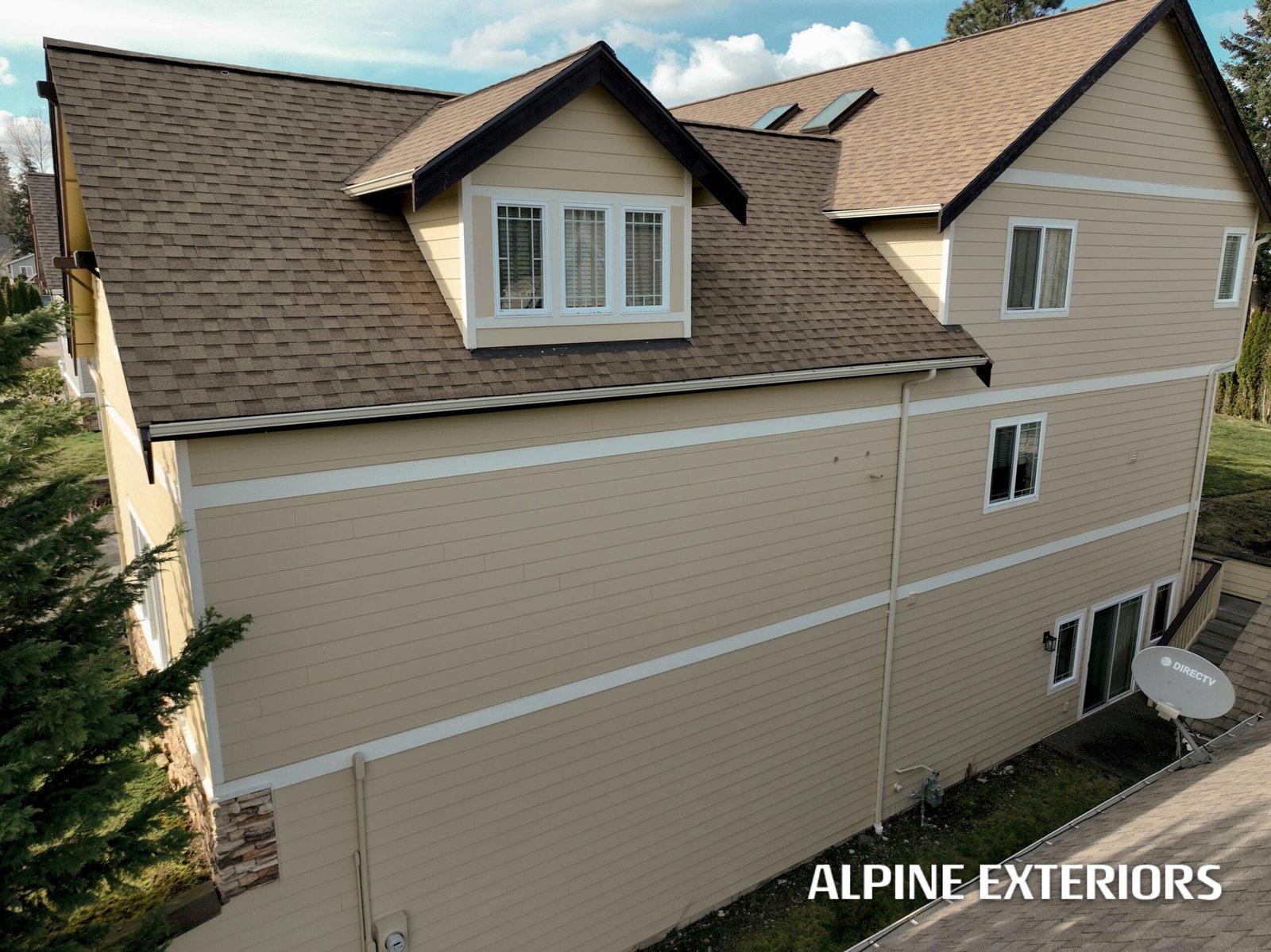
A few local conditions show up again and again in this part of Skagit and Snohomish County, and they change what a gutter and drainage system actually needs to do:
None of these individually is unusual for the Pacific Northwest, but the combination — long wet season, heavy needle drop, and older crawlspace construction — is a specific mix that calls for gutter and drainage decisions tuned to this area rather than a generic install.
Start with an honest look at capacity. If your gutters overflow at the same spot every heavy rain, that's not a one-time clog — it's a sizing problem, and a bigger downspout or an added outlet will do more for you long-term than another round of cleaning. On homes with large or complex roof planes, 6-inch gutters and 3x4 downspouts are usually worth the modest upcharge over 5-inch systems.
Match the guard to the debris, not the marketing. Standard leaf guards clog with fir and cedar needles faster than most homeowners expect. A guard with a tighter mesh or a surface-tension design built for needle debris costs more up front but cuts down on the twice-a-year ladder work considerably.
Get water away from the foundation, not just off the roof. Downspouts that dump onto a splash block six inches from the siding just relocate the problem to the crawlspace vents. Extensions, buried solid-pipe leads, or a tie-in to a perimeter drain that discharges well clear of the house — 6 to 10 feet minimum, farther on sloped lots — make the difference between a gutter system that protects the foundation and one that just protects the fascia.
Check the crawlspace itself, separately from the gutters. If there's standing water, damp insulation, or a musty smell under the house, gutters alone won't solve it — the ground around the footing needs its own drainage path, whether that's regrading, a French drain, or tying downspout leads into an existing storm line. This is also where the Washington State Energy Code becomes relevant: current crawlspace ventilation and vapor barrier requirements assume the ground water and roof water problems have already been handled, so a crawlspace that's fighting standing water will struggle to meet the moisture control intent of the code no matter how well it's vented.
Plan on two cleanings a year, not one. Given how much needle and moss debris this area produces, a fall cleaning alone usually isn't enough — a spring pass catches what accumulated over the wet months and gets ahead of clogs before the next heavy rain season.
Alpine Exteriors, WA contractor license ALPINI751OW, looks at gutters, downspouts and crawlspace drainage as one connected system rather than three separate line items, because on most of the homes we see in Stanwood, Camano Island and the surrounding towns, that's exactly how they behave — a weak point in one shows up as damage in another.
For most single-story homes with moderate roof area, a properly installed 5-inch gutter can keep up, but anything with a steep pitch, multiple valleys, or roof planes over roughly 700 square feet draining to one downspout is better served by 6-inch gutters and 3x4-inch downspouts. The right call depends on the roof's actual geometry, which is why a measured walk of the roof beats a rule of thumb.
Twice a year is a reasonable baseline for most properties under tree cover in this area — once in late fall after most of the needle drop, and again in spring to catch what built up over the wet months. Homes with heavy overhanging canopy or a lot of moss on the roof may need a mid-winter check as well, especially after a windstorm.
Yes, and it's one of the more common patterns we see. A downspout that discharges right at the foundation, or an overflow point that dumps water along one wall, sends far more water toward the footing than normal ground saturation would, and older homes without a dedicated perimeter drain have no way to carry that extra volume away. Fixing the discharge point is often cheaper than any crawlspace remediation work that follows if it's left alone.
Standard leaf guards are usually sized for broadleaf debris and clog faster than expected once fine fir or cedar needles get involved, sometimes within one season on a heavily treed lot. A guard style built for needle debris, or a tighter micro-mesh, holds up considerably longer under the tree cover common around Stanwood and Camano Island, though no guard eliminates the need for periodic cleaning entirely.
If your gutters are overflowing in the same spot every winter, your crawlspace has that damp, musty edge to it, or you're just not sure your current system was ever sized for a Stanwood winter, it's worth having someone look at the whole path water takes off your roof — not just the gutters themselves. Alpine Exteriors serves Stanwood, Camano Island and the rest of Skagit, Island and Whatcom counties, and can walk your roof, downspouts and crawlspace together to find where the system is actually falling short before more rain finds it for you.



