
For most homes in Oak Harbor and the rest of Island County, a well-installed architectural (dimensional) asphalt composition shingle roof or a standing-seam metal roof will serve you best. Both handle the region's defining conditions well: long stretches of winter rain, wind that funnels down the Strait of Juan de Fuca and off the Skagit flats, salt-laden air near the water, and shaded, damp roof planes that grow moss faster than almost anything else short of standing water. Architectural shingles remain the practical middle ground on cost and appearance for the majority of houses on Whidbey Island. Standing-seam metal earns its higher price tag on homes exposed to open wind, waterfront lots, or owners planning to stay 25-plus years and wanting to shed moss and debris with minimal upkeep. Synthetic composite shake is worth a look if you want a cedar look without cedar's maintenance burden. Traditional cedar shake still has a place aesthetically but comes with real trade-offs in this climate that owners should go in understanding, not discover later. As always, the installation quality — proper underlayment, flashing, and ventilation — matters as much as the material itself, and Alpine Exteriors sees more roof failures caused by shortcuts in those details than by the shingle or panel brand chosen.
Island County isn't judged by the same standards as a hot, dry, or hurricane-prone market. The criteria that actually matter for a roof over an Oak Harbor home are specific to Puget Sound weather:
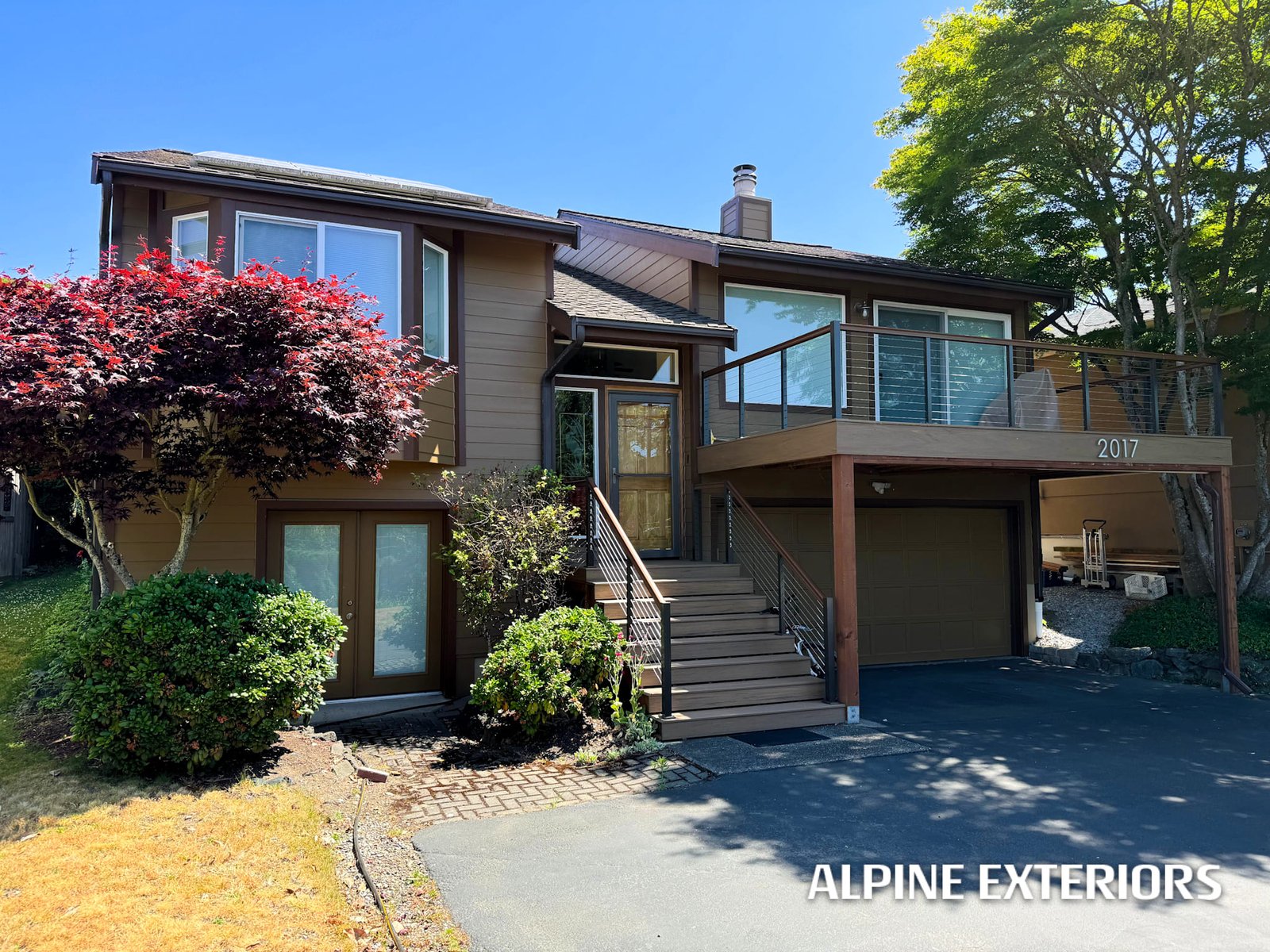
This is the roofing most Oak Harbor and broader Island County homes are wearing today, and for good reason. Modern architectural shingles carry algae-resistant granules that slow moss and moss-related staining compared to older three-tab shingles, they're rated for wind speeds that comfortably cover typical Whidbey Island gusts when installed with the correct nailing pattern, and they're the most affordable of the durable options, generally running in the range of roughly $450 to $650 per square installed depending on pitch, tear-off scope, and access. The trade-off is service life: even a good architectural shingle in this climate typically delivers somewhere in the 20-to-30-year range rather than the 40-plus years a metal roof or better can offer, and shaded north-facing slopes will still need periodic moss treatment regardless of the algae-resistant coating. They're also more vulnerable than metal to wind-driven damage at the edges and ridge if the installer skips proper starter strip and ridge cap fastening — a corner some lower-bid crews cut.
Standing-seam metal is the strongest performer against the two conditions that matter most here — wind and moss. The continuous panel runs and concealed fasteners give wind almost nothing to catch, and the smooth, non-porous surface sheds moisture fast enough that moss struggles to establish compared to a shingle surface. On a coastal or waterfront lot near Oak Harbor, a quality steel or aluminum panel with a proper factory finish also resists the salt-air corrosion that will eventually attack lesser hardware. The downsides are real: material and installation cost is meaningfully higher than asphalt, commonly landing somewhere in the $900 to $1,400-plus per square range depending on panel profile and metal type, installation requires a crew that specifically knows standing-seam detailing (a poorly installed metal roof can actually leak worse than a shingle roof at penetrations), and it can be noisier in heavy rain unless a solid deck and underlayment are used underneath. For homeowners planning to stay in their Island County home long-term, the lifetime cost math often favors metal despite the higher upfront number.
Composite shake and slate products, usually made from engineered polymer or rubber blends, are worth serious consideration for owners who want the Pacific Northwest cedar-shake look without cedar's maintenance load. They carry a Class A fire rating, resist moss better than real wood because they don't absorb moisture the way cedar does, and hold up well to wind when installed per the manufacturer's fastening spec. Cost sits in the middle of the pack, generally above architectural asphalt and often close to or somewhat below metal, and color consistency and impact resistance vary noticeably between manufacturers, so the specific product line matters more here than with asphalt or metal. Some lower-tier composite products have shown premature fading or brittleness in real-world Pacific Northwest installations, so this is a category where checking the specific manufacturer's track record in a wet marine climate is worth the extra time.
Cedar has genuine regional heritage and a look many Oak Harbor and Whidbey Island homeowners still want, especially on older or craftsman-style houses. Honestly assessed, though, it's the highest-maintenance option for this specific climate. Our winter rain and any amount of shade accelerate moss growth and rot on cedar faster than on any of the manufactured alternatives, and keeping a cedar roof healthy here typically means regular cleaning, moss treatment, and periodic replacement of individual shakes — an ongoing cost many owners underestimate at purchase. Insurance carriers in Washington have also grown more selective about cedar roofs in recent years, and some require documentation of fire-treatment or recent maintenance. Cedar isn't a wrong choice, but it's the option where the gap between \"how it looks the day it's installed\" and \"what it costs to keep looking that way for 20 years\" is widest.
Not a whole-house solution, but many Oak Harbor homes have a flat or low-slope section — a dormer, an attached porch, a bump-out addition — where a single-ply membrane like TPO or EPDM is the right call rather than trying to force a pitched material onto a slope it wasn't designed for. These membranes handle standing water from our wet winters well when installed with correct drainage and are a sensible, affordable way to weatherproof those smaller flat sections without over-engineering the whole roof.
A few choices come up often enough in Island County that they're worth flagging directly. Basic three-tab asphalt shingles, while cheap, are rated for lower wind speeds than architectural shingles and tend to lift at the tabs during the region's repeated wind events off the Strait and the flats — they're a false economy on an exposed Oak Harbor lot. Skipping ice-and-water shield membrane at eaves, valleys, and around penetrations is another shortcut that shows up on failed roofs; even though this area doesn't see the deep freeze-thaw cycling of colder climates, the sheer volume of winter rain here means valleys and low-slope transitions need that extra membrane layer, and occasional ice in the higher terrain toward the Cascade foothills makes it cheap insurance regardless. Painting over moss instead of addressing it with zinc or copper strips and proper cleaning just traps moisture under a cosmetic fix. Near the water, uncoated or bargain-grade fasteners and flashing corrode faster than the roofing material around them and cause leaks that look like a shingle problem but are actually a hardware problem. And weight-sensitive older homes should have a structural check before anyone proposes heavy tile or thick natural slate — it's rarely the right retrofit here and the older framing common in parts of Oak Harbor and Coupeville often isn't sized for it. Finally, avoid any contractor who won't pull permits or can't speak to how their ventilation plan satisfies Washington State Energy Code requirements — that's usually a sign of a bigger corner-cutting pattern.
It depends heavily on material, slope orientation, and tree cover more than on the manufacturer's headline warranty number. A well-installed architectural asphalt shingle roof on a sunny, unshaded slope commonly reaches the higher end of its rated life, while a shaded north-facing section on the same house can need moss treatment or earlier replacement. Standing-seam metal and quality synthetic composite products tend to outlast asphalt by a wide margin when installed correctly, which is part of why they can be worth the higher upfront cost for owners planning to stay long-term.
It's not oversold for this climate. The volume and duration of winter rain in Island County, combined with shaded roof planes that stay damp longer, make ice-and-water shield at vulnerable transitions and a properly balanced intake-and-exhaust ventilation system genuinely important rather than optional upgrades. Skipping either is one of the more common causes of premature roof problems Alpine Exteriors sees when diagnosing leaks on homes that are otherwise structurally sound.
The Washington State Energy Code doesn't dictate a specific roofing material, but it does set requirements around insulation levels and ventilation that a roof replacement should be planned around, especially if the project also touches the attic, insulation, or a re-roof over an addition. A contractor pulling the right permits will factor those requirements into the ventilation and insulation plan rather than treating the roof as a purely cosmetic swap.
More than most homeowners expect, especially for anything metal. Fasteners, flashing, and valley metal that aren't rated for coastal exposure can start corroding years before the main roofing material shows wear, which is why material selection and hardware quality both matter more for homes close to the water on Whidbey Island than they would inland. It's a detail worth asking about directly when getting quotes for a waterfront or near-shore property.
Every Oak Harbor home carries its own mix of sun exposure, tree shade, and wind exposure, and the right roofing choice depends on those specifics more than on any general ranking. Alpine Exteriors is licensed in Washington (ALPINI751OW) and works across Island, Skagit, and Whatcom counties, including Oak Harbor, Anacortes, and the rest of Whidbey and Camano Island, and can walk your roof, talk through honest trade-offs between asphalt, metal, and composite options, and put together a written estimate based on your actual house rather than a generic quote.