
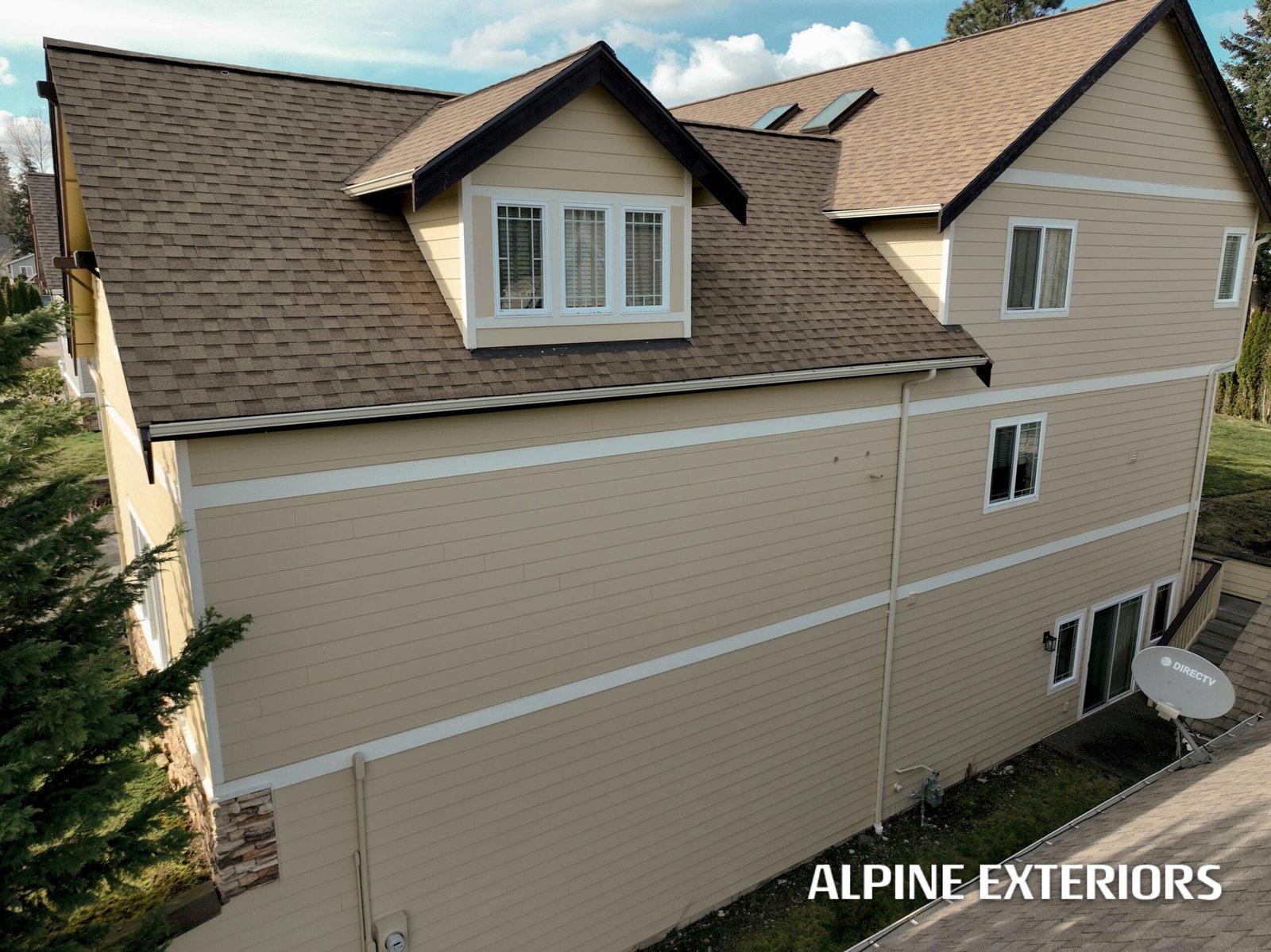
Darrington sits up against the Cascade foothills along the Sauk and Suiattle river valleys, tucked under heavy tree canopy at higher elevation than most of Skagit and Whatcom county. That setting changes the roofing math. Homes here deal with more shade, more standing moisture from constant winter rain, occasional snow load and freeze-thaw cycles that lowland Skagit Valley homes rarely see, and a lot of falling debris from surrounding evergreens. For most Darrington homes, our top pick is a heavyweight architectural asphalt shingle rated for algae resistance, because it balances cost, code compliance and moss resistance well. For homes on steeper roofs, in deep shade, or where snow tends to pile up against a north-facing slope, standing-seam metal is the stronger long-term choice because it sheds snow and discourages moss from ever taking hold. Neither is universally "best" — the right call depends on your roof's pitch, sun exposure and how long you plan to own the home.
Alpine Exteriors has worked on homes throughout the Skagit, Island and Whatcom county region and into the surrounding foothill communities, and the same principle holds everywhere we go: a roof built for coastal Puget Sound rain patterns needs different detailing than a roof built for a shaded canyon town with occasional snow. Darrington gets both wet winters and real winter weather, so the roof assembly underneath the shingles or panels matters as much as the material on top.
We weighed each roofing option against the conditions that actually show up on a Darrington roof, not generic marketing claims. The criteria that matter most here:
A heavyweight, algae-resistant architectural shingle is the most common re-roof choice we install in this part of Snohomish and Skagit county, and for good reason. It's a known quantity, contractors and suppliers here stock it reliably, and a 30-year-class product with copper or zinc granule treatment resists the algae and moss growth that plagues shaded roofs far better than older shingle lines did. Cost typically lands in the moderate range compared to metal or synthetic alternatives, and installation crews across the region are experienced with the product.
Pros: Lower upfront cost than metal, wide style and color selection, straightforward repairs if a section is damaged by a falling branch, good fire rating options.
Cons: Even algae-resistant shingles need occasional moss treatment on heavily shaded north-facing slopes. Shorter realistic lifespan than metal in a wet climate — expect meaningful granule loss and eventual replacement well before the rated warranty period if the roof stays damp most of the year. Not the best choice on very low-slope sections where standing water can collect.
For the shadiest, steepest, or snow-prone roofs in Darrington, standing-seam metal is worth the extra cost. The smooth panel surface and steep run give moss very little to grip, snow slides off instead of building up, and a properly installed metal roof routinely outlasts two or three shingle roofs. It also holds up well to the debris load from surrounding fir and cedar trees.
Pros: Long service life, minimal moss growth on steep runs, sheds snow rather than accumulating it, strong performance in sustained heavy rain when seams and flashing are installed correctly.
Cons: Meaningfully higher upfront cost than asphalt. Rain noise is more noticeable in living spaces directly under an uninsulated metal roof, though solid decking and proper insulation largely solves this. Panel and trim replacement after storm damage requires a metal-experienced crew rather than a general roofer, and matching panels years later can be harder than matching shingles.
Synthetic composite roofing, made to mimic the look of cedar shake or slate, gives Darrington homeowners who want that traditional Cascade foothills look without the maintenance burden of real wood shakes. Quality composite products carry good algae resistance and hold up to impact from falling debris better than natural cedar.
Pros: Traditional look that suits the wooded setting, better rot and moss resistance than real wood, lighter than concrete tile, good impact tolerance.
Cons: Costs more than architectural asphalt and, on many jobs, close to standing-seam metal. Product quality varies a lot between manufacturers, so warranty and material sourcing deserve real scrutiny before committing. Fewer installers in this region have deep composite experience compared to asphalt or metal.
Most Darrington homes are steep-slope roofs, but porch roofs, dormers, and single-story additions often have low-slope sections that shingles and metal panels aren't rated for. A properly installed TPO or EPDM membrane, with correct drainage slope and flashing back into the main roof, is the right tool for those spots rather than trying to force a steep-slope material to work on a shallow pitch.
Pros: Purpose-built for low-slope drainage, handles sustained rain without ponding when installed with correct slope, reasonably affordable for the square footage involved.
Cons: Only appropriate for low-slope sections, not a whole-roof solution on a typical steep Darrington roofline. Seams and penetrations need careful detailing or leaks will show up at the transition to the main roof.
A few choices that cause repeat problems on foothill homes like the ones in and around Darrington:
It depends heavily on how much direct sun a given roof slope gets. A north-facing section under heavy tree cover may need moss treatment or gentle removal every year or two, while a sunnier south-facing slope on the same house might go several years without issue. Zinc or copper strips near the ridge and algae-resistant shingle or panel products both reduce how often manual treatment is needed, but they don't eliminate the need entirely in a shaded, wet climate like this one.
Darrington sees more snow and colder winter stretches than the lowland parts of Skagit and Whatcom county, so it's worth having a roofer check your specific roof's structural rating and material against expected local snow load, especially on additions or older sections of a home. Standing-seam metal is a strong choice where snow buildup and sliding are a concern, since it's designed to shed snow cleanly rather than let it accumulate against a shingle surface.
Requirements vary depending on the scope of the project, but a re-roof that involves the building envelope, insulation, or ventilation typically needs to meet current Washington State Energy Code standards for the applicable climate zone, including adequate attic or roof-deck ventilation. A licensed contractor pulling the permit will confirm exactly what applies to your specific project and roof assembly before work starts.
Most single-family roof replacements in this region take a few days of actual on-roof work once materials are staged, though the exact timeline depends on roof size, pitch, weather windows between rain systems, and whether the crew is also replacing decking or flashing found to be damaged underneath. Winter installations often need to work around wetter stretches, so scheduling flexibility matters more here than it would in a drier climate.
If you're weighing shingles against metal, wondering whether moss damage means a full replacement or just a cleaning, or trying to figure out what a re-roof will actually cost for your specific roofline, Alpine Exteriors can walk your roof and give you a straightforward assessment. We're licensed in Washington under contractor license ALPINI751OW and work throughout Skagit, Island and Whatcom counties and the surrounding foothill communities, including homes in and around Darrington. Reach out to schedule an inspection and get options that fit your roof, your budget and this region's weather — not a generic sales pitch.