
Most homes in Alger need gutters sized for heavier, more sustained rainfall than a standard national sizing chart assumes, plus downspouts and outlets large enough to keep pace with runoff from tall Douglas fir and cedar canopy. Get the sizing and the needle-shedding under control and you also solve a big share of the crawlspace moisture problems that show up under older homes in this part of Skagit County.
Alger sits in a wooded corridor between Mount Vernon and Bellingham, tucked against the lower slopes of the Chuckanut range, and that combination of heavy tree cover, valley rainfall, and homes built with vented crawlspaces means gutters here are doing more work than they would on an open, treeless lot. A gutter system that is merely "code minimum" or copied from a builder's standard spec often can't keep up, and the failure shows up as water at the foundation rather than water in the yard.
Gutter and downspout sizing is a function of roof area, roof pitch, and expected rainfall intensity, not just gutter length. A 5-inch K-style gutter is the builder-grade default across western Washington, and it's adequate on a lot of homes. But once a roof plane exceeds roughly 700-900 square feet of collection area, or the roof has long uninterrupted runs feeding a single corner, a 5-inch gutter paired with a single 2x3-inch downspout can be overwhelmed during the kind of prolonged, moderate-to-heavy winter rain that this region sees for days at a stretch. The result isn't usually a dramatic overflow during one storm — it's a slow overtopping at the low point of a run, over and over, that saturates the soil right at the foundation.
Upsizing to a 6-inch gutter with 3x4-inch downspouts roughly doubles the carrying capacity compared to 5-inch/2x3 components, and it's the single most reliable fix on homes with large or steeply pitched roof planes, or roofs that shed onto a single valley. Downspout count matters as much as size: a rule of thumb used by many gutter installers is one downspout outlet for every 30-40 linear feet of gutter, tightened up to every 20-25 feet on steep metal or heavier composition roofs where water sheets off quickly rather than soaking in.
The second half of the sizing problem is what's falling into the gutter, not just what's running through it. Douglas fir and western red cedar shed fine needles almost year-round, not just in autumn like a maple or oak. Those needles don't just sit on top of debris the way leaves do — they pack into downspout outlets and elbows and form a dense mat that can choke a 3x4 downspout down to a fraction of its rated flow, even when the gutter trough itself looks reasonably clear. A gutter that's correctly sized on paper still fails in practice if the outlet is clogged with fir needles by December.
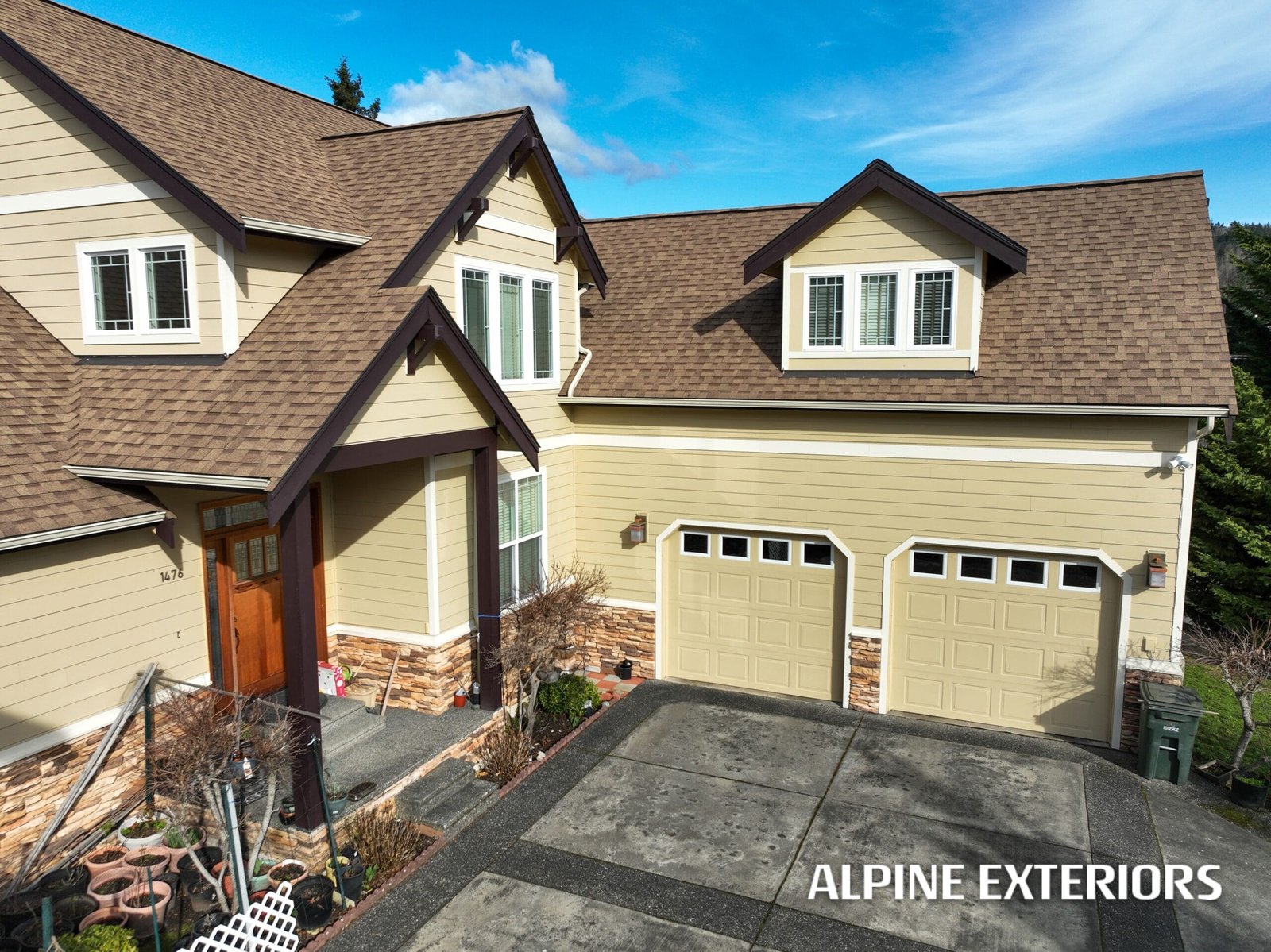
A few things about Alger and the surrounding Skagit, Island and Whatcom county area change how gutters and drainage should be designed, compared to a generic national guide:
Start with an honest look at where water is causing problems, not just at how the gutters look from the ground. Standing water or a musty smell in the crawlspace, siding staining at a particular corner, or a soft or spongy patch of lawn near a downspout outlet all point back to the roof drainage system, even though the visible symptom is somewhere else entirely.
None of this is guesswork that has to be done all at once. A practical sequence is: fix any downspout outlets that are undersized or clogged first, since that's usually causing the most immediate damage; then evaluate whether the gutter size itself is adequate for the roof area; then address grading and discharge routing; and only then look at crawlspace ventilation and vapor barrier upgrades as the last line of defense. Alpine Exteriors, WA contractor license ALPINI751OW, walks Alger homeowners through that sequence roof by roof rather than selling a one-size system, because a house tucked under fir canopy with a north-facing roof plane needs a different combination of gutter size, guard type, and discharge routing than an open lot near the Skagit flats.
It depends on the roof, not just the lot. A steep roof, a large collection area, or a single long run funneling into one corner usually benefits from 6-inch gutters and 3x4-inch downspouts, since they move roughly double the water of a 5-inch/2x3 system before overtopping. A smaller roof with several shorter runs and enough downspout outlets can perform fine with correctly installed 5-inch gutters — the mistake is assuming 5-inch is always the safe default regardless of roof size.
Coarse leaf guards marketed for deciduous leaves generally don't stop fine Douglas fir or cedar needles, which pass through the same openings that block larger leaves. Fine-mesh or micro-mesh guards perform better against needles, but no guard eliminates maintenance entirely — needle debris still accumulates on top of most guard systems and needs to be brushed or blown off periodically, and the guards still need to be lifted for an occasional check of the trough underneath.
When a downspout or gutter run overflows at the same spot repeatedly, that water saturates the soil right along the foundation instead of being carried away. In homes with a vented crawlspace, that saturated soil raises the moisture level right where the crawlspace vents and vapor barrier are trying to keep things dry, and over time it can overwhelm even a well-installed vapor barrier at that corner. Fixing the gutter and downspout routing is usually a bigger factor in solving crawlspace dampness than anything done inside the crawlspace itself.
Twice a year is a reasonable baseline — late fall after most needle drop has settled, and again in late winter or early spring before heavy spring rain — but a heavily wooded lot may need a mid-winter check as well, focused specifically on downspout outlets and elbows rather than just the gutter trough, since that's typically where fir needles cause a blockage first.
If gutters are overflowing at the same spot every winter, a crawlspace corner stays damp, or you're just not sure whether your current gutters are sized for your roof, Alpine Exteriors serves Alger and the rest of Skagit, Island and Whatcom counties — including Mount Vernon, Anacortes, Burlington, Sedro-Woolley, La Conner, Stanwood, Camano Island and Bellingham. A straightforward roof and drainage assessment can identify whether the fix is downspout routing, gutter sizing, guard selection, or crawlspace ventilation, and Alpine Exteriors can walk through the options and rough cost ranges before any work begins.