
Stanwood sits at the north end of Snohomish County, just across the bridge from Camano Island and a short drive from the Skagit flats. That location matters when you're pricing gutters. Homes here deal with a long, wet fall-through-spring rainy season, wind that funnels down the flats and off Port Susan and Skagit Bay, salt-tinged air pulled in from the Sound and the islands, and moss that builds up fast on shaded, tree-covered roofs west of I-5. None of that makes gutter installation exotic, but it does change what a well-built system needs to hold up, and that affects price. Alpine Exteriors installs and replaces gutters throughout Stanwood and the surrounding Skagit, Island and Whatcom county communities, and this guide walks through what local homeowners can realistically expect to pay and why the number moves the way it does.
There's no single number that fits every Stanwood home, because gutters are priced by linear foot, material, and the complexity of the roofline, and those three things vary a lot from a single-story rambler to a two-story home with multiple gables. As a general planning range, a straightforward seamless aluminum gutter replacement on a typical single-story Stanwood home tends to fall in the low-to-mid thousands of dollars, while larger two-story homes, homes with steep or complex rooflines, or homes that add leaf protection can run into the mid-to-upper thousands. Heavier materials like steel or copper, or half-round profiles instead of standard K-style, push the range higher still. These are broad planning brackets, not quotes — the only way to get an accurate number for your home is a measurement and an on-site look at your fascia, roof pitch, and downspout layout.
| Cost Factor | Typical Low End | Typical High End |
|---|---|---|
| Material (aluminum vs. steel vs. copper) | Standard seamless aluminum | Heavy-gauge steel or copper, several times aluminum pricing |
| Gutter profile (K-style vs. half-round) | Standard 5-inch K-style | Custom half-round or oversized 6-inch profiles |
| Linear footage / home size | Small single-story footprint | Large two-story home with multiple wings |
| Roof pitch and story count | Single story, moderate pitch | Steep pitch or two-story requiring extra staging |
| Downspout count and routing | Minimal downspouts, simple drainage | Many downspouts, buried drain lines to daylight |
| Leaf/debris protection | No guards | Full-system gutter guards |
| Fascia or trim condition | Sound fascia, no repair needed | Rotted fascia or trim requiring rebuild before hanging gutter |
| Old gutter removal and disposal | Simple pull-and-haul | Extensive removal from multiple stories or hard-to-reach areas |
A few conditions specific to this part of Washington show up on almost every estimate we write for Stanwood homes. The first is moss. Properties tucked under fir and cedar canopy — common on the wooded lots around Stanwood, Camano Island, and out toward the Skagit foothills — collect moss and needle debris in the gutter troughs, and that buildup adds weight and accelerates corrosion on the seams and hangers. If your roof has a heavy moss load, we'll usually flag it, because it affects whether guards are worth the added cost and whether the existing hangers are salvageable.
The second is wind. Open exposure across the Skagit flats and along the Stanwood-Camano corridor near the water can put real lateral load on a gutter system during fall and winter storms, so hanger spacing and fastening method matter more here than in a sheltered inland lot. Skimping on hangers to save money is one of the most common ways a gutter system fails early in this area — it's not the material that pulls loose first, it's an undersized hanger schedule.
The third is salt air. Homes closer to Port Susan, Skagit Bay, or on Camano Island itself sit in a mild salt-air environment. It's nowhere near the corrosion load of an oceanfront property, but over years it can accelerate pitting on lower-grade fasteners and finishes. For homes in that zone, we'll sometimes recommend marine-grade fasteners or a heavier-gauge material, which nudges cost up slightly but extends service life.
Fourth, occasional ice and heavier wet snow in the foothills toward Sedro-Woolley and the Cascade approaches can stress gutters that weren't sized or hung correctly, since ice adds significant weight during a cold snap. And fifth, if your project touches soffit or attic ventilation — for example, if we're rebuilding rotted fascia and opening up the roofline — the work needs to keep your home's ventilation and moisture control consistent with Washington State Energy Code requirements, since gutters, fascia, and roof ventilation all interact at that transition.
Beyond regional conditions, the biggest cost swings come from three things: how many linear feet of gutter your home needs, how many stories and how steep the roof is (which changes labor and staging), and whether the fascia underneath is sound. Rotted or soft fascia boards have to be repaired or replaced before new gutter can be hung correctly, and that's a common surprise once old gutters come down and the crew can actually see the wood underneath.
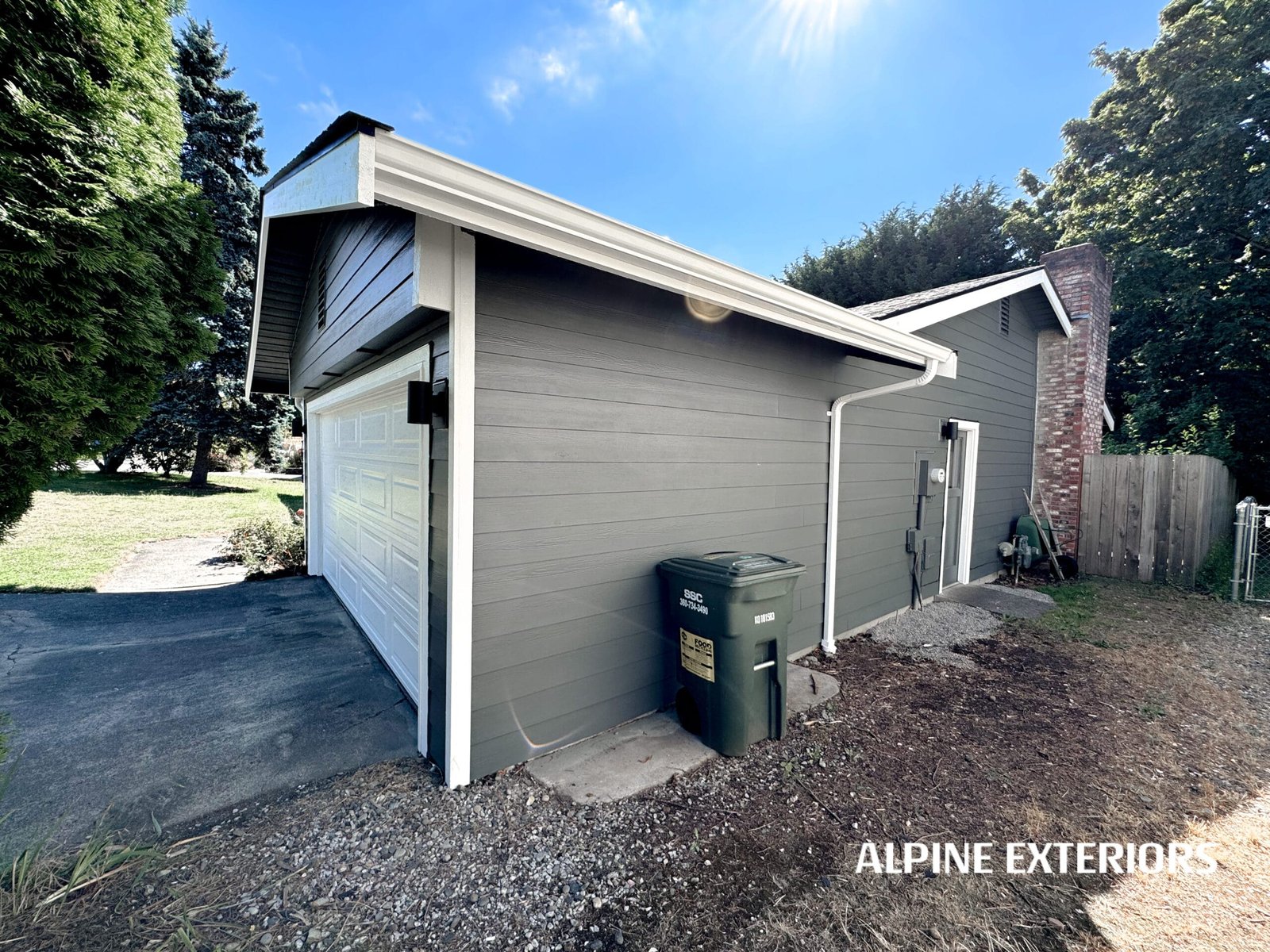
A usable, apples-to-apples quote should spell out more than a bottom-line number. Look for a written scope that lists the gutter material and gauge, the profile (K-style, half-round, etc.), the total linear footage being installed, the number and size of downspouts, and where those downspouts discharge — surface splash blocks, extensions, or tied into a buried drain line. It should note whether old gutters are being removed and hauled away, whether any fascia or trim repair is included or billed separately, and whether hangers are hidden hanger style or older spike-and-ferrule (hidden hangers hold up better under the wind loads common here). If gutter guards are part of the job, the quote should name the guard type, not just say "leaf protection." Finally, it should state the warranty terms — both the material warranty from the manufacturer and the workmanship warranty from the installer — and confirm the contractor's WA state license number. Alpine Exteriors' license number is ALPINI751OW; any contractor you hire should be able to give you theirs on request, and it's worth checking that it's active before signing anything.
When you're holding two or three bids side by side, resist the urge to compare only the bottom-line total. Start by confirming everyone measured the same linear footage — a low bid is sometimes just a shorter measurement or a scope that skips a section of roofline. Check that the material and gauge match across bids; a thinner aluminum gauge or a downgraded hanger spec will always come in cheaper but won't hold up the same way in a windy winter storm. Ask each contractor directly whether fascia repair is included or an add-on, since that's the most common source of a mid-project change order. Compare warranty length and what it actually covers — workmanship warranties vary quite a bit between contractors. And ask how disposal of the old gutters is handled; hauling and dump fees are sometimes buried in the price and sometimes billed separately. A slightly higher bid that includes proper hanger spacing, fascia inspection, and a real workmanship warranty is often the better value over a decade of Northwest winters than the lowest number on the page.
Gutter replacement on its own is rarely a homeowner's insurance claim — insurance typically comes into play only when gutters were damaged by a specific covered event, like a falling tree limb during a windstorm, and even then the insurer will usually want documentation of the damage and its cause before approving anything. Routine wear, sagging from age, or moss-related deterioration generally isn't something a policy will cover, so most gutter projects here are paid out of pocket or financed directly. If cost is a concern, ask any contractor you're considering whether they offer financing options or payment plans, and get the terms in writing before committing. If your gutter work is happening alongside a larger roofing or siding project, it's worth asking whether bundling the work reduces mobilization costs, since staging and access are often shared across those trades.
It doesn't change the base price of materials, but it does change what a properly built system needs — closer hanger spacing to handle wind off the flats and the Sound, attention to moss and debris load from wooded lots, and in some cases upgraded fasteners for homes near the water. Cutting those details to save money up front tends to show up as sagging or pulled hangers within a few winters.
Guards make the most sense on homes with heavy tree cover, which describes a lot of shaded lots around Stanwood and Camano Island. They reduce how often you're up on a ladder clearing debris and can extend the life of the gutter by cutting down on standing moss and organic buildup, but they add to the upfront cost and aren't necessary for every home. If your roofline gets little tree exposure, you may not need them at all.
This is one of the most common surprises once old gutters come down. Soft or rotted fascia has to be repaired or replaced before new gutter can be hung securely, since the fascia is what the hangers actually anchor into. A good contractor will flag this as a possibility before starting and give you a clear price if it's found, rather than absorbing it silently into a low initial number.
Straightforward gutter replacement typically doesn't require a separate building permit, but if the project involves structural fascia rebuild, changes to roof drainage routing, or work tied into a larger roofing project, permit requirements can apply. It's worth confirming with your contractor or the local jurisdiction before work starts, especially if the scope grows beyond a simple gutter swap.
The only way to move from a planning range to a real number is to have someone measure your roofline, check your fascia condition, and talk through drainage for your specific lot. Alpine Exteriors serves Stanwood and the surrounding Skagit, Island and Whatcom county communities — including Camano Island, Mount Vernon, Burlington, and Anacortes — and can walk your property, explain what your home actually needs, and put together a detailed, itemized quote. Reach out to schedule a look at your gutters before the next round of fall rain arrives.