

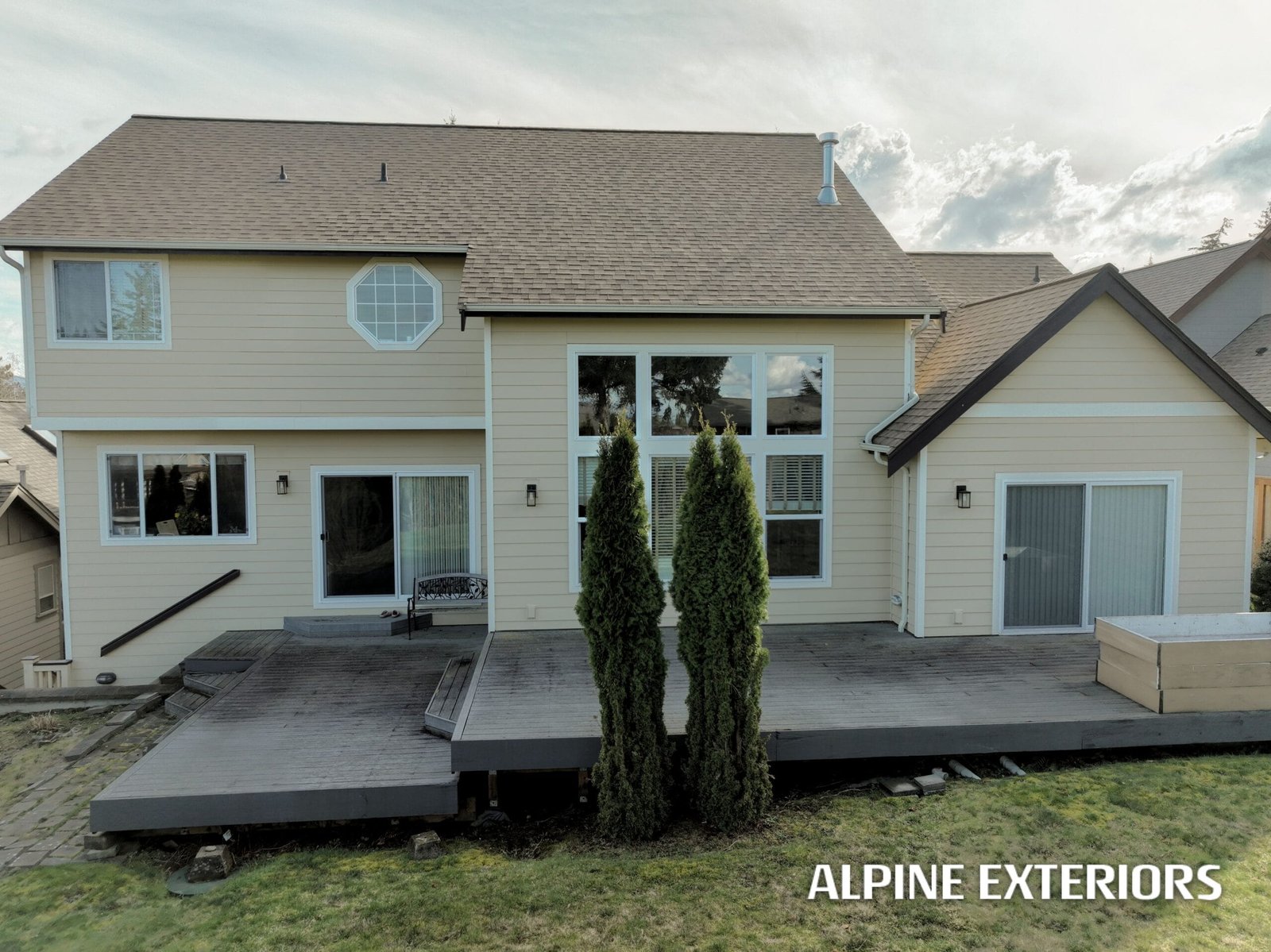
Clinton sits at the south end of Whidbey Island, right where the ferry lands from Mukilteo, and the roofs here take a particular kind of beating. You've got salt-laden air coming off Saratoga Passage and Possession Sound, wind that funnels through the trees and across open bluffs, long stretches of shaded roofline under Douglas fir and cedar that never quite dry out between November and April, and the kind of steady, soaking Pacific Northwest rain that finds every weak seam eventually. None of that is hurricane weather, and it doesn't need to be — moisture, moss, and time do the damage slowly, and by the time a homeowner notices, the roof is often further along than it looks from the ground. This page walks through the actual warning signs we see on Clinton roofs, what causes each one in this specific climate, and how to tell whether you're looking at a weekend repair or a roof that needs to come off.
Asphalt shingles are built with a mat of granules embedded in asphalt, and those granules are what shield the underlying material from UV light and moisture. On a Clinton roof, years of wet-dry cycling — soaked all winter, baked in the occasional July heat wave — cause the asphalt to lose flexibility. Shingles start to curl up at the edges or cup in the middle, and granules wash into the gutters, leaving bald, shiny patches that look almost like gravel is missing from the surface. Once a shingle has curled, it no longer lies flat against its neighbors, which means wind can get a grip on the edge, and gusts coming off the Sound don't have to be extreme to start prying shingles loose. A few curled shingles scattered across an otherwise sound roof can sometimes be spot-repaired. Curling across most of a slope, or granule loss heavy enough that you can see bare asphalt, usually means the shingle mat itself has degraded and repair won't hold for long.
This is probably the single most common reason we get called out in Clinton. Between the tree cover common on south Whidbey lots and roofs that face north or sit under a canopy, moisture has a hard time evaporating off the surface, especially through the wetter months. Moss takes hold in that environment, and it doesn't just sit on top of the shingles — its root structure works down into the granule layer and lifts shingle edges as it grows, creating a path for water to get underneath. Left alone for a few seasons, a mossy roof develops a spongy, uneven surface, and what started as a cosmetic issue turns into trapped moisture and rot in the decking below. Light moss on an otherwise young, sound roof can be treated and the roof can be kept on a regular cleaning schedule. Thick, established moss with visible lifting at the shingle edges, especially on a roof that's already older, is usually a sign the underlying material is compromised and cleaning alone won't fix it.
A roofline should read as a straight, even plane from the street or from the yard. Any dip, wave, or soft spot — something you can feel give slightly when walked on, or see as a shadow line from a distance — points to a structural problem, not a surface one. On Clinton roofs this is almost always the result of water that's been getting into the decking for a while, softening the plywood or the framing underneath, sometimes compounded by the added weight of built-up moss or, less often here than in the foothills, a wet snow load sitting on an already weakened deck. Sagging is never a wait-and-see item. It means water has already reached the structural wood, and the fix isn't a shingle repair — it's replacing the affected decking and, in some cases, the roof covering above it.
By the time a stain shows up on a ceiling, water has already worked its way through the roofing, the underlayment, and the decking. In an area that gets extended stretches of steady rain rather than isolated downpours, a small leak doesn't dry out and reseal itself between storms the way it might in a drier climate — it just keeps finding the same path in, week after week, and the stain grows. Check the attic directly if you can get up there: look for dark streaking on the rafters, damp or matted insulation, or a musty smell, all of which show up before a ceiling stain ever does. A single small stain that's dry and hasn't grown after checking it again after the next rain might be an isolated flashing leak worth a targeted repair. Multiple stains, a stain that keeps expanding, or visible mold or rot in the attic framing point to a leak that's been active for a while and to a roof covering that's no longer doing its job broadly, not just in one spot.
Whidbey Island storms tend to bring sustained wind funneling down Saratoga Passage and across open water toward Clinton's bluffs, and even without anything close to hurricane-force gusts, that wind is enough to lift shingles that have already lost some of their seal from age or curling. After any windstorm it's worth a look from the ground with binoculars, or a look at the gutters and yard, for shingles that are visibly lifted, torn, or missing outright, and for shingle-shaped debris on the lawn. A handful of shingles blown off an otherwise sound, newer roof is a straightforward repair. Repeated wind damage after ordinary storms, or damage that keeps happening in the same area, usually means the shingles nearby have also aged past the point of holding a seal and the repair will just recur.
Flashing — the metal strips and pieces around chimneys, skylights, vent pipes, and roof valleys — does the actual work of keeping water out at every place where the roof surface is interrupted. It's also usually the first thing to fail, well before the shingle field around it, because it's fastened, caulked, and joined in ways that a plain shingle surface isn't. Salt air off the Sound accelerates corrosion on metal flashing faster than it would inland, and caulking around penetrations dries and cracks under UV exposure and temperature swings. Rust streaks below a vent pipe, a chimney with a gap at the counter-flashing, or a valley where you can see daylight or bent metal are all flashing symptoms. If the shingle field around the flashing is otherwise in good shape, re-flashing on its own can solve the problem. If the roof is already older and the flashing is one symptom among several, it's more efficient to address it as part of a full re-roof rather than a stand-alone repair that'll need to be redone again when the shingles are replaced anyway.
Composition shingle roofs in this climate generally run somewhere in the 20 to 30 year range depending on the product, the installation, and how much shade and moss exposure the roof has dealt with over its life — heavily shaded, moss-prone slopes tend to land toward the shorter end of that range. If you don't know when the roof was last replaced, county permit records or a look at the attic decking, newer plywood versus older skip sheathing, can help establish a rough age. A roof approaching or past that window doesn't need to be showing dramatic damage to be worth a serious look — the materials are simply nearing the end of their useful life, and a proactive replacement is usually cheaper and less disruptive than waiting for a failure during a January storm.
Not every warning sign means drop everything. Active leaks, visible sagging, daylight through the deck, or storm damage that's exposed the underlayment are urgent — water is getting into the structure right now, and every additional rain event compounds the cost. These need a tarp or emergency repair immediately and a full assessment within days, not weeks. Moderate moss growth, isolated curling shingles, a few missing granules, or minor flashing wear on a roof that's otherwise mid-life can usually wait for a scheduled inspection and be planned around your budget and the season, rather than treated as an emergency. The one exception worth flagging: don't let a can-wait issue stretch through an entire wet season if the roof is already near the end of its expected lifespan — what's a minor issue on a 10-year-old roof can be the tipping point on a 25-year-old one.
Start with a visual check from the ground and, if it's safe, from the attic — most of the signs above are visible without climbing on the roof yourself, which we'd recommend leaving to someone with the right harness and footing anyway, especially on wet moss. From there, get an actual inspection rather than guessing from photos or from what a neighbor's roofer told them about their own house; every roof's exposure to shade, wind, and slope pitch is different even within the same Clinton neighborhood. A written estimate should separate repair options from full replacement, note the current condition of the decking, not just the shingles, and, if replacement is on the table, confirm that the proposed materials and ventilation meet Washington State Energy Code requirements for insulation and air sealing at the roofline — this matters more than people expect on Whidbey Island homes, where a poorly ventilated attic compounds moisture problems that are already working against you from the outside. Get more than one opinion if the diagnosis is inconsistent, and be wary of anyone offering an exact price before actually getting on the roof. Cost for a full tear-off and replacement on a typical Clinton home generally lands somewhere in the broad range of $12,000 to $30,000-plus depending on roof size, pitch, material choice, and how much decking repair is needed underneath — arriving at a real number always requires an in-person look.
Alpine Exteriors has worked on roofs across Skagit, Island, and Whatcom counties, including plenty of homes on south Whidbey dealing with exactly this combination of shade, salt air, and wind, and is licensed in Washington under ALPINI751OW. Alpine Exteriors will tell you honestly when a repair is the right call and when it isn't — a roof replacement is a real expense, and we'd rather earn that job with a straight assessment than push one you don't need yet.
Once a year is a reasonable baseline for most roofs here, ideally in early fall before the heavy winter rains set in, with an additional check after any significant windstorm. Roofs with heavy tree shade or existing moss issues benefit from a look twice a year, since moss and moisture problems progress faster under a canopy than they do on an open, sun-exposed slope.
Sometimes, yes — if the moss is relatively light, the shingles underneath haven't been lifted or degraded, and the roof isn't already near the end of its lifespan, a professional low-pressure cleaning followed by a maintenance plan, such as zinc or copper strips near the ridge and periodic follow-up cleaning, can extend the roof's life meaningfully. Heavy, long-established moss that's already lifted shingle edges usually means the damage is done and cleaning won't restore what's underneath.
Yes, more than most homeowners expect. Clinton properties don't need to be waterfront to get salt-laden air off Saratoga Passage and Possession Sound, and that airborne salt accelerates corrosion on metal components — flashing, fasteners, gutter hardware — faster than it would further inland. It's one more reason flashing tends to fail before the shingle field around it does on south Whidbey roofs.
A repair addresses a specific, isolated problem, such as a section of damaged shingles, a flashing leak, or a small area of moss, without touching the rest of the roof. A full replacement strips the roof down to the decking, replaces any damaged sheathing, installs new underlayment and flashing throughout, and puts down new roofing material across the entire roof, which also gives an opportunity to correct any ventilation or insulation gaps relative to the Washington State Energy Code. Replacement makes sense once problems are widespread, the decking is compromised, or the roof is old enough that repairing one area just means another will fail soon after.
If you're seeing any of the signs above on your Clinton or south Whidbey Island home, it's worth getting a straightforward, in-person look before another wet season adds to the damage. Alpine Exteriors serves Clinton alongside the rest of Island, Skagit, and Whatcom counties, and is happy to walk your roof, explain what's found in plain terms, and lay out repair versus replacement options with real numbers behind them. Reach out to schedule an inspection and get a clear answer on where your roof actually stands.



