
Most Marysville roofs do fine with standard 5-inch K-style gutters and 2x3 downspouts, but homes with long or steep roof planes, multiple rooflines draining into one corner, or heavy overhead fir cover usually need to size up to 6-inch gutters and 3x4 downspouts to keep pace with Snohomish County's winter rain volume. Getting the sizing and downspout placement right matters less for the gutters themselves and more for what happens underneath the house: undersized or clogged gutters overflow at the foundation line and are one of the more common, and more preventable, contributors to crawlspace moisture in this area.
Gutter capacity is a function of roof area, pitch, and how many downspouts are carrying the water away, not just the width of the trough. A 5-inch gutter with a single undersized downspout can be overwhelmed on a roof that would be fine with a 6-inch gutter and two downspouts spaced correctly along the run. Snohomish County's wet season isn't defined by short, violent downpours the way some regions are — it's defined by long stretches of sustained, moderate rain that can run for days at a time between October and April. That pattern is actually easier on gutters than a flash-flood-style storm, but it means undersized systems don't just get overwhelmed for twenty minutes and recover — they run at or near capacity for hours, and any restriction in the system, whether a partially clogged downspout, a gutter pitched wrong, or a debris dam at an inside corner, turns into a steady overflow rather than an occasional splash.
The other half of the equation is what fir needles do to that capacity over a season. Unlike broadleaf debris, which mostly falls in a few weeks each autumn and is easy to time cleanings around, Douglas fir and western red cedar shed needles, small cone scale, and duff in a slow, steady drip nearly year-round, with heavier flushes after wind events. Needles are thin and rigid enough to slip through standard gutter guard mesh that stops full-size leaves, and once inside the gutter they mat together with grit and cedar duff into a dense, spongy layer that holds water instead of letting it flow through. That layer doesn't announce itself the way a visible leaf clog does — a gutter can look mostly clear from the ground while the channel underneath is well over half full of packed needle mat, quietly cutting the gutter's real carrying capacity far below what its size on paper suggests.
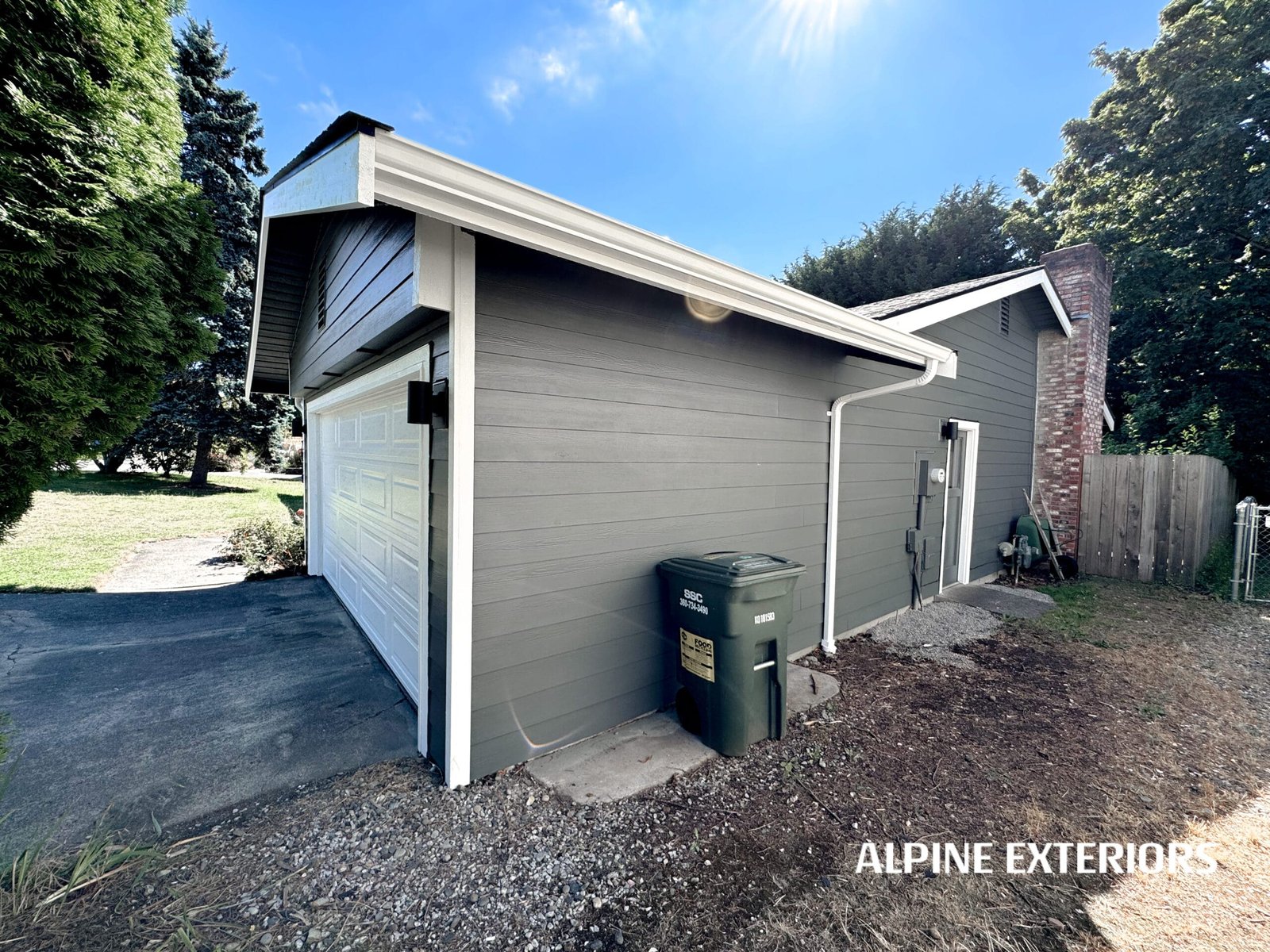
Marysville sits low and flat along Ebey Slough and the edge of Port Susan Bay, and a lot of the housing stock, especially older neighborhoods near the historic downtown and along Grove Street, was built on grade with a vented crawlspace rather than a full basement or slab. That combination of low elevation, a high water table for much of the winter, and native soils that lean toward silty clay and glacial till means water doesn't drain away from a foundation quickly on its own. Where a gutter dumps water matters as much as whether the gutter is clean, because slow-draining ground gives overflow and poorly placed downspouts much more opportunity to soak into the soil right next to the crawlspace vents instead of running off toward the street or a ditch.
Tree cover compounds it. Much of Marysville, especially the older lots and anything backing onto greenbelt or the Tulalip and Kayak Point tree lines, has mature fir and cedar directly over the roof. That's the needle-clog problem described above, but it also means roofs on the shaded, north-facing sides of these homes stay damp longer after a rain and are more prone to moss growth, which sheds its own grit into the gutters and adds to the debris load over a season. Wind is a real factor too: storms funneling up Port Susan Bay and Possession Sound can drive rain sideways against west- and north-facing walls, pushing water past gutters that are only marginally undersized and straight down the siding, which adds another moisture path into the crawlspace that has nothing to do with roof drainage at all. Snow and hard freezes are uncommon in the Marysville lowlands, but they aren't unheard of — a cold snap a few times most winters can freeze standing water in a clogged gutter into a short-lived ice dam, one more reason not to let debris sit in a gutter through the coldest months. Washington State Energy Code requirements for crawlspace ventilation and vapor barriers are aimed at exactly this kind of moisture load, which is a sign of how routine the underlying problem is in homes of this style and vintage, not a sign that code compliance alone solves it.
None of this requires an unusual system, just the right sizing and a maintenance rhythm that matches the tree cover rather than a generic once-a-year schedule.
Plan on at least twice a year, once in late fall after the heaviest seasonal needle drop and once in late winter or early spring, and more often if the home sits directly under mature conifers or backs onto greenbelt. Needles don't fall in one clear window the way broadleaf leaves do, so a single autumn cleaning often isn't enough to get a home through a full wet season without a mid-winter clog.
For homes with long eave runs, steep roofs, or several rooflines converging on one downspout, yes — the added capacity meaningfully reduces overflow during sustained winter rain, which is the pattern this area sees most. For a simple single-story roof with short runs and adequate downspouts already in place, 5-inch gutters kept clean are usually enough, so it's worth sizing to the specific roof rather than upgrading by default.
Yes, indirectly but reliably. Overflow and downspouts that discharge too close to the house saturate the soil right next to the foundation, and on Marysville's slow-draining, low-lying ground that water has nowhere to go but down toward the crawlspace vents and the vapor barrier. It's rarely the sole cause of a wet crawlspace, but it's one of the most common contributing factors and one of the cheapest to fix compared to grading or drain work.
Start with the gutters and downspout discharge points, since that's the lower-cost fix and often accounts for a meaningful share of the water reaching the foundation. If water still pools near the crawlspace after gutters are sized correctly, clean, and discharging well away from the house, that points to a grading or subsurface drainage issue that a French or perimeter drain is built to solve, and it's worth having that assessed on its own rather than assuming gutter work alone will fix it.
Gutters, roofing, and crawlspace moisture are connected problems, and it's easy to spend money fixing the wrong one first. Alpine Exteriors, WA contractor license ALPINI751OW, works on roofing, gutters, and the drainage details that tie into siding and window performance across Snohomish, Skagit, Island and Whatcom counties, including Marysville and the surrounding communities. If fir needles, winter overflow, or a damp crawlspace are recurring issues at your home, Alpine Exteriors can walk the roofline, check downspout sizing and discharge points, and give you a straight read on whether the fix is gutter work, a drainage improvement, or both before any work starts.